Traveler at Amsterdam airport checks in suitcase containing a toy car. Then, customs officers find 26 critically endangered creatures taped inside
Inhumane conditions.
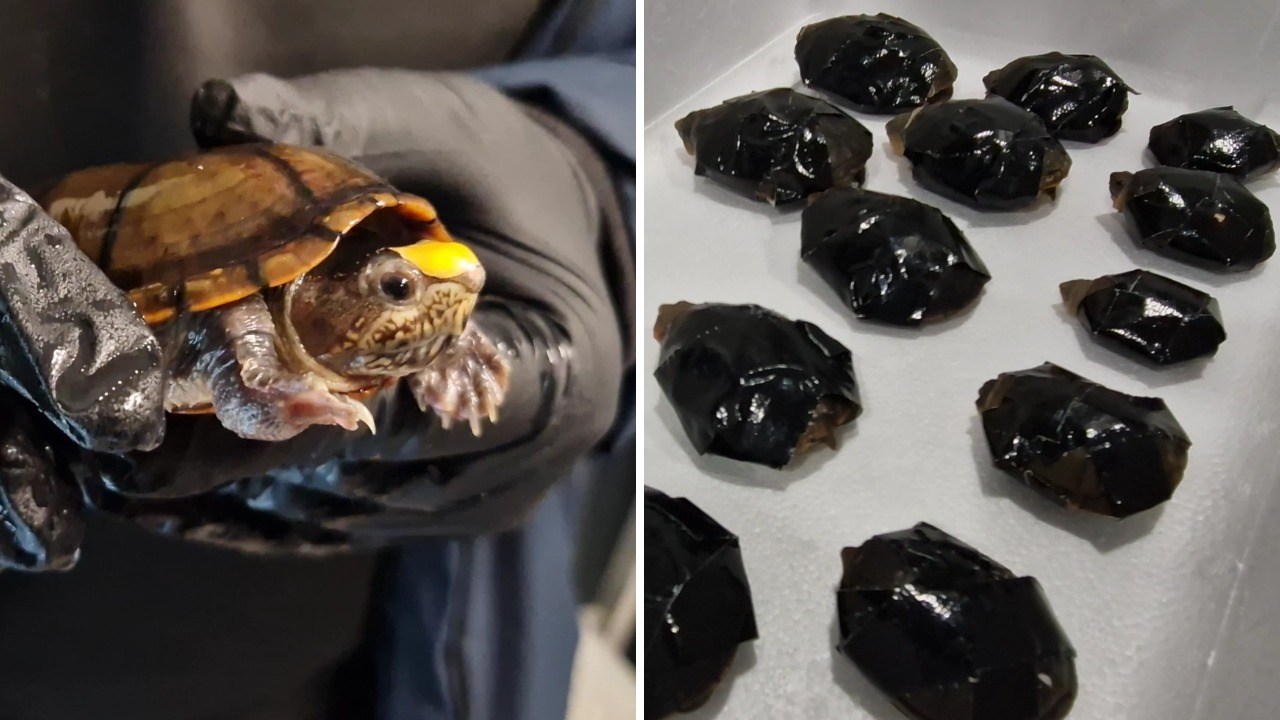
Customs Department officers at Amsterdam’s Schiphol Airport made a startling discovery on November 21, 2026, when they inspected a traveler’s checked luggage and found 26 critically endangered turtles taped up inside. According to PEOPLE, the passenger, who was flying from Mexico to Hong Kong, had hidden the rare reptiles in a box containing a toy car and inside a closed sock.
This discovery has sparked a major investigation into what authorities suspect is a significant case of wildlife trafficking. The animals involved are Vallarta mud turtles, a species so rare that scientists only formally described them in 2018. According to the Netherlands Food and Consumer Product Safety Authority (NVWA), the turtles had been wrapped in duct tape to prevent them from moving during the flight.
Despite these cruel conditions, all 26 turtles survived the journey. They are now safe at a specialized sanctuary where the tape was carefully removed and they are receiving the care they need.
The situation is quite dire considering the population numbers of these turtles
The NVWA estimates that only about 300 of these tiny freshwater turtles remain in their native habitat in western Mexico. By removing 26 of them, traffickers may have reduced the entire wild population by nearly 10 percent in a single trip.
The man responsible for the luggage was arrested by the Royal Netherlands Marechaussee at the request of the NVWA. He remains in custody as the Public Prosecutor’s Office continues to investigate the circumstances surrounding this smuggling attempt.
The Vallarta mud turtle, scientifically known as Kinosternon vogti, is one of the smallest turtle species in the world, growing to a maximum length of about 10 centimeters or less than 4 inches. Because of their small size and striking appearance, they have become prime targets for illegal collectors. According to the BBC, a single specimen of this species can sell for $10,000 or more on the black market in Asia.
IUCN classifies Vallarta Mud Turtles as critically endangered
The species is currently classified as critically endangered on the International Union for Conservation of Nature’s (IUCN) Red List. Vallarta mud turtles also receive the highest level of protection under the Convention on International Trade in Endangered Species of Wild Fauna and Flora (CITES). This international treaty is designed to regulate wildlife trade and prevent the over-exploitation of vulnerable species.
The Turtle Island organization, which is working to preserve the turtles in Mexico, estimates that over 99 percent of their natural habitat has been lost to urbanization, roads, and a growing tourist trade in the Mexican state of Jalisco. What’s worse is that this case is not an isolated incident when it comes to the illegal movement of reptiles toward Asia.
Earlier this year, customs authorities in Hong Kong reported several seizures of endangered turtles. In October, officials there intercepted eight turtles with an estimated market value of about $54,000.
Three months before that, authorities detected two separate smuggling cases in Hong Kong where 42 live turtles were seized, carrying a total estimated market value of $210,000. These patterns show a clear and persistent demand for rare wildlife that continues to threaten biodiversity.
The NVWA is using this case to encourage the public to be more vigilant
The authority is asking people to report any suspected instances of illegal wildlife trade, whether it happens through online marketplaces, internet forums, bird fairs, or antique and curiosity markets. Reporting these activities gives organizations like the NVWA the information they need to launch investigations and intervene before more animals are taken from the wild.
The NVWA stresses that the survival of the Vallarta mud turtle hangs in the balance. Organizations like Turtle Island are even working to breed these turtles in Austria as a genetic reservoir for potential rewilding efforts. The fact that these 26 survivors are now in a sanctuary is a small victory, but it highlights the ongoing struggle to protect species that are being pushed to the brink.
Have a tip we should know? [email protected]
Follow The Mary Sue: