


A New York Man Sent a Harsh Email to the ICE Director, Only for Federal Agents to Track Him to a Hotel Halfway Across the Country
Blatant First Amendment violation.
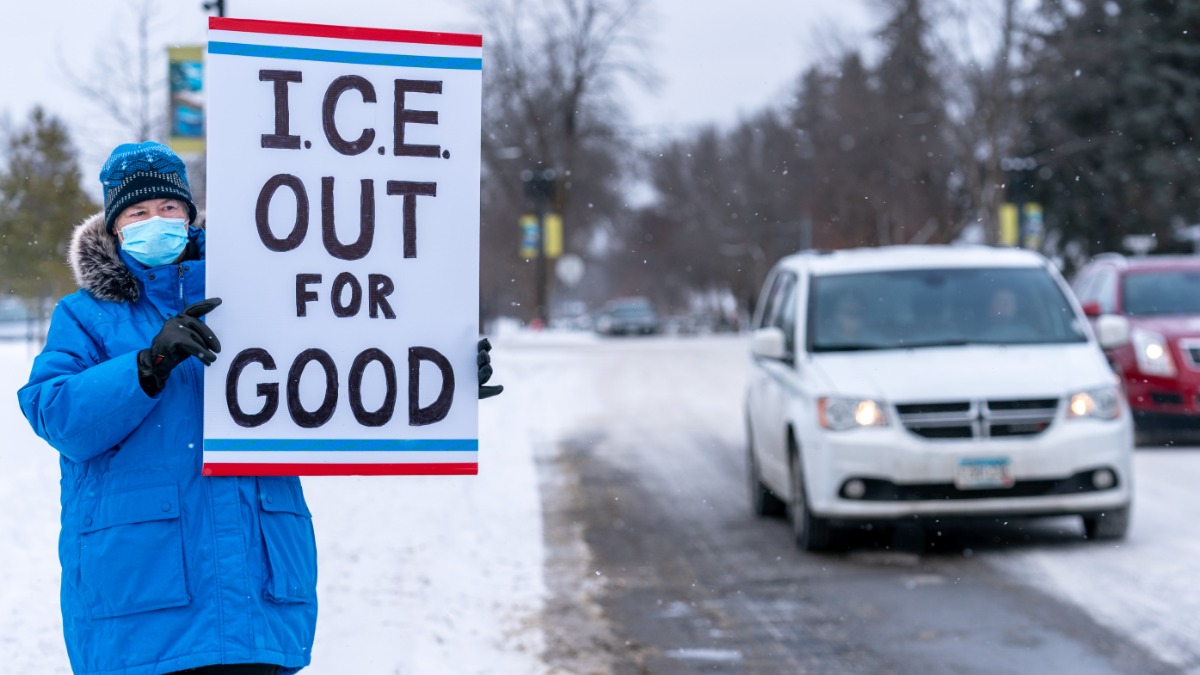
A New York man is suing the Department of Homeland Security (DHS) after federal agents tracked him down at a hotel over an email he sent months earlier to the former head of Immigration and Customs Enforcement (ICE). The lawsuit, filed by the Foundation for Individual Rights and Expression (FIRE), argues that David Streever’s January email was protected speech under the First Amendment and that the government’s response was an intimidation attempt.
According to NPR, Streever, a resident of Rochester, sent the email to Todd Lyons on January 26 after federal immigration officers in Minneapolis fatally shot two U.S. citizens during an enforcement operation. The three-paragraph message, which had the subject line “What’s next,” compared Lyons to a Nazi and suggested he would be haunted by his conscience.
On June 23, two Homeland Security Investigations agents showed up at Streever’s home while he was traveling with his 7-year-old daughter. They left a “WARNING NOTICE” with his wife, alleging that his email may have violated federal laws against threatening federal officials. The notice warned that continued behavior could lead to further consequences.
The DHS didn’t stop there
The situation escalated when Streever, returning from a trip to a Finnish theme park, checked into a hotel near John F. Kennedy International Airport. That evening, he was informed that a federal agent had visited the hotel looking for him and left a business card. His wife had not disclosed his location to the agents, raising serious questions about how they tracked him down.
Streever, who had no prior criminal record, said he never expected his email to trigger such a response. “Like many Americans, I was deeply upset after the shootings in Minnesota and I felt compelled to do something,” he said. “Writing an email to the head of ICE seemed like the least I could do to express my sense of outrage. I never dreamed it would lead to a knock on my door by federal officers or descending on my hotel in the dark of night.”
The lawsuit, filed in federal court in Washington, D.C., names three federal agents, Secretary of Homeland Security Markwayne Mullin, and ICE officials as defendants. It argues that the government’s actions violated Streever’s First Amendment rights by threatening him over protected speech.
The suit also claims that the warning notices themselves are designed to chill free expression, noting that ICE’s decision to deliver them in person “can have only one purpose: to systemically chill ICE’s critics and coerce them into silence.” The lawsuit asks the court to rule that Streever’s email was constitutionally protected and to block the government from taking further action against him for his speech.
Streever isn’t the only person to receive such a warning
On the same day agents visited his home, they also confronted Paigelynne Gonyea, a Syracuse resident and a poll worker during New York’s primary election. Gonyea was approached about an Instagram post she made in January regarding Jonathan Ross, the ICE officer who fatally shot Renee Good in Minneapolis.
The agents left her a voicemail claiming she had doxxed Ross, a term typically used to describe the release of someone’s private or sensitive information online. Gonyea denied the accusation, telling NPR she believed the agents were referring to a post where she identified Ross by name after the Minnesota Star Tribune reported it and called for his indictment.
The encounter at the polling place raised additional concerns. Video captured by fellow poll workers shows two agents with badges speaking to Gonyea inside the library where she was working. Local election officials later stated that federal agents should not have entered the polling place, as New York law bars federal immigration officers from voting sites unless there’s an emergency.
Gonyea said the agents didn’t specify which post had prompted their visit, but they confirmed it was related to Ross. After media coverage of the incident, DHS released a statement accusing Gonyea of committing a federal crime by posting Ross’s address online.
However, DHS did not provide evidence of the doxxing
The department did share with NPR a redacted screenshot of an Instagram post with the Associated Press, which appeared to be from Gonyea’s account. The post included a photo of Ross with text reading, “The killer’s name is Jonathan Ross of,” followed by a redaction that presumably contained his address. Gonyea said she had reviewed the screenshot but did not believe she had posted it.
Adam Steinbaugh, a senior attorney at FIRE, said that simply posting someone’s address isn’t a criminal offense. “What the law criminalizes is publishing an address or sharing an address with the intent to convey a threat,” he said.
Steinbaugh noted that some social media posts sharing Ross’s address were part of a broader public debate about whether federal immigration officers should be allowed to wear masks and refuse to identify themselves, essentially acting as a “secret police.” He argued that such posts, even if controversial, are protected speech and cannot be criminalized.
DHS’ response has also drawn criticism for its timing
Steinbaugh pointed out that if Streever’s message had truly been a threat, authorities wouldn’t have waited five months to act on it. He said, “This pursuit is designed to intimidate lawful speech, pure and simple.” DHS initially declined to comment on Streever’s case, citing an ongoing investigation. Later, it issued a statement denying that the department was attempting to “squash” free speech.
Streever and Gonyea are the first two people to publicly disclose receiving these warning notices from Homeland Security agents, but their cases raise questions about how far the government can go in monitoring and responding to criticism. For Streever, the experience has already had a chilling effect. The lawsuit argues that the government’s actions have caused him to self-censor his views, a direct violation of the First Amendment’s protections.
(Featured image: Lorie Shaull)
Have a tip we should know? [email protected]
Follow The Mary Sue:
