


Trump Pulls the Plug on South Korean War Games, Claiming the Move Is a Peace Gesture to His ‘Great’ Friend Kim Jong Un
Confusing signals?
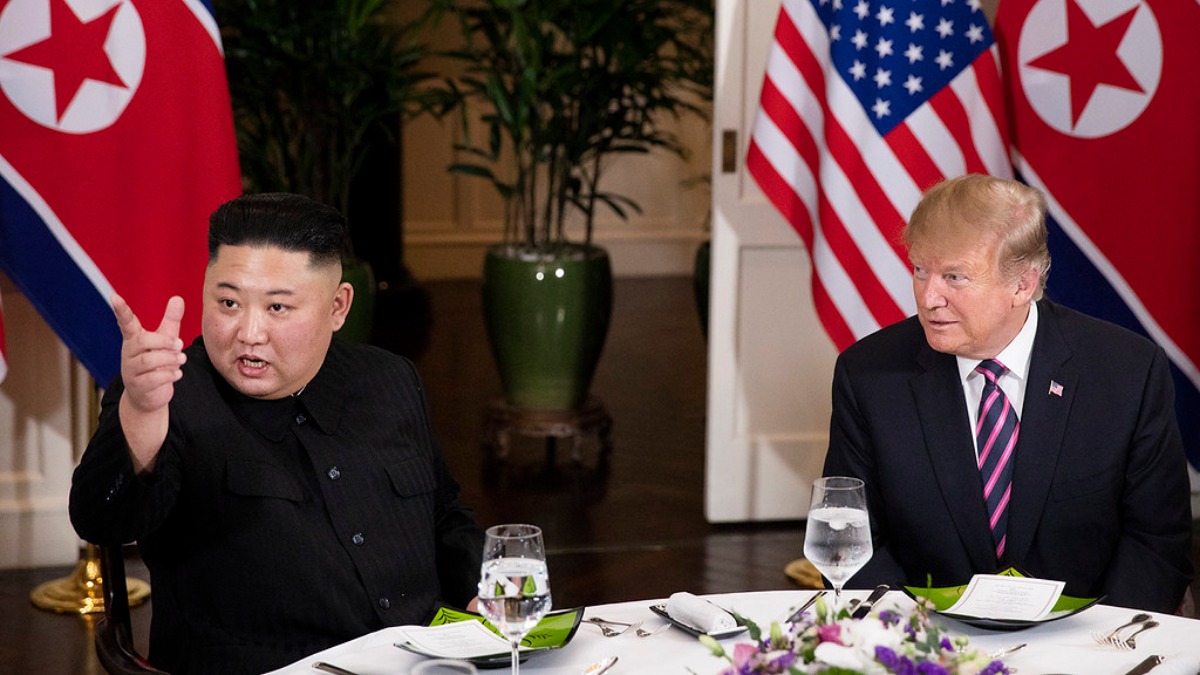
Donald Trump ordered the Pentagon to slash this year’s joint military exercises with South Korea, calling the drills expensive and “totally inappropriate” while praising his “great” friendship with North Korea’s Kim Jong Un. According to NPR, the move came just hours before the 11-day Ulchi Freedom Shield exercises were set to begin with 18,000 South Korean troops and U.S. forces running live-fire drills, wet-gap crossings, and precision targeting scenarios.
Instead of the full-scale training, the Defense Department will now run a stripped-down version, a decision that has already drawn sharp criticism from lawmakers and military experts. Trump made the announcement in a late-night Truth Social post, saying he had instructed Secretary of War Pete Hegseth to “substantially reduce” the exercises because North Korea has been “unthreatening and respectful” during his time in office.
He also took a swipe at South Korea, claiming the ally had refused to help with the “denuclearization of Iran.” The president added that it was too late to cancel the drills entirely, so scaling them back was the next best option. A day earlier, he posted a photo of himself standing next to Kim, writing that the two leaders “get along great” despite the stiff expression in the picture.
This isn’t the first time Trump has tried to halt the war games
During his first term, he abruptly announced after his 2018 Singapore summit with Kim that the exercises were “provocative” and would be stopped to save money. At the time, he told reporters the drills would resume only if negotiations with North Korea stalled. The exercises were later redesigned and resumed under modified names, but the pattern is clear: Trump sees the drills as a bargaining chip in his personal diplomacy with Kim.
The exercises were meant to simulate responses to North Korea’s growing military threats, including new drone tactics and cyberattacks learned from Pyongyang’s support of Russia’s war in Ukraine. More than 14,000 North Korean troops have already fought alongside Russian forces in the Kursk region, and Ukraine’s president has warned that Moscow is preparing to receive another 30,000.
U.S. and South Korean military officials confirmed that this year’s drills were specifically designed to counter those battlefield lessons, with scenarios involving GPS disruption and drone swarms. According to The Guardian, Colonel Ryan Donald, public affairs director for the U.S.-led commands in South Korea, said the exercises had evolved over the past five years to account for North Korea’s “contemporary battlefield experience.”
Lieutenant General Scott Winter, deputy commander of the United Nations Command, called the threats “bigger and better than ever,” emphasizing that the drills were critical for maintaining readiness. Yet Trump’s decision to scale them back sends a confusing signal – just days after North Korea test-fired ballistic missiles in defiance of U.N. bans.
North Korea, unsurprisingly, isn’t impressed by the partial cancellation
North Korea’s foreign ministry called the exercises a “rehearsal for an aggressive war” and threatened “a new level of deterrent” in response. Experts say Pyongyang has long used U.S.-South Korean drills as an excuse to ramp up its own weapons testing, and this year is no different.
Cheong Seong-chang, vice president of the Seoul-based Sejong Institute, warned that Trump might go even further if he meets Kim again, potentially suspending the exercises entirely or reducing U.S. troop levels without consulting South Korea. That prospect has raised alarms in Seoul, where public support for developing an independent nuclear deterrent is growing, despite international opposition.
Democratic Senator Mark Kelly, a former Navy pilot, called Trump’s decision “shortsighted and a mistake” in a social media post. Military analysts agree that downsizing the drills weakens deterrence and slows South Korea’s ability to take on more responsibility for its own defense.
Leif-Eric Easley, a professor of international studies at Ewha Womans University in Seoul, said that the cost savings from scaling back the exercises are “marginal,” while the diplomatic benefits are “doubtful.” Lim Eul-chul, a North Korea expert at Kyungnam University, added that Kim is unlikely to see the move as meaningful unless the drills are canceled entirely.
The exercises have always been a point of tension
North Korea routinely condemns them as provocations, while U.S. and South Korean officials insist they are purely defensive. This year’s drills were set to include personnel from 11 of the 18 United Nations Command member states, reinforcing the alliance’s role as a “linchpin for regional peace and security,” according to the U.S. military.
But Trump’s decision to scale them back – just as North Korea’s military capabilities are expanding – has left many questioning the long-term impact on regional stability. South Korea’s presidential Blue House responded cautiously, saying it hopes Trump’s “friendly relationship” with Kim will lead to “meaningful dialogue” between the two countries.
The statement also noted that the allies would continue coordinating on their combined defense posture, but the damage may already be done. Retired Lieutenant General Chun In-bum, who once commanded South Korea’s special forces, warned that the improvement in North Korea’s military capabilities is “very serious” and should not be taken lightly.
For now, the scaled-back exercises will proceed, but the message is clear: Trump’s personal diplomacy with Kim is taking priority over long-standing military alliances. Whether that approach will lead to lasting peace or simply embolden North Korea remains to be seen. One thing is certain: the decision has left U.S. allies in the region scrambling to adjust to a rapidly shifting security landscape.
(Featured image: The White House)
Have a tip we should know? [email protected]
Follow The Mary Sue:
