


Tesla’s new flying car guarantees excitement, not success: ‘Not necessarily safety optimized’
‘Flying cars are real.’
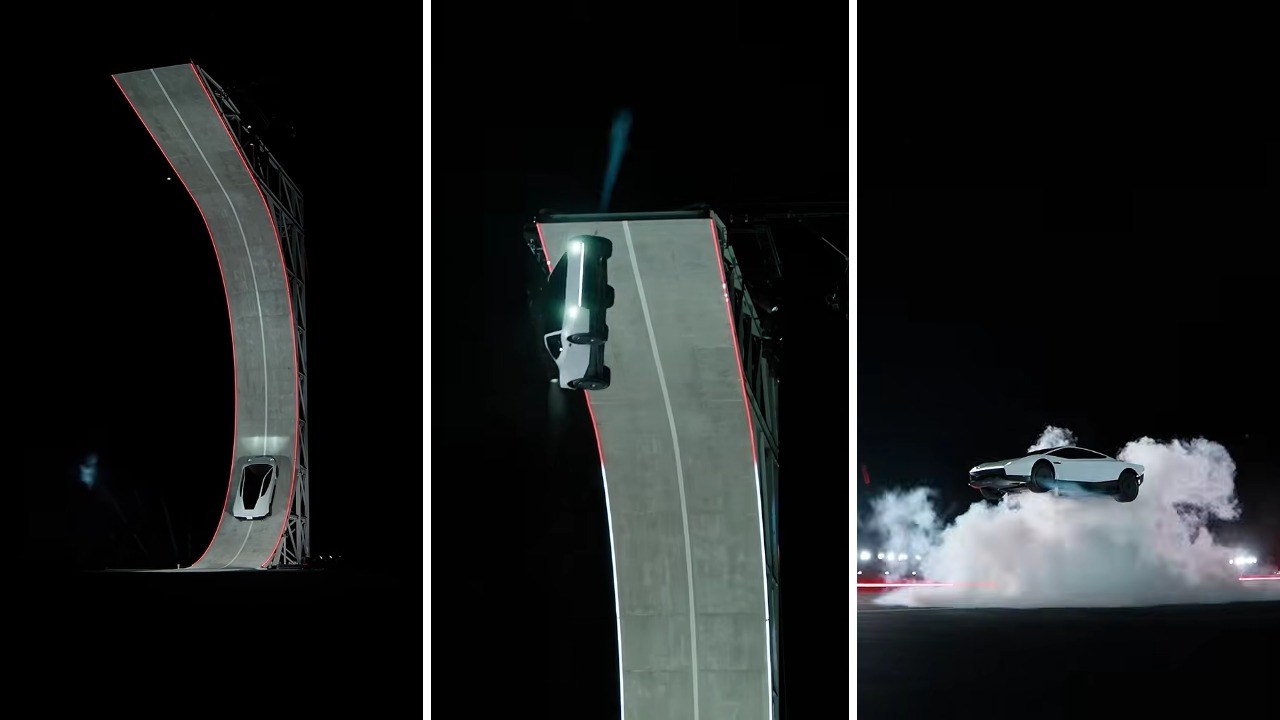
The future of transportation just took a wild turn at the SpaceX facility in Texas. Elon Musk unveiled a new version of the Tesla Roadster that ‘flies’. This event occurred on Thursday, October 15, 2026. UNILAD states that the car uses SpaceX technology to achieve these aerial maneuvers. It can launch into the air, flip, and hover briefly before landing. This landing relies on specialized air jets to keep things stable. The demonstration was quite a spectacle for those in attendance.
The car sped up a ramp, flipped mid-air and successfully landed. Musk told the crowd, “Well, it worked. Phew. Flying cars are real.” He even demonstrated a move called a Kickflip. This saw the car fly over five parked cars before touching down again. The Tesla CEO explained that the vehicle uses 10 nozzles to accomplish these feats. He described the technology as “the results of what happens when you have a collaboration with the world’s best car company and the world’s best rocket company.”
There was no driver inside the vehicle during the demonstration. Musk noted that this was “to make sure we don’t kill anyone.” He added, “Success is not guaranteed,” he said. “I mean that. It’ll probably work, but if it doesn’t work, we’re at a safe distance.” He also promised that “Excitement is 100% guaranteed.”
The vehicle is expected to enter production in 2028
It is said to be the final car Tesla will design primarily for human driving. Musk said, “So if it’s going to be the only manually driven car, let’s take it to the limits and beyond the limits.” The car is slated to go from 0 to 60 mph in less than a second. However, Musk admitted the car is not necessarily “safety optimized” despite its capabilities.
Fans on X were quick to react to the footage. One user wrote, “This is one of the top-3 craziest things I’ve ever seen.” Another person stated, “I thought this was AI but no that’s real what the hell that’s crazy cool dude.” Google CEO Sundar Pichai said, “The FSD version of this will be something:) congrats!” Musk replied to the feedback by saying, “Thanks. It’s such an honor working with incredible engineers.”
Despite the excitement, the regulatory path forward remains unclear. According to POLITICO, the Federal Aviation Administration stated that the vehicle does not meet its “definition of an aircraft.” This means the agency will not need to certify the vehicle as airworthy. The Transportation Department noted that regulators are keeping a close eye on the project.
Officials stated, “While the vehicle may appear to defy the laws of physics, the manufacturer must ensure that it does not defy applicable Federal Motor Vehicle Safety Standards and drivers must obey all local traffic laws.” They added that the “NHTSA will continue to monitor the situation and won’t hesitate to act to protect the driving public.”
Safety advocates have already voiced concerns about the implications of such a vehicle
Cathy Chase, president of the Advocates for Highway and Auto Safety group, said the demonstration “presents numerous questions regarding the safety of the vehicle if it was introduced on public roads.” She pointed out that “Chiefly among them is the vehicle’s apparent top speed of 230 MPH. Speeding remains one of the leading contributing factors of crashes in the U.S., killing over 11,000 people in 2024.”
Musk seems aware of the legal hurdles ahead. He even joked, “I’m not necessarily sure it’s legal in all jurisdictions.” It is still not certain if the flying version will be allowed on public roads. Tesla has not yet clarified the rules around the car’s flying capabilities.
Pricing is another mystery that remains unsolved. When reservations opened in 2017, the car was advertised at $200,000. The limited Founders Series was priced at $250,000. It is unclear if these prices will hold given the new SpaceX-inspired technology.
This regulatory ambiguity is not unique to Tesla
Other vehicles that mix different modes of transport face similar issues. For instance, the Viceroy Seaglider is overseen by the Coast Guard rather than the FAA. It seems the industry is entering uncharted territory with these designs.
The public can expect more debates as the 2028 production date approaches. For now, the world is left to process the fact that a car really did flip through the air in Texas. It is a bold vision that pushes the boundaries of what a car can do. Whether this becomes a common sight on the road or stays a novelty remains to be seen.
Have a tip we should know? [email protected]
Follow The Mary Sue:
