


Trump Pushes NASA to Dump Classified UFO Files, and the Latest Images Have Officials Admitting They Are Stumped
Still no answers.
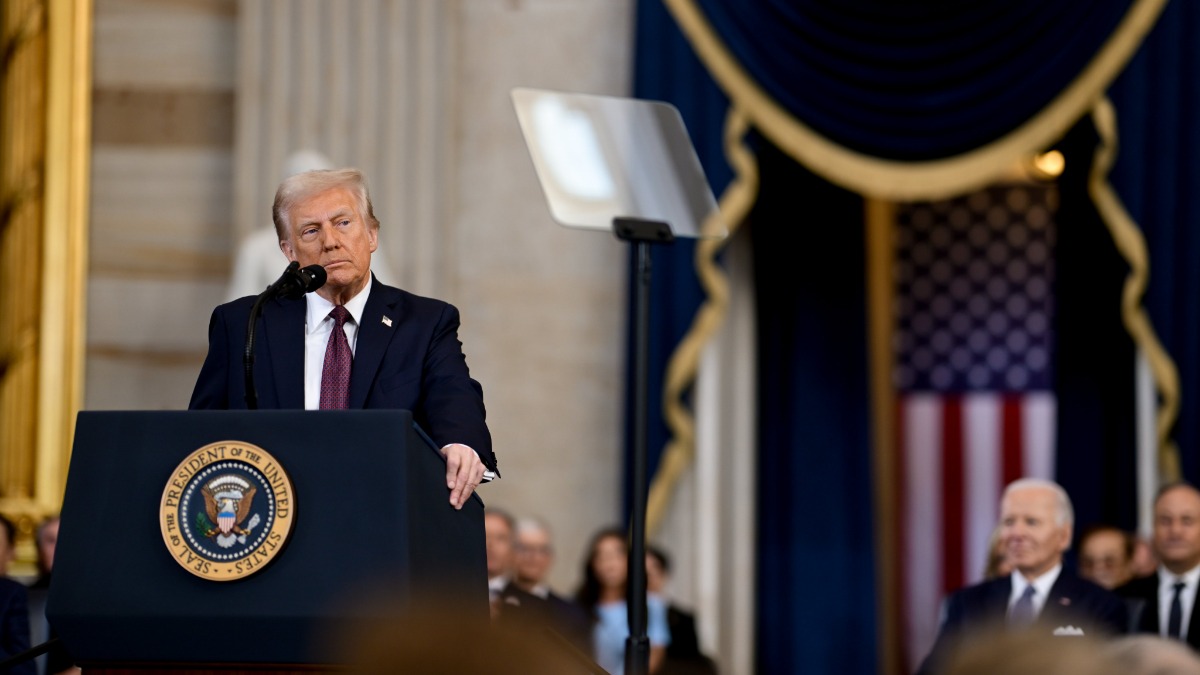
Donald Trump just pushed NASA to release classified UFO files, and the latest images have officials admitting they’re completely stumped. NASA chief Jared Isaacman confirmed recently that the agency has captured unexplained imagery of objects that defy conventional explanation. He didn’t outright claim they were alien spacecraft, but he didn’t rule it out either. He framed the mystery as part of NASA’s broader mission: figuring out whether we’re alone in the universe.
According to Fox News, Isaacman, who took over as NASA’s administrator in December, said, “We have captured imagery – and this is what President Trump is very forward-leaning about – that, based on the data that we have within that imagery, we don’t know what it is.” The admission is a rare moment of candor from an agency that has historically downplayed UFO speculation.
Isaacman stopped short of declaring the images proof of extraterrestrial life, but he did say he believes humans will eventually conclude that life exists beyond Earth. “I think there’s a very real possibility we’re going to arrive at a conclusion in our lifetime that perhaps there’s life everywhere out there and that it isn’t as infrequent as it could possibly be,” he added.
NASA has long maintained that it has no evidence linking UFOs to aliens
A 2023 report by an independent group of scientists and experts convened by the agency echoed that stance, concluding that more data was needed to understand certain unexplained encounters. But the Pentagon has been more proactive in releasing information, dropping batches of declassified files, images, and videos through the Trump administration’s Presidential Unsealing and Reporting System for UAP Encounters, or PURSUE.
The initiative is part of a government-wide effort to declassify records related to unidentified anomalous phenomena (UAPs), and Isaacman made it clear that Trump is driving the push for transparency. “We did keep a lot of that buried in files somewhere, and the president said, ‘Why? Put it out there. We don’t have time to study it. Let other people tell us what it is,’ and you’re seeing that effort,” he said.
So far, none of the released files have provided definitive proof of alien life. Isaacman was quick to clarify that NASA hasn’t found evidence of crashed alien bodies or recovered spacecraft. But he did tease the possibility of microbial life on Mars, noting that samples currently being collected on the red planet could hold answers. “If we bring them back, there is a very high probability that they will point to, at some point, microbial life at least on Mars,” he said.
The idea that life might exist just 250 million miles away is enough to keep scientists and UFO enthusiasts hooked. “I can’t hate the subject,” Isaacman admitted. “In fact, I’m incredibly fascinated by it because that is at the heart of what we’re trying to do at NASA – answer the question, ‘Are we alone?'”
The latest batch of declassified files includes some really intriguing footage
The batch was released as part of Trump’s directive. Among the highlights is an 18-second infrared video from U.S. Indo-Pacific Command, captured in 2025, showing an object that officials described as resembling a six-pointed star. The footage, taken over the Yellow Sea, tracks what the government called an “area of contrast,” though officials were careful to note that the description wasn’t an official conclusion about the object’s identity.
Another newly released video, this one from 2024, shows a military sensor tracking an elongated area of contrast that eventually appears as a line of bright points before fading into the distance. As with the other footage, officials cautioned against jumping to conclusions about what the object might be.
The files also include a newly declassified Department of Energy report detailing a 2015 incident at the Pantex Plant near Amarillo, Texas, the nation’s primary facility for assembling and maintaining nuclear weapons. The report describes an unidentified object observed near the plant, though portions of the document remain redacted to protect sensitive information.
The release of these details marks a shift in how the government handles UAP reports, with Trump’s administration prioritizing transparency while still safeguarding national security. The latest tranche also includes a Navy “Range Fouler Debrief,” a standardized report used to document unauthorized intrusions into military training airspace.
In one case, a military operator described seeing a “quite small” object with a metallic appearance and reflective underside. However, the report noted that the description was based on the observer’s impressions at the time and wasn’t a definitive assessment.
Videos show objects that appear to flicker or change shape as military sensors track them
In one 2019 Air Force infrared video, the All-domain Anomaly Resolution Office (AARO) included technical context explaining that the apparent flickering could be due to the sensor’s automatic contrast adjustments. The AARO, established by Congress in 2022, is tasked with investigating UAP reports across air, sea, space, and other domains.
Its goal is to determine whether sightings can be attributed to foreign adversaries, classified U.S. programs, or conventional explanations before labeling them unresolved. The office’s work is part of a broader effort to take UAP reports seriously, especially when they occur near sensitive military sites or involve potential flight safety risks.
The latest release is the fourth in a series of declassified tranches, and it’s clear that Trump’s push for transparency is reshaping how the government handles UFO files. Isaacman’s comments suggest that NASA is now more open to discussing the unknown, even if it doesn’t have all the answers.
(Featured image: The Trump White House)
Have a tip we should know? [email protected]
Follow The Mary Sue:
