


Construction at the White House Compromised Marine One, Putting the President’s Flight Path in the Way of a Passenger Jet
Cause for concern.
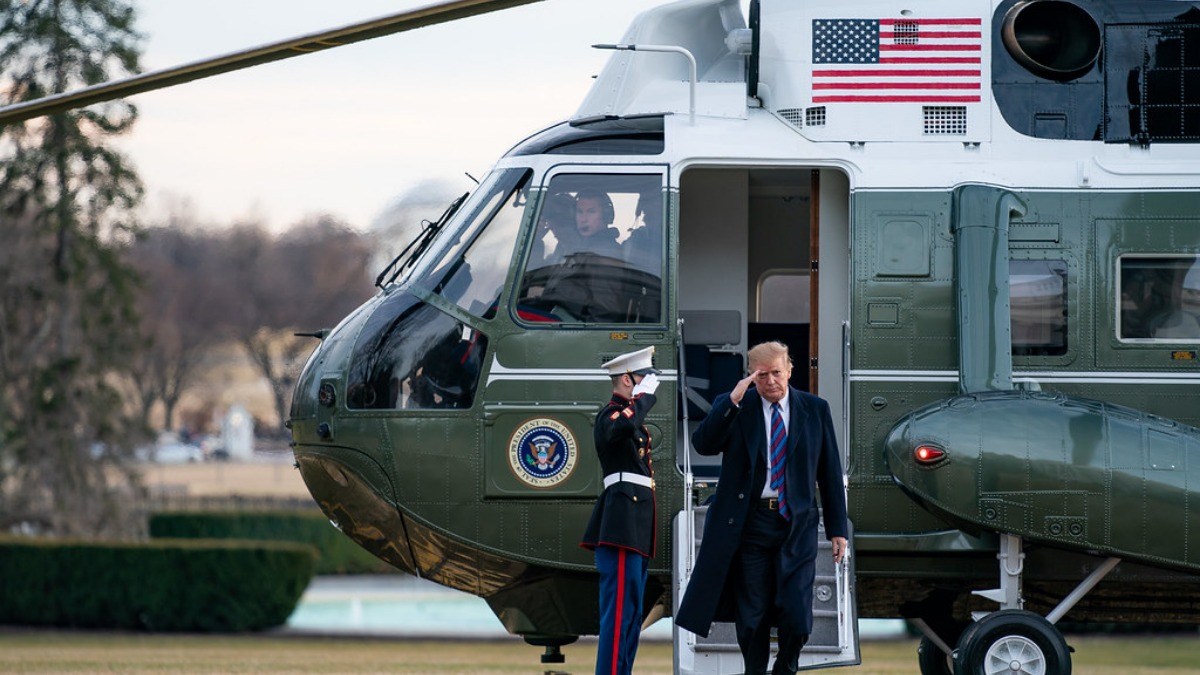
A recent preliminary report from the National Transportation Safety Board (NTSB) has shed light on a troubling situation involving the presidential helicopter, Marine One. According to The Guardian, during a flight earlier this month, the aircraft experienced a close call with a passenger jet, an incident that safety officials now link to the relocation of a helipad amidst ongoing construction at the White House.
This disruption has highlighted significant communication vulnerabilities that have persisted despite attempts to rectify them. The incident occurred on August 4, 2026, when Marine One was carrying President Donald Trump. Because of extensive construction projects at the White House, including a new ballroom and a redesigned helipad, helicopter operations were shifted from the South Lawn to the Ellipse in May.
This temporary move placed the presidential flight path in a precarious position relative to commercial traffic departing from Ronald Reagan Washington National Airport. Under standard protocols, flights from the airport are halted three minutes before Marine One takes off to ensure a clear corridor. On this occasion, however, those precautions failed to trigger.
The NTSB identified communication issues as the primary culprit
The crew of Marine One attempted to radio air traffic controllers at least twice to provide the mandatory three-minute notice, but their calls were either not received or were completely unreadable. Consequently, an Embraer E170 jet operated by an American Airlines subsidiary was cleared for takeoff for Florida while the president was still on the ground or just beginning his departure.
The resulting loss of separation saw the two aircraft reach a point where they were only 0.82 nautical miles apart laterally and 700ft vertically. While the Federal Aviation Administration (FAA) noted that the aircraft were not apparently converging and characterized the event as not being a dangerous close call, the margin of error was significantly tighter than the standard requirement of 1.5 miles horizontally and 500ft vertically.
This issue is particularly concerning given the history of aviation safety in the nation’s capital. These proximity rules were tightened significantly following a January 2025 collision between a commercial airliner and an army Black Hawk helicopter that resulted in 67 fatalities. To avoid a repeat of such a tragedy, controllers and Marine One staff had actually met on July 30 to discuss concerns regarding missed communication calls.
During that meeting, the flight crew acknowledged that radio signals had been spotty and agreed to use alternative methods to contact the tower if the primary radio failed. Unfortunately, those backup measures also fell short on August 4, as the crew was unable to establish contact via a facility at Joint Base Anacostia-Bolling.
The technical root of these failures appears to be related to the site change
FAA technicians determined that there was not adequate line-of-sight to ensure consistent communications from the Ellipse. Transportation Secretary Sean Duffy previously addressed these concerns on August 11, noting that infrastructure development in the Virginia and Washington, DC area had created interference with antennas. At the time, he expressed confidence that a fix was in place. However, the situation remains fluid and prone to repeat errors.
The ongoing construction at the White House is not just a logistical hurdle but a source of frustration for the administration as well. Beyond the communication issues, it has been reported that the new helipad being built on the South Lawn is already undergoing modifications. President Trump has reportedly expressed dissatisfaction with the appearance of the structure and an apparent slope, leading to further adjustments.
These infrastructure challenges were underscored again on August 27. According to CBS News, as the president prepared to depart for an event in Texas, air traffic controllers once again lost contact with Marine One. In this instance, another pilot had to intervene to facilitate communication. While the FAA confirmed that contact was eventually established prior to takeoff and that no safety issues arose, the recurring nature of these radio failures is notable.
Bryan Bedford, the head of the FAA, stated that the agency had relocated an antenna and adjusted procedures following the initial August incident. While early checks suggested these changes were effective, the latest disruption proves that maintaining clear, reliable communication in such a complex environment remains a significant challenge.
For now, the administration and aviation authorities continue to navigate the intersection of high-stakes presidential travel and the physical transformation of the White House grounds.
(Featured image: The White House)
Have a tip we should know? [email protected]
Follow The Mary Sue:
