


Trump promised a ‘Golden Dome’ to stop missiles. Now, experts say it’s a $1.2tn gift to defense contractors with a fatal weakness
False sense of security?
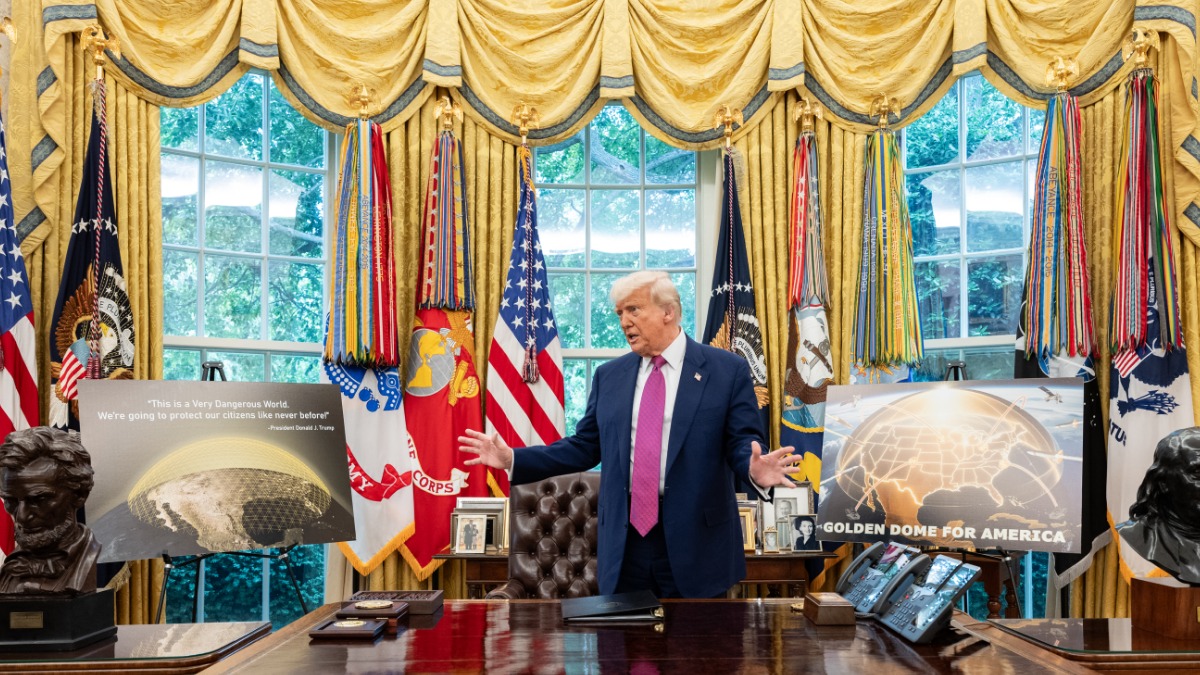
Donald Trump’s “Golden Dome” missile defense system is shaping up to be one of the most expensive military projects in U.S. history and experts say it might not even work when it matters most. The nonpartisan Congressional Budget Office (CBO) estimated the system will cost a staggering $1.2 trillion over the next two decades. That’s nearly seven times the initial $175 billion price tag Trump touted when he unveiled the plan.
The Golden Dome is supposed to be the ultimate shield against next-generation missile threats. This includes hypersonic weapons that travel at more than five times the speed of sound.
Trump has framed it as a long-overdue upgrade to America’s defenses, promising it would intercept missiles “launched from the other side of the world, or even from space.” But the CBO’s analysis suggests the system could be overwhelmed by a full-scale attack from Russia or China, leaving the U.S. just as vulnerable as before, only now with a much lighter wallet, according to the BBC.
The numbers are eye-watering
Acquisition costs alone will top $1 trillion, covering everything from interceptor layers to a space-based missile warning and tracking system. Space-based components are expected to eat up a whopping 70% of the total acquisition budget, which makes sense given how much more complex and expensive it is to deploy tech in orbit.
SpaceX and Lockheed Martin already won contracts worth up to $3.2 billion to develop space-based interceptor prototypes, so the spending spree is well underway. But here’s the kicker: Newsweek states that the U.S. doesn’t even have operational hypersonic missiles of its own yet. Meanwhile, China has been ramping up its missile production at a breakneck pace.
Corporate filings show 81 Chinese firms publicly reported producing missile parts last year, with many posting record revenues. The U.S. assesses that China now has more than 3,100 ballistic missiles in its arsenal, and its military spending has increased for 31 consecutive years. The Stockholm International Peace Research Institute (SIPRI) found that China hiked its defense budget by over 7% in 2025, bringing it to $336 billion, still just a third of U.S. spending, but growing fast.
The timing of the Golden Dome’s rollout couldn’t be more awkward
Trump is currently in Beijing for a high-stakes summit with Chinese leader Xi Jinping, where trade, Taiwan, and military posturing are all on the table. Taiwan, in particular, is a major flashpoint. China sees the self-governing island as a breakaway province and has repeatedly threatened to take it by force.
The U.S. has long supported Taiwan with arms sales, but Trump’s decision to discuss those sales with Xi has raised alarms in Taipei and among U.S. lawmakers. If Trump trades away Taiwan’s security for better trade deals, it could embolden China to push harder on its military ambitions, including its missile stockpile.
Back home, the Golden Dome is already facing fierce criticism
Democratic Senator Jeff Merkley, who requested the CBO’s cost estimate, didn’t mince words. “The President’s so-called ‘Golden Dome’ is nothing more than a massive giveaway to defense contractors paid for entirely by working Americans,” he said.
The U.S. is already struggling to replenish its missile stockpiles after more than 10 weeks of war in the Middle East drained supplies. Defense contractors are under pressure to backfill those shortages, and now they’re getting a $1.2 trillion windfall for a system that might not even work.
The Golden Dome’s fatal weakness, according to the CBO, is its vulnerability to saturation attacks. In other words, if Russia or China launch enough missiles at once, the system could be overwhelmed. That’s a major problem for a project that’s supposed to be the backbone of U.S. defense.
The system is designed to cover the U.S. mainland, Alaska, and Hawaii, with Canada in talks to join, though Ottawa would need to cough up tens of billions to be included. Right now, the U.S. and Canada rely on NORAD for missile defense, but the Golden Dome is meant to be a next-level upgrade.
Trump has compared the Golden Dome to Ronald Reagan’s 1980s “Star Wars” program, which was ultimately scrapped due to technological limitations and sky-high costs. Advocates argue that tech has advanced enough to make a space-based system feasible, but the CBO’s report suggests those advances might not be enough to justify the price tag. The White House and Pentagon haven’t responded to requests for comment, but the silence speaks volumes.
The bigger picture here is an accelerating arms race
China’s missile production surge and the U.S. push for the Golden Dome are both symptoms of a world where military dominance is increasingly tied to who can build the most advanced and expensive weapons. The U.S. is already the world’s top military spender, with a proposed defense budget of $1.5 trillion, nearly 50% higher than previous years.
Programs like the Golden Dome and Trump’s plan to revive battleships are driving that increase, but it’s not clear if taxpayers are getting their money’s worth. For now, the Golden Dome is still in the planning stages, but the clock is ticking. If the system can’t handle a full-scale attack, all that money will have bought is a false sense of security and a lot of very happy defense contractors.
(Featured image: The White House)
Have a tip we should know? [email protected]
Follow The Mary Sue:
