


Woman with a service animal warns Walmart help desk of two off-leash dogs, then employees tell her there’s nothing they can do: ‘Nobody upholds it’
In the end, she left the store.
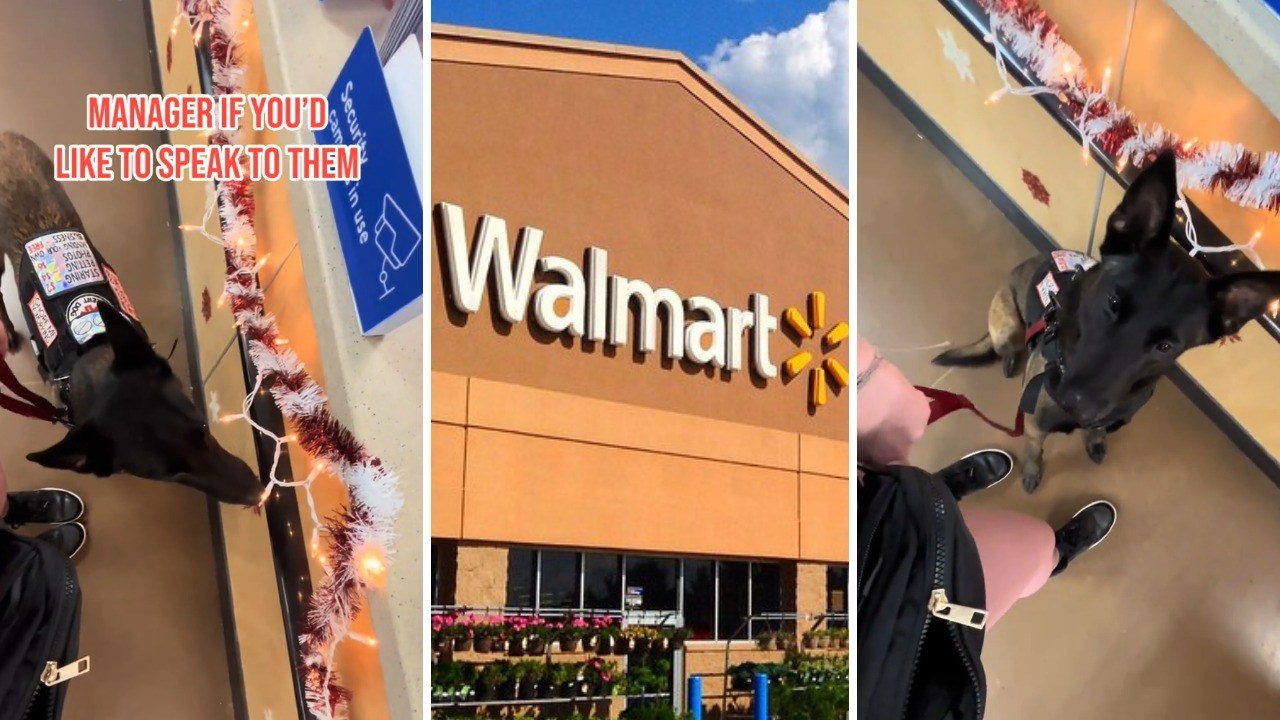
Service dogs have become vital for people with disabilities, as they are trained to perform tasks to help their humans navigate daily life. Because of this, they are legally protected and can always accompany their humans wherever they go. However, there have been cases where individuals allegedly abuse such protections. Service dog influencer Jay (@theserviceflower) shared the incident in a video that has amassed hundreds of thousands of views on TikTok, capturing an interaction she had with a Walmart employee when she went to report a shopper’s dogs.
According to Jay, she reported a shopper to Walmart employees after seeing his two pet dogs off-leash in a shopping cart, which she claimed had tried to jump out and reach her service dog. Jay said she told the shopper that Walmart allowed service animals but not pets, but then he began to follow her and crossed paths with her three or four more times during her shopping trip.
“At this point it was clear that this had to be intentional, so I decided to try to get the staff involved as his dogs were not only breaking federal law, [health] code violations, but also store policies,” Jay wrote. However, Jay said she was told by employees that they could not do anything with the shopper’s dogs. The employees offered to call for their superior, but Jay said a manager never showed up despite being called for several times and waiting 20 minutes. “I ended up walking out,” she said.
The law supposedly prevents Walmart employees from taking action
In the video, Jay described the shopper’s pets as “two white fluffy dogs” that she considered “aggressive.” But an employee immediately responded, “That’s on the owners,” according to the clip.
Jay then argued about Walmart’s policy on service animals and pets. “On the owners? Well, your policy says service animals only. No pets, and pets cannot be in shopping carts, and they’re in shopping carts and off-leash,” she told the employee. “It’s a health code violation.”
The employee appeared to try to de-escalate the situation, saying they understood Jay has a service dog and that they have a purpose. However, they also acknowledged that Walmart has shoppers who visit and “don’t abide by the rules” before offering to call for a manager.
In response, Jay told the employee that they had to comply with their own store policy. “It’s just, there’s no point in your store policy or the federal law if nobody upholds it,” Jay said. Another employee said they do not disagree with Jay, but reasoned that they would not be able to do anything if the shopper said his two dogs were service animals. “We can’t do nothin’,” the employee said.
Fake service dogs affect the real ones
According to the Americans with Disabilities Act (ADA), only two questions are legally allowed to be asked when inquiring about a service animal. The questions are limited to asking whether the service animal is required because of a disability and what task it is trained to perform. Asking questions beyond that, requesting the service animal’s identification, or asking for other proof violates federal law and may open an establishment or individual to legal consequences depending on circumstances.
The hesitancy of the employees is understandable, given the law. However, fake service dogs have negatively impacted legitimate service dogs. According to Canine Companions, businesses have begun to put a blanket ban on animals from entering an establishment due to the rise of fraudulent service animals who have “urinated on expensive furnishings, contaminated food, bitten staff and driven away paying customers.”
“Service dog fraud has had a profound impact on numerous service dog teams, including increased skepticism around the legitimacy of service dogs and actual injury or career-ending behavioral changes in service dogs,” Canine Companions said in a report. “Service dog fraud and poorly trained service dogs pose a wide-spread and serious problem regardless of location.”
Have a tip we should know? [email protected]
Follow The Mary Sue:
