


Woman says she picks zero tip on $21 chicken fingers, then sees a $25 charge and the server calls it an accidental tip: ‘Did you just try to rob me?’
She says it was only about $3.50, but 'it's not that much money, but it's the principle.'
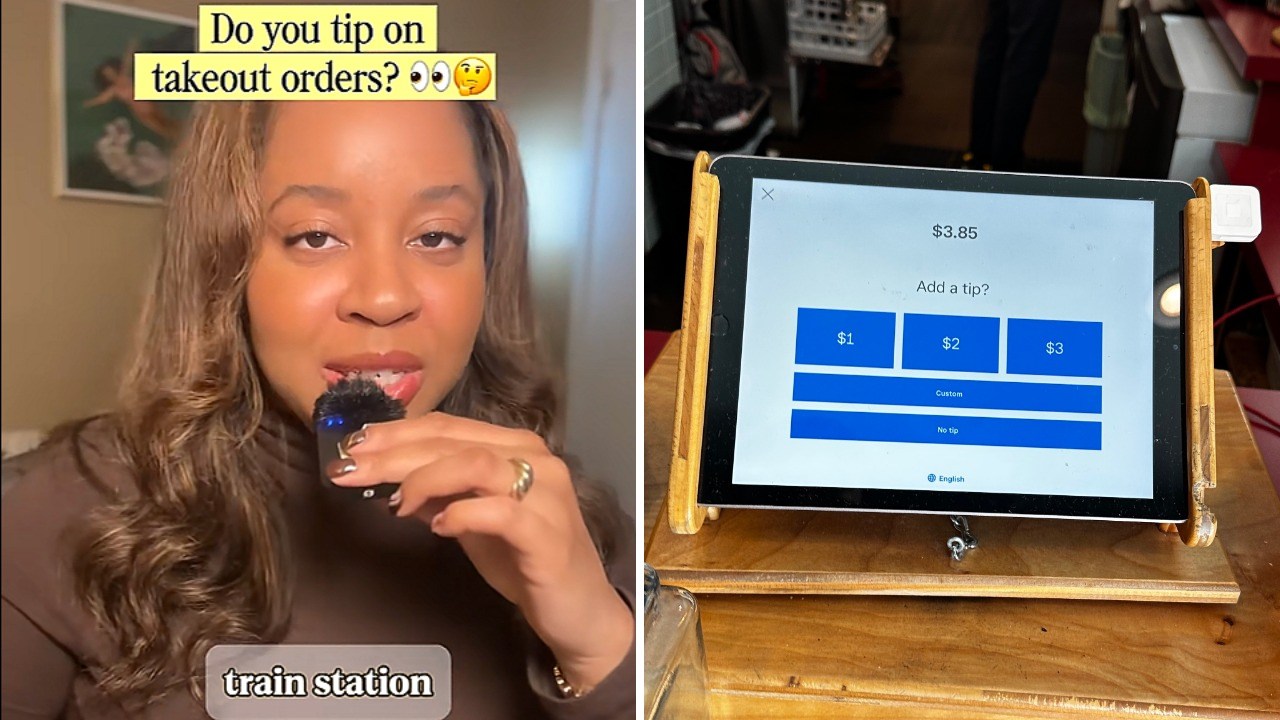
A woman says a server at a train station food counter added an 18% tip to her $21 takeout order after she had chosen not to tip. In a TikTok video, Danica says she only noticed because her phone showed a charge of about $25. She explains that she had just left an event and wanted a quick meal before catching her train. According to Upworthy, she ordered chicken fingers and fries to go, and the server told her the total was a little over $21.
When he handed her the card machine, the tip options started at 18%. “I am not tipping you on $21 chicken fingers that I’m taking out,” she says. She states that she pressed zero because she was leaving right away. Her card tap then brought up an error, so she asked the server to fix it. By her account, he told her he had never seen that before, pressed a few buttons and handed the machine back. She tapped again and saw the $25 charge on her phone.
After asking for her receipt, she found an 18% tip on it. Since it was only about $3.50, she decided it was still worth raising. “It’s not that much money, but it’s the principle,” she says. She also asks in the video, “Did you just try to rob me?”
She says he told her he tipped himself by mistake
Receipt in hand, she went back to the counter and asked why she had been charged more than the total he gave her. The server allegedly told her he must have accidentally tipped himself when he pressed the button before she paid. He apologized and offered a refund, but told her he could not put it back on her card.
“That’s fine. I’ll take my change,” she told him, and he handed her about $3.50 in cash. She ends the video with, “The audacity of this man.” That report adds that the amount was not her only concern, since a tip she had declined was added anyway. She also wondered how many other customers had been charged without noticing.
All details are based on her account in the video, which presents only her version of events. The video does not name the restaurant, say where the station is or show which payment system it used, and the server’s side has not been heard.
The Emily Post Institute, which publishes etiquette guidance, lists takeout as carrying no obligation to tip. It suggests about 10% only for extra service, such as curbside delivery or a large, complicated order. The same guide treats tip jars as optional, with a tip suggested only occasionally for a little something extra. Against the 10% it lists for large orders, an Atlanta woman charged $40 tip on a $15 takeout order says the amount equaled 266% of her bill. She says her bank alert showed a $15.01 bill, a $40 tip and a $55.01 total.
A study in the Journal of Services Marketing examined how customers react to tip prompts, using two pilot studies and four scenario-based experiments with 1,274 participants. Prompts in settings where tipping is not customary, such as café drive-thrus, lowered satisfaction and intentions to return. Authors Jamie Hyodo, Bonnie Simpson and Jennie Choi link those reactions to a perceived threat to autonomy.
Toast, which runs payment systems for restaurants, updated its tip adjustment workflow this year to prevent accidental changes to the payment amount. The update covers cases where a server means to adjust only the tip. A server without tip-edit permissions who tries to use the keypad now triggers a manager approval dialog.
The IRS states that a payment is a tip only if the customer voluntarily decides to pay it and determines the amount. Automatic charges added to a bill, such as a mandatory 18% charge for large parties, are service charges instead. It adds that whether a payment counts as a tip depends on the facts and circumstances.
The agency also lists digital payment prompts that require a customer to select a tip above zero before paying as service charges. A salon customer charged 15% tip after a facial waxing asked the worker whether customers usually get a choice, once the card had already been processed. She had been billed $25.91 and asked to pay the tip in cash instead.
The Consumer Financial Protection Bureau states that a credit card holder disputing a charge should tell the card company right away. It says the cardholder must also send a written billing error notice within 60 calendar days after the charge appeared on the statement. A charge found to be an error must be removed from the bill.
Have a tip we should know? [email protected]
Follow The Mary Sue:
