


Woman bites into apple and notices ‘weird’ taste. After leaving it out for a day, her suspicions grow: ‘It’s just crazy’
One bite had her growing suspicious of her apple.
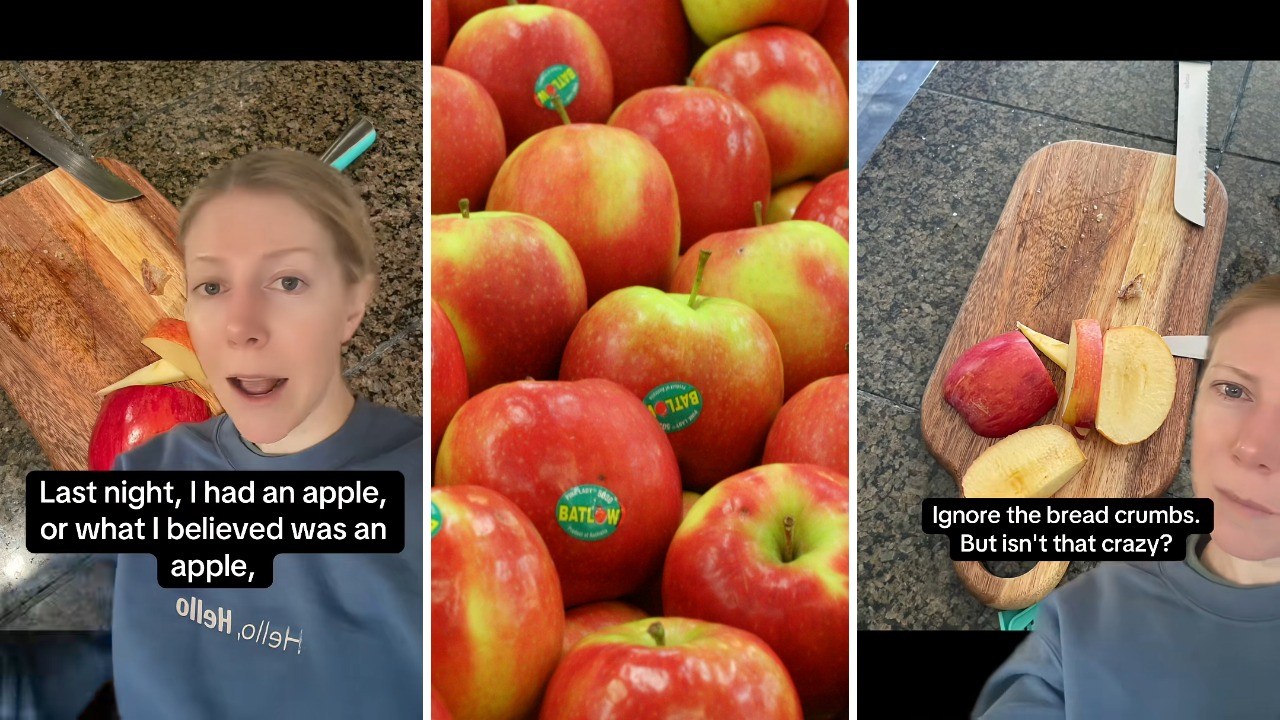
Americans are grappling with rising food costs every day, but it appears that prices aren’t the only thing they need to worry about when grocery shopping. For one woman, taking a bite of her organic apple made her question the quality of fresh produce in the country—and whether what she was eating was even real food.
“Have you noticed lately that the FOOD doesn’t even taste like FOOD it’s so insane,” Shannon McNamara (@fluentlyforward) shared her suspicions in a video, which has since gained over a million views on TikTok. According to McNamara, she went to eat an apple she purchased from Whole Foods, but felt that the taste and texture were wrong once she took a bite.
“I was like, this just doesn’t taste good. The texture doesn’t taste like an apple I grew up with,” McNamara, who’s based in Denver, Colorado, said. “It’s just weird. So I decided not to eat it.”
McNamara says even animals didn’t go near the apple
After hearing stories online claiming that “food isn’t food,” McNamara decided to conduct her own experiment by leaving her sliced apple out on the counter. Normally, apples begin to brown soon after being sliced because their cells are exposed to oxygen, though an apple’s variety, environment, and how it’s stored play a role in the speed at which it browns. However, McNamara claimed that her apple “didn’t brown at all” despite being out on the counter for two hours.
In the video, the apple appeared to still look newly sliced with no signs of browning even with oxygen exposure, so McNamara decided to keep observing it for a few more hours. “I was like, I’m gonna leave it out for even longer, because this is, like, so f****** suspicious to me,” she said.
The next day, 15 hours after McNamara left the apple on the counter, the apple still didn’t have any browning. However, it did seem less fresh, appearing to have lost some of its moisture due to the wrinkles that formed on the flesh.
McNamara also tried snapping the sliced apple in half, which she claimed had a texture akin to styrofoam. “The texture is so weird. I don’t even know how to describe it,” she said. “It’s like styrofoam.”
McNamara took her experiment further, leaving slices of the apple outside for animals to eat. Yet, the apple remained untouched by the ants and squirrels around her home. “It’s just crazy. I’m spending money on food that doesn’t taste like food,” she added.
While McNamara’s video doesn’t necessarily prove the apple she bought was fake, it does raise concerns about what corporations are opting to put on grocery aisles these days. Notably, more individuals have been claiming that 3D-printed food is making its way into stores.
3D-printed food is growing more common
The Independent reported that 3D-printed food isn’t limited to fruits and vegetables, but technology companies like Steakholder Foods have used their 3D printers to create plant-based fish and meat. Now, they’re reportedly bringing their brand Perfecta, which offers plant-based filet mignon, marbled steak, chicken breast, white fish patties, and salmon patties, to Northeastern U.S.
Food producers say that 3D-printed food should taste similar to conventional food, since it’s made with regular ingredients. However, the main challenge and difference would be in its appearance and texture, as printing the food reportedly allows for more creative freedom.
The nutritional value and health impact of 3D-printed food are still up for debate, as it’s still a relatively new development. Ali Ubeyitogullari, an assistant professor of food engineering at the University of Arkansas, argues that 3D-printed food has several benefits, including coaxing children to eat their vegetables by being able to print them in different shapes and colors.
Ubeyitogullari also believes it may help individuals suffering from medical conditions like dysphagia, which is difficulty in swallowing and affects around 300,000 to 700,000 Americans per year. According to Ubeyitogullari, 3D-printed food may help individuals with this condition regain their experience of food by returning purees to their original appearance and shape, while still maintaining a soft, easy-to-eat consistency.
Ubeyitogullari added that 3D printing food would also benefit production lines, as they would only need to modify the product through software and switch out bioink cartridges. The assistant professor also noted that food customization is what will appeal to the masses, aside from cutting costs and reducing waste.
Viewers, however, fear the decline in food quality in the U.S. “I remember when apples would brown within minutes,” one comment said. “In the UK and sometimes my apples brown while I’m still sat eating them. Thats genuinely scary!”
Others, however, pointed out that McNamara ate an Envy apple, a variety known for staying fresh and resisting browning for a long time after being sliced: “Envy apples are bred to resist browning and this also looks like it has been stored wrong! Wrong storage can compromise cellular integrity.” Whether technology had something to do with McNamara’s apple or not, individuals can still expect 3D-printed food to grow more common in the future as technology advances.
Have a tip we should know? [email protected]
Follow The Mary Sue:
