


What Horror’s Most Disturbing Meals Say About Modern Life
From cannibal banquets to dystopian food systems, horror's most unsettling meals reveal our deepest fears about humanity.
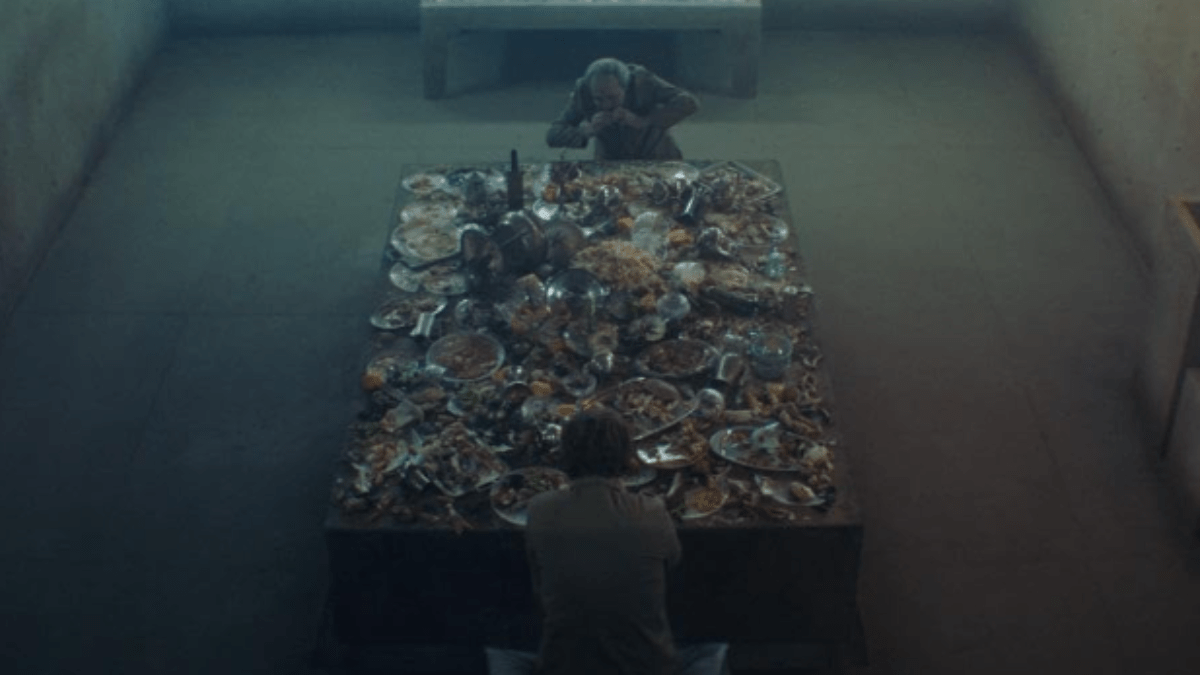
Everyone has to eat. It is one of the few things that connects all of us, regardless of culture, tax bracket, or location. As humans, we eat to survive, but food is also used to celebrate, mourn, socialize, fall in love, make friends, and feel at home. A meal can be an act of kindness or intimacy. Sitting down at a table with someone is, in its simplest form, an invitation to something.
Which is exactly why horror loves to focus on food and ruin any comfort dinner might bring us. Filmmakers use food to attack our senses and transform food into a source of disgust, violence, and even fear. Sometimes the horror is obvious, as with cannibalism. Other times it is more subtle, hiding in the dark shadows of humanity and the systems we have created. The scariest food in horror isn’t terrifying because it’s gross or vile; it’s because it reveals our deepest fears about consumption and survival.
The Family Dinner Is Never Just Dinner
A family dinner can be many things. For some it’s a comforting time with loved ones, and for others it can be a nightmare. No movie portrays this unsettling power of a shared meal better than “The Texas Chain Saw Massacre.” In this horror classic, the “family” gathers at the dinner table and turns a place of comfort and connection into one of straight domination and terror.
The cannibalistic Sawyer family represents more than a group of monsters. Their gathering at the dinner table reflects that traditional structures have broken down. The family’s connection to the slaughterhouse industry, mixed with social isolation, turns food into a symbol of desperation. If the systems that once provided stability disappear, what happens when people are left to fend for themselves? That question feels uncomfortably familiar today.
The horror of “The Texas Chain Saw Massacre” isn’t just that people are being eaten. It’s the suggestion that a society can become so desperate that the boundaries between nourishment and survival begin to disappear.
Horror’s Most Terrifying Ingredient Is Inequality
If The “Texas Chain Saw Massacre” imagines food as a product of social collapse, “The Platform” imagines it as a product of social hierarchy. In the 2019 dystopian horror film, prisoners are placed in a structure where a lavish platform of food descends through levels. The prisoners on the top floor get first dibs. By the time the platform reaches the bottom level, there is nothing but slobber and scraps left.
The metaphor is almost painfully direct. The movie turns wealth inequality into a literal meal. Everyone is technically participating in the same system, but their experiences are radically different depending on what level they are on. Those at the top can consume more than they need while those below fight over scraps. The structure encourages people to protect their own position rather than question the system. The horror of “The Platform” comes from recognizing that the food is not actually scarce. There is enough for everyone. The problem is distribution. When resources feel limited, compassion can become a luxury, and survival can become a competition.
Sometimes Hunger Is Really Loneliness
Not all food horror is about economic systems. Sometimes the most disturbing appetite is emotional. In “Bones and All,” described as a cannibalistic romance, there is a deep sense of longing, desperation, and desire to find someone who understands you. The characters’ hunger is physical, but it is also deeply emotional. They are searching for intimacy in a world that has given them few places to belong. That makes the movie’s central metaphor particularly resonant in a culture increasingly defined by isolation.
According to the World Happiness Report, more people are living alone, eating alone, and forming relationships through screens (via The Guardian). At the same time, food has become one of the primary ways we perform our identities online. We post what we eat, where we eat, and who we eat with. Even with all this sharing online, many feel disconnected from society. The film’s most disturbing idea is not that people might eat one another. It is that sometimes the desire to be understood can feel just as consuming as hunger itself.
When Eating Becomes a Performance
Modern food culture has made consumption more visible than ever. Restaurants that were once places to share a meal with friends or family have become “Instagrammable” or influencer havens. Meals are social media posts and high-end dining is status signaling. Mukbangs turn enormous quantities of food into entertainment. Influencers build entire careers around what they eat.
Emerging food-centered horror projects such as “Saccharine,” “Dinner to Die For,” and “Ice Cream Man” point toward a growing fascination with food culture as a source of satire and fear. The genre is increasingly interested not only in what we consume, but in why we consume it and what our consumption says about us.
We are no longer eating to survive. We are now crafting content to show off our lives, and in turn we are documenting, ranking, reviewing, photographing, and monetizing the experience. The horror lurking beneath all of that is the possibility that consumption has become disconnected from satisfaction. We want more. The endless appetite of modern consumer culture can begin to resemble a kind of hunger that can never actually be satisfied.
We Are What We Watch
Food horror remains compelling because everyone understands hunger. That universality gives filmmakers a powerful way to explore our deepest anxieties. It allows the audience to ponder what happens when social structures collapse. These food focused horror films examine our relationship with other people. All the while, none of these stories are really about food.
They are about power and scarcity. These movies tell us how to survive. They make us turn inward and think about our status and identity. They are about what happens when our most basic needs become entangled with the complicated systems we have built around them. Horror doesn’t corrupt the idea of food. Instead, it reveals the anxieties that were already sitting at the table.
Image by Netflix
Have a tip we should know? [email protected]
Follow The Mary Sue:
