Donald Trump orders JD Vance to stop Iran negotiations and pivot to domestic issues: ‘We don’t need a deal with Iran’
Change in strategy?
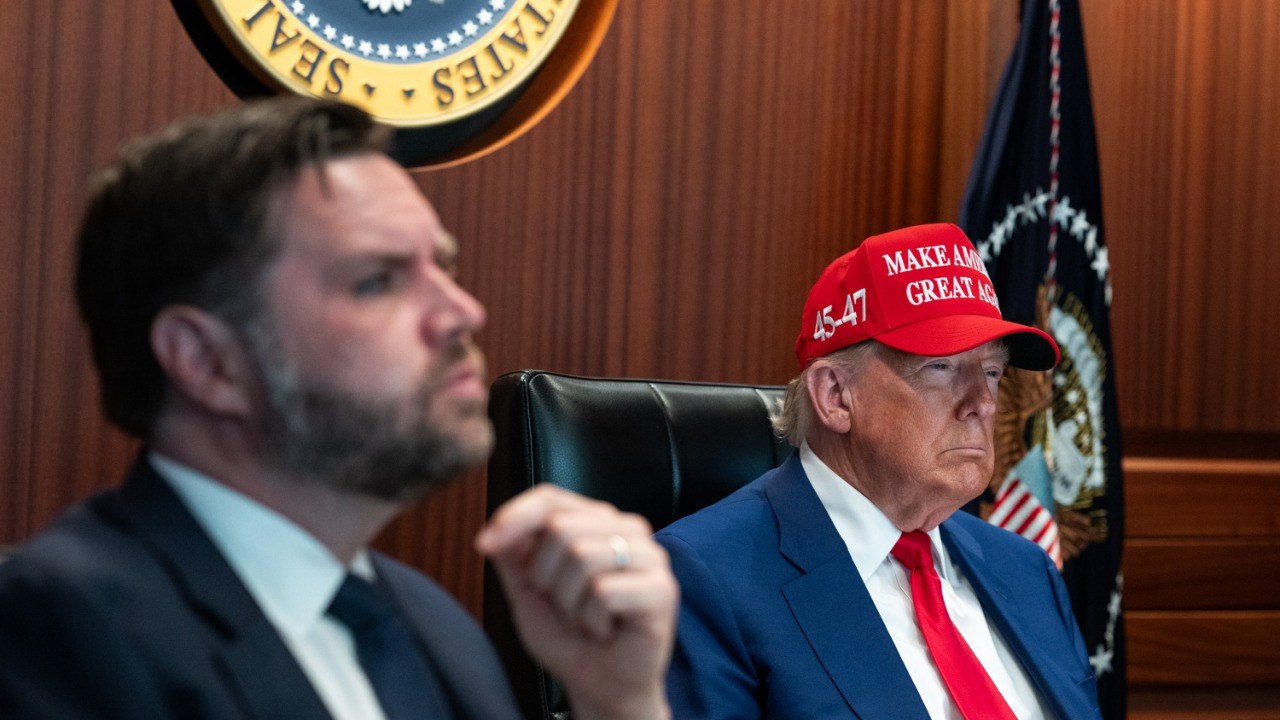
President Donald Trump has officially signaled a major shift by ordering Vice President J.D. Vance to stop all negotiations regarding Iran. This move marks a departure from the recent diplomatic efforts aimed at closing out the war that began in February when joint strikes from the U.S. and Israel targeted Iran. Instead, the president wants the vice president to dedicate his time to domestic issues.
According to The Guardian, in a post on Truth Social on Thursday, November 12, 2026, Trump laid out his reasoning for this pivot. He instructed Vance to focus his complete and total attention on the “Massive Corruption and Crime taking place in Democrat run Cities and States throughout the U.S.” The president did not hold back in his assessment of these areas. He said, “The Blue States, like Minnesota, California, Illinois, and many more, are all poorly run, corrupt disasters.”
Trump also noted that he believes the budget could be balanced by correcting large scale criminal activity. He went as far as to say that “Corruption is in the Democrat Leadership’s blood.” This directive effectively sidelines Vance from the primary foreign policy hurdle he had been managing. The vice president had been the face of these efforts for months, even leading a delegation to Islamabad in April to seek an end to the conflict.
Vance had reportedly been in communication with intermediaries in Qatar and Iran
There were rumors he was weighing another round of direct talks with a senior Iranian official. Despite these efforts, Trump seems to have lost interest in finding a diplomatic resolution. He made his stance clear in his post, writing, “We don’t need a deal with Iran. Those days have long since passed. We’ve got their money, Hundreds of Billions of Dollars, and we’ve got their Strait!”
This declaration suggests that the administration is comfortable with the current stalemate. The U.S. has maintained a blockade on Iranian ports, and while the Strait of Hormuz has mostly reopened to marine traffic, the situation remains tense. International tankers are often relying on U.S. Navy escorts to move crude oil through the waterway. Even with these measures, recent reports from the British military indicate that at least two tankers were struck by projectiles while navigating these contested waters earlier this week.
The conflict has also had significant political fallout at home. Following the midterm elections, Vance was quite vocal about how the war impacted Republican performance. In a post on X, he wrote, “If you’d like to argue it was worth it, that losing the Senate for the next 6 years was worth it, then do so.” He suggested that the economic reverberations of the war were a major factor in the party’s recent losses.
Trump, however, has doubled down on his choice to launch the war
He has acknowledged that the conflict drove up fuel prices, but he maintains that the action was necessary to prevent Iran from obtaining a nuclear weapon. While he has claimed that the war is effectively over from a military standpoint, he has not fully ruled out future strikes. According to the Associated Press, during an interview on The Hugh Hewitt Show on Thursday, Trump noted that he would not hesitate to restart military action if something does not work out.
There is also a complex international layer to these negotiations. Mohammad Bagher Qalibaf, the Iranian parliament speaker and chief negotiator, recently claimed that the United States asked Russian President Vladimir Putin to facilitate direct talks. Qalibaf mentioned that Iran holds Putin in high regard and that the secretary of the Supreme National Security Council had briefed the Russian leader on their position. The White House has not responded to these specific claims regarding Russia.
Meanwhile, the regional landscape remains precarious. A Saudi-led coalition is still fighting Iranian-backed Houthi rebels in Yemen, which complicates the transport of goods through the Bab el-Mandeb Strait. Secretary of State Marco Rubio recently attempted to get G7 counterparts in Paris to help increase protection for ships in the region, but he reported making no headway.
For now, the focus from the White House is clearly shifting toward the domestic front. By tasking Vance with investigating corruption and crime in Democrat-run areas, the president is signaling a new political strategy. This move comes as Democrats prepare to take control of Congress in January, with many promising to launch oversight efforts into the president’s business dealings.
Have a tip we should know? [email protected]
Follow The Mary Sue: