


Woman browses through sweaters on Abercrombie & Fitch website, then notices fabric disparities between men’s and women’s clothing
Her side of the story
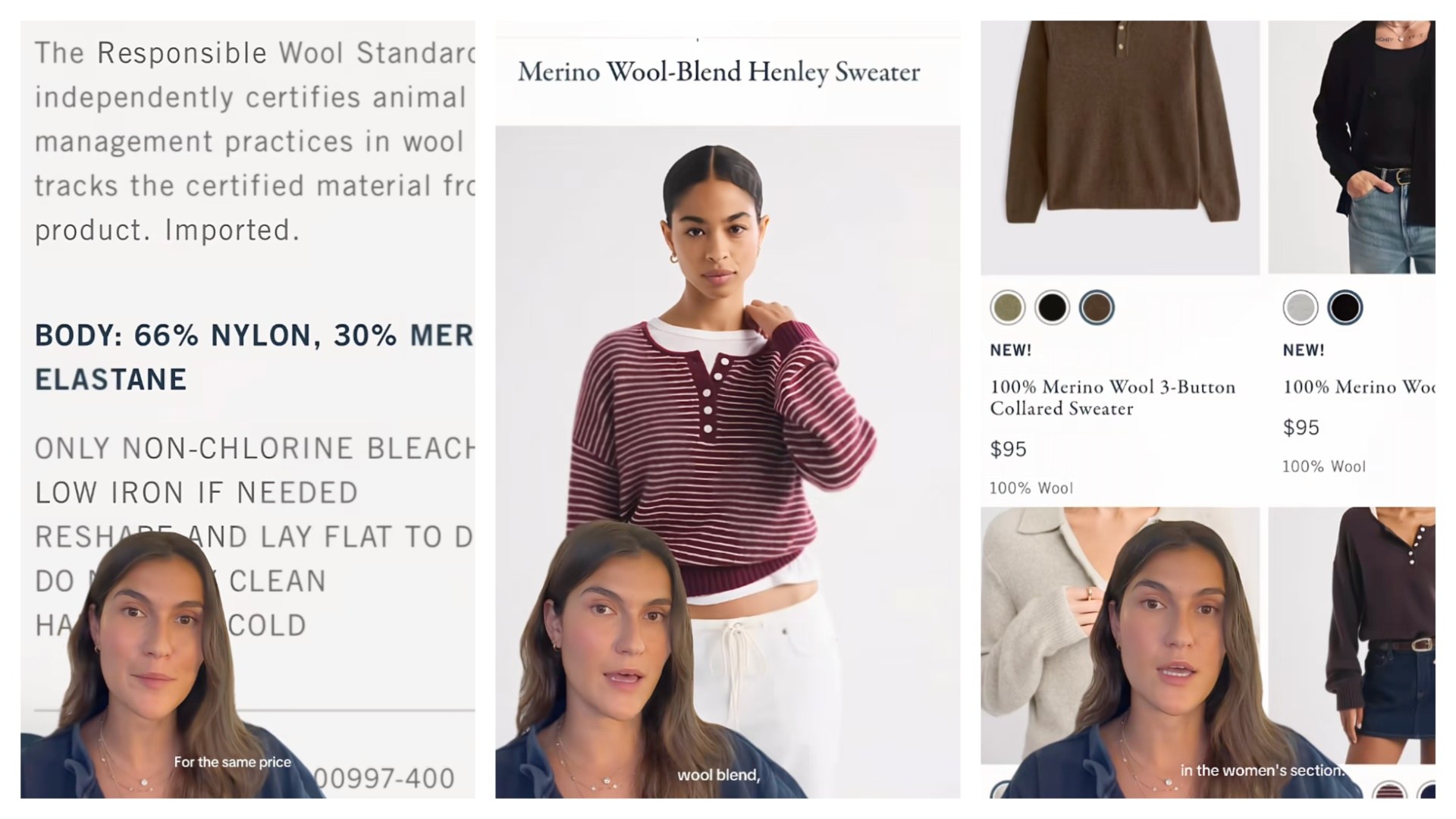
While browsing sweaters on Abercrombie and Fitch’s website, a woman noticed an unexpected difference between the men’s and women’s clothing: the fabrics used to make them. Rachael Brownfield (rsbrownfield) said in a TikTok video that she was already “disappointed” by the “misleading marketing” used to promote the specific range of products, but her observations made it “worse.” So what did Brownfield actually find?
While browsing Abercrombie & Fitch’s catalog, Brownfield noticed that the men’s merino wool sweaters were 100 percent merino wool, while the women’s were a “wool-blend” that was “mostly polyester” or nylon. A quick visit to the company’s page confirms Brownfield’s assertions.
Searching for “merino wool” in the men’s section brings up products described as “100% merino wool.” The same search in the women’s section, on the other hand, brings up products listed as “Merino wool blend” mostly made of 66% Nylon, 30% Merino wool, and 4% Elastane.
Raising questions about the disparity between the materials, Brownfield said, “So you guys made the fabrics? You made some of the fabrics and then decided, ‘no, no,’ we won’t make the women’s sweaters in this.” Brownfield made another notable observation: while the materials of the men’s and women’s clothing differed, they were priced the same.
Highlighting two products, one for men and one for women, she said, “They’re both $95. But for the women’s sweater, it’s a wool blend that’s actually mostly plastic. For the same price as a men’s 100% merino wool sweater.” She asked, “No, Abercrombie, why did you do this? Why? This is so weird. This is so weird that for the same exact price, just because it’s a man’s sweater or a woman’s sweater, it’s gonna be made with much worse materials.”
“This is good fashion journalism”
Brownfield’s video about Abercrombie & Fitch sweaters drew significant attention, garnering more than 2 million views. It also received thousands of likes, comments, shares, and saves.
Some commenters praised Brownfield for raising the issue. One person wrote, “This is good fashion journalism.” Another said, “This needs to have news coverage fr.”
A few people pointed to the same disparity Brownfield highlighted in other brands’ clothing. One person commented, “Skims does this too! Men get full cotton women get cotton polyester for the same hoodie in a different cut.” Another said, “Wait until you go to H&M and find 99.9% of women’s clothing is poly or acrylic for $39+. Then go to the men’s side and find lots of 100% cotton for like $19.99. It makes me livid.”
That said, some commenters noted that contrary to what Brownfield highlighted, Abercrombie & Fitch’s website did offer women’s clothing made from 100 percent merino wool, although we couldn’t independently verify that. One person wrote, “They have them for women. Just search it on the website.”
Another commenter pointed out, “Weird new layer to this story… I’m in Canada and my version is completely different! 1. I have a 100% merino wool section under women’s sweaters. 2. The exact same funnel neck sweater you showed is 25% wool here! I think it may be due to our marketing laws for “wool- blend.” Both individuals shared screenshots to support their claims.
In another video on her profile, Brownfield showed the impact her video had, sharing screenshots of people calling out the company over the apparent differences in how it makes men’s and women’s sweaters.
In a separate video, Brownfield alleged that within 24 hours of her criticism, Abercrombie & Fitch, which has received its share of online criticism in the past couple of years, put some sweaters, mostly women’ s styles, on sale for 30 percent off. While she welcomed the change, she stressed that price was only “part of the problem” and said the main issue was that, at “any price point, this is a garbage piece of clothing.”
She also raised concerns about textile waste and said the company should not make “new bad things” if the products are going to end up in landfills anyways.
Have a tip we should know? [email protected]
Follow The Mary Sue:
