Visitors walk through Art Zoo museum and realize they are the ones trapped behind bars while the animals roam free: ‘It was a little creepy’
A return to wonder.
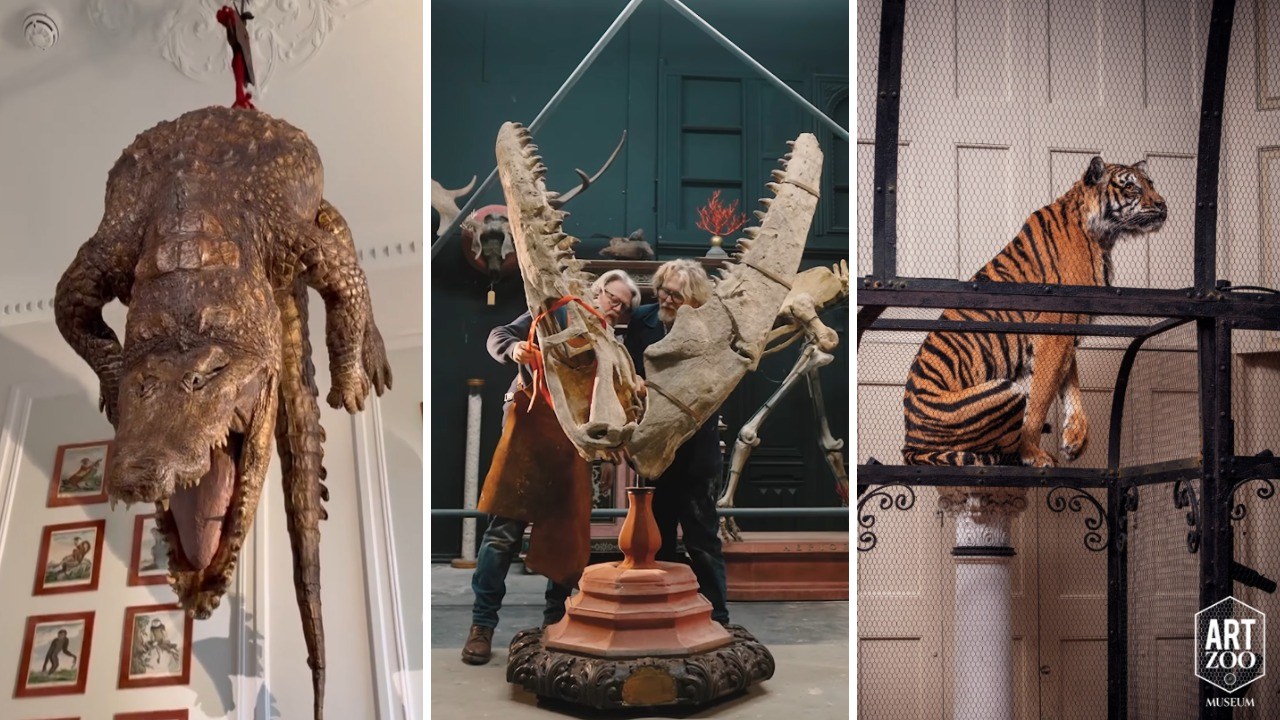
Visitors at the Art Zoo in Amsterdam are finding themselves in a strange position where they are the ones trapped behind bars while preserved animals appear to roam free. This unique setup flips the traditional museum experience on its head. As you walk through the space, you might feel a bit uneasy. That is exactly what the creators intended for their guests.
According to the New York Post, when you first step into the museum, a 12-foot crocodile greets you from above with its mouth wide open. This taxidermic reptile is just one of hundreds of specimens on display. Visitors also find piles of bones arranged with care, glowing tulips inside apothecary jars, and cabinets filled with unusual fish. While the vibe fits well with the spooky season, it is not actually a Halloween-themed exhibit.
Tomáš Vaško, a local resident, visited the museum and shared his reaction to the intense environment. “It was a little creepy,” admitted Vaško, a Slovak living in the Dutch capital. Art Zoo’s Instagram page offers a peek of the exhibits. The bio describes it as Amsterdam’s wildest museum, a 17th-century canal house full of wonders and an artistic ode to nature and the animal world.
The designs showcase how curiosity helps explore the natural world
The artists behind this project are Jaap Sinke and Ferry van Tongeren. They drew inspiration from wunderkammers. Wunderkammers were curiosity cabinets used by wealthy Europeans during the 16th and 17th centuries to show off objects from the natural world. Sinke and van Tongeren want to bring that sense of wonder back to life. They view their work as a form of storytelling.
“The main thing is that we like storytelling with the animals. We like to add drama. We add an attitude to the animals, where traditional taxidermists just want to mimic nature,” van Tongeren said, per The Associated Press.
This drama is obvious in how they pose their subjects. A cheetah sits in an alcove while a cassowary watches over it. In a typical natural history museum, animals are posed to look like they are living in the wild. Here, the artists take a different approach. You might see a Japanese giant spider crab with 6-foot legs stretching over a doorway. Right next to it, you will find the leg bones of a mastodon that seem to reach all the way to the ceiling.
The duo gained quite a bit of fame back in 2015
That was when artist Damien Hirst bought their entire collection from a London art show. Now, they are pushing the boundaries of how people view animal displays. The most striking part of the Art Zoo is the layout. Unlike a traditional zoo, the humans are the ones behind bars. The display rooms are inside a 17th-century canal house, and they are surrounded by heavy black metal cages.
“We really like the concept of having all the people in a cage and then all the animals free,” van Tongeren says. “In that way, the whole building becomes one artwork.”
It is important to note that none of the animals were taken from the wild for this collection. The creators are careful about where they get their specimens. “All our animals come from zoos where they died of natural causes,” said Sinke. He noted that the paperwork is often difficult to manage. To keep things clear, they focus on getting animals from Europe. This helps them stay informed about the history of each creature.
The two artists actually consider themselves part of a trio. They include naturalist Charles Darwin as a key contributor to their vision. They describe their museum as a return to the wonder that Darwin once felt. To honor him, they included a wall display featuring a series of Darwin busts turned sideways. There is a sense of irony in celebrating Darwin inside a building that once served as the Biblical Museum.
Not every item on display is a real animal
Below the large crocodile, you will find a collection of Jenny Hanivers. These are ray carcasses that 16th-century sailors modified to look like monsters. They would show these creatures to collectors as if they were real sea beasts. These strange, misshapen faces watch you as you move between the caged rooms. It is a haunting detail that adds to the overall experience.
The Art Zoo feels like a departure from what most people expect when they visit a museum. By trapping the visitors in cages, the artists force us to think about our relationship with the natural world. The exhibits offer a look at taxidermy that goes beyond standard preservation. It is about creating a narrative, adding drama, and making visitors feel like a guest in a world where the animals have taken over.
Have a tip we should know? [email protected]
Follow The Mary Sue: