


Texas Classrooms Turn Battlegrounds for a High-Stakes Supreme Court Showdown Over the Ten Commandments
Seeding indoctrination?
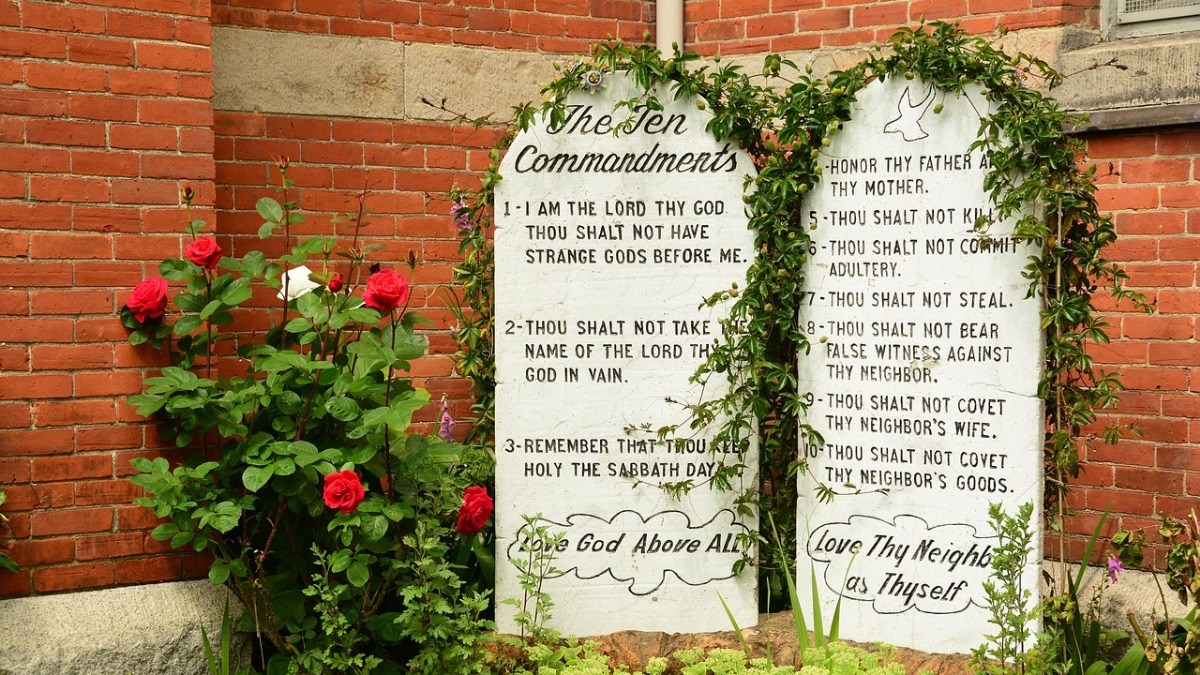
Texas classrooms are at the center of a legal firestorm that could reshape how religion and public education intersect across the country. On August 17, 2026, civil rights advocates asked the U.S. Supreme Court to review a Texas law that mandates the display of the Ten Commandments in public school classrooms. The move sets the stage for a high-stakes showdown over whether state-sponsored religious expression violates the First Amendment’s establishment clause.
According to AP News, the law, signed by Republican Gov. Greg Abbott last September, requires schools to hang posters of the Ten Commandments if they’re donated. Since then, conservative groups and individuals have flooded Texas campuses with thousands of the displays. The state educates about 5.5 million students, meaning the posters are now a daily presence for nearly every child in Texas public schools.
An appeals court earlier this year upheld the law in a narrow 9-8 decision, reversing lower court rulings that had blocked some districts from putting up the posters. The court’s opinion argued that students aren’t forced to recite or believe in the commandments, framing the displays as passive rather than coercive.
But opponents say the law crosses a constitutional line
Over two dozen Texas families, represented by the American Civil Liberties Union (ACLU) and other groups, are now asking the Supreme Court to intervene. Heather Weaver, an ACLU attorney, called the case one of “nationwide importance” because similar laws have already passed in Louisiana, Arkansas, and Alabama, with more states considering them.
“We would like for the Supreme Court to make clear that singling out Scripture for display in public schools is a violation of the First Amendment,” Weaver said. The families’ legal brief argues that the law forces impressionable children to confront religious doctrine for nearly every hour of every school day, sometimes for up to 13 years.
“The question of whether a state may impose scripture on captive-audience children implicates the most fundamental guarantees of the First Amendment and our Nation’s highest ideals,” their attorneys wrote. The legal battle isn’t just about Texas. It’s the latest front in a broader push to integrate religion into public education, a movement driven in large part by David Barton, a self-styled historian and political activist.
According to The Wall Street Journal, Barton, a former math and science teacher with no formal training in history, has spent decades amassing a private collection of founding-era documents and artifacts, which he uses to argue that America was founded as a Christian nation. His nonprofit, WallBuilders, has become a key player in crafting legislation and shaping school curricula across the country.
Barton’s influence is particularly strong in Texas
He helped draft the Ten Commandments law and has been appointed to advise the state Board of Education on social studies standards. His approach is controversial. Historians and academics accuse him of cherry-picking quotes and distorting history to fit a conservative agenda.
Mark A. Chancey, a religious studies professor at Southern Methodist University, dismissed Barton’s expertise, saying, “He is a very accomplished collector. But that does not make one an expert, a scholar, or historian, no more than collecting stamps would make me a postal worker.”
John Fea, a history department chair at Messiah University, said: “For Barton, the past is instrumentalized for the present. He needs a certain kind of past because he needs the Founding Fathers on his side to advance his political agenda.”
Despite the criticism, Barton’s reach is undeniable. He and his nonprofit have helped facilitate Ten Commandments legislation in more than a dozen states, often providing lawmakers with historical “evidence” from his personal archive. In Texas, state Sen. Phil King worked directly with WallBuilders to draft the bill, which initially failed in the House before passing in a later session.
At a WallBuilders legislative conference, King urged attendees from other states to pick up the effort. “I hope some of y’all are able to pass it this year and beat us,” he said.
The strategy worked
In 2024, Louisiana became the first state to enact a Ten Commandments law since the Supreme Court struck down a similar Kentucky statute in 1980. By 2025, at least four states had passed such laws, with nearly identical language appearing in bills across the country.
Barton advises hundreds of state lawmakers, consults with the White House on historical exhibits, and has helped shape social studies curricula for Texas’ massive public school system. A memo he wrote this year, reviewed by the Wall Street Journal, pushed for third-grade lessons on “Moses, Hebrew slavery, the Exodus, and the Promised Land.” Much of his input made it into the final standards.
His allies include high-profile figures like House Speaker Mike Johnson, who has called Barton’s work “profoundly influential” on his own career. “I was introduced to David and his ministry a quarter-century ago, and it has had such a profound influence on me and my work and my life and everything I do,” Johnson said in 2021.
The legal fight over the Ten Commandments is gathering steam
The Supreme Court’s decision to take up or decline the case could have sweeping implications for how religion is treated in public spaces. In 1980, the court ruled that a Kentucky law requiring Ten Commandments displays in classrooms violated the establishment clause because it served no secular purpose.
But the current court, with its conservative majority, has shown a willingness to revisit long-standing precedents on religion and government. If the justices side with Texas, it could open the door for even more state-sponsored religious expression in schools, from prayer to curriculum changes.
For now, the posters remain on Texas classroom walls, a daily reminder of the battle over who gets to define America’s identity. The families challenging the law argue that the displays send a message to non-Christian students that they don’t fully belong.
(Featured image: 1931526 on Pixabay)
Have a tip we should know? [email protected]
Follow The Mary Sue:
