


NASA Just Named the Artemis III Crew, but They Are Ditching the Moon Landing for a Risky High-Stakes Rehearsal in Orbit
Clearing the way.
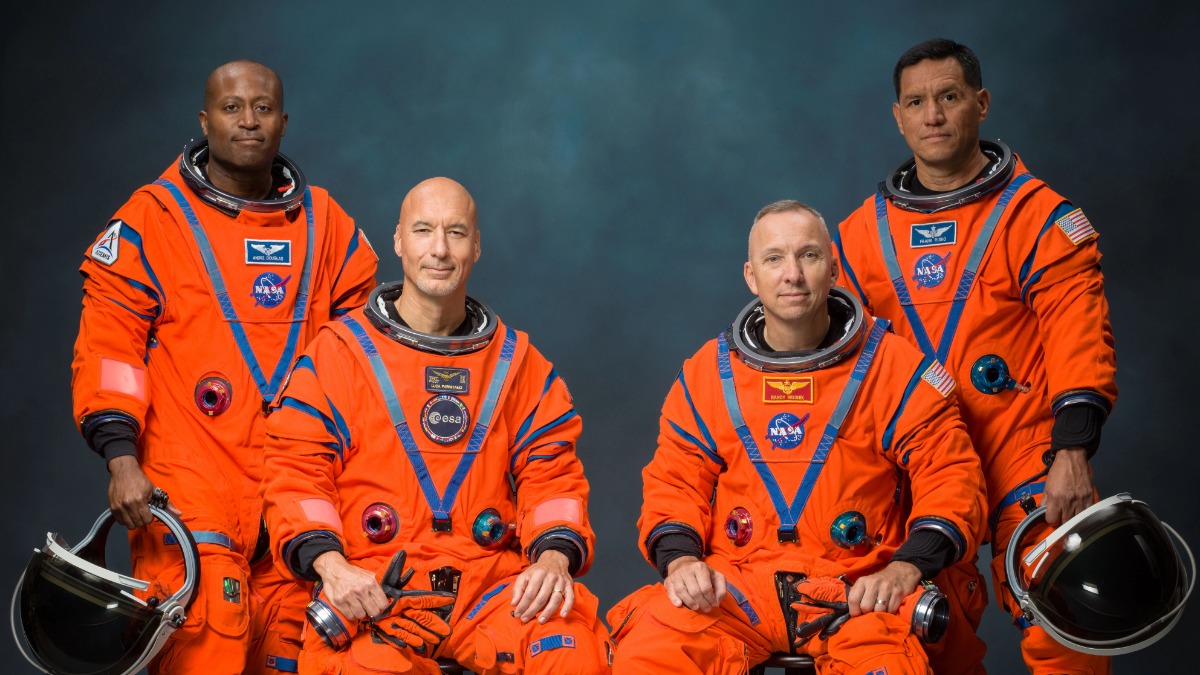
NASA just named the four astronauts flying Artemis III in 2027, but the mission has been completely reworked. Instead of landing on the moon, the crew will stay in low Earth orbit to test prototype lunar landers and new spacesuits in a high-stakes rehearsal for the real landing coming in 2028.
The Artemis III crew includes commander Randy Bresnik, pilot Luca Parmitano, and mission specialists Andre Douglas and Frank Rubio, according to the BBC. They’ll launch on NASA’s Space Launch System rocket from Kennedy Space Center, riding inside the Orion capsule that just flew during the Artemis II mission in April 2026.
This time, Orion won’t loop around the Moon. It’ll stay in low Earth orbit, about 290 miles up, where it’ll dock with prototype lunar landers called pathfinders. At least one astronaut will climb inside to test hatches, life-support connections, and the new Axiom spacesuits designed by Prada.
Those spacesuits are a big deal
Axiom Space handled the engineering of the suits, including a backup cooling loop in case the primary fails. Prada designed the inner garment that circulates chilled water across the body during the eight-hour Moonwalks planned for Artemis IV. The crew will spend a slightly longer time in Orion than the nine days of Artemis II, and their return will test an upgraded heat shield during re-entry.
NASA changed the mission in February 2026 because SpaceX’s Starship lander isn’t ready, and its in-orbit refuelling has never been demonstrated. Rather than delay further, NASA turned Artemis III into a docking rehearsal to make sure the techniques and suits are tested with people on board.
The crew is stacked with experience. Randy Bresnik is a former Marine Corps test pilot and Topgun graduate with over 32 hours of spacewalk time. He commanded the ISS in 2017. Luca Parmitano, an ESA astronaut since 2009, is a test pilot with experience on 40 aircraft types and has also commanded the ISS.
Andre Douglas, selected by NASA in 2021, is a former US Coast Guard officer specializing in robotics and planetary defense. Frank Rubio set the record for the longest single US spaceflight in 2023, spending 371 days in orbit. Bob Heintz, a test pilot with 170 days in space, is the backup who can step into any role.
Artemis IV and V will land on the moon
Artemis IV, now targeted for 2028, is set to be the first crewed lunar landing since 1972. Astronauts will descend to the Moon’s south polar region, where frozen water in shadowed craters could be used for drinking water, oxygen, and rocket fuel.
Artemis V, also in 2028, will carry a second crew to the surface using Blue Origin’s Blue Moon Mk2 lander. The long-term goal is a Moon base, with robotic landers and drones surveying the south pole before 2029, repeated crewed missions expanding the site, and semi-permanent habitats by the mid-2030s.
The Moon base would allow sustained research, test tech for Mars missions, and extract lunar resources. It’s also about staying ahead of China in the new space race. But experts doubt NASA’s timeline. SpaceX’s Starship lander is moving slowly, and in-orbit refuelling hasn’t been tested. The first demo is optimistically scheduled for late 2026.
The biggest setback came on May 28, 2026, when Blue Origin’s only launch pad at Cape Canaveral was destroyed after a rocket exploded during an engine test. Rebuilding could take months, and Blue Origin has no backup pad, putting Artemis V’s lander in question.
Artemis II was the first crewed mission beyond low Earth orbit since 1972
Artemis II, which flew in April 2026, was the first crewed mission beyond low Earth orbit since 1972. Over ten days, Orion looped around the Moon, coming within 4,000 miles of the surface and reaching 252,756 miles from Earth. The crew tested life-support and communication systems, and engineers got their first look at how the heat shield performs on a lunar return. It was proof that the hardware works with people on board.
The last Moon landing was Apollo 17 in December 1972. Astronauts Eugene Cernan and Harrison Schmitt spent three days on the surface, and no human has been back since. Only 24 Americans have traveled to the Moon so far, and just 12 have walked on it. The Apollo program was driven by Cold War competition with the Soviet Union, but once the U.S. won, funding and public interest faded. Now, the race is back on, but this time, China is the main competitor.
China plans to land astronauts by 2030 testing its Mengzhou capsule and Lanyue lander while developing the Long March 10 rocket. India aims for a crewed landing around 2040 after its Chandrayaan-3 mission successfully touched down near the south pole in 2023.
Russia is part of a China-led lunar base project, but sanctions and funding issues make its role uncertain. European and Japanese astronauts may fly on future Artemis missions, though there’s no guarantee of an international seat on Artemis III.
The biggest hurdle for NASA is the lander. Dr. Simeon Barber from the Open University said that the lander is the most challenging piece of the mission and the one least under NASA’s control. If delays keep piling up, China could beat the U.S. back to the Moon. For now, Artemis III is a critical step, even if it’s not the landing everyone expected.
(Featured image: Bill Stafford)
Have a tip we should know? [email protected]
Follow The Mary Sue:
