


Machine Gun Kelly’s Erratic Blackout Ink Is Making a Statement, but Experts Say It’s Also Raising Questions About a Clinical Red Flag
Proceed with caution.
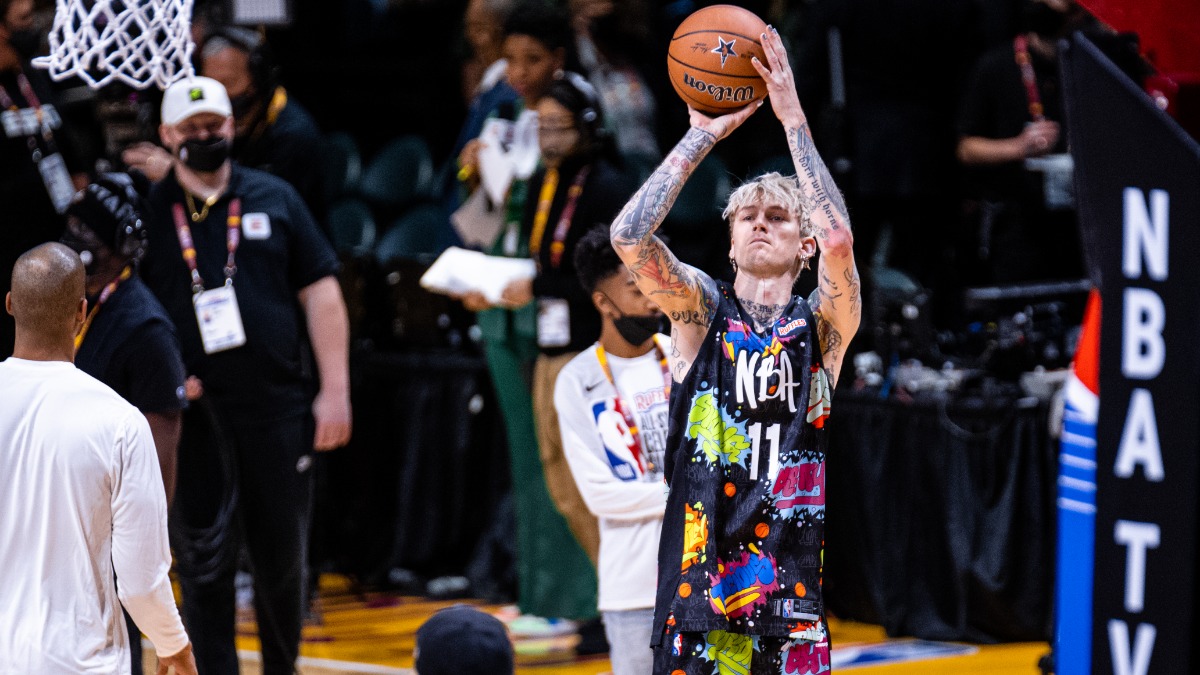
Machine Gun Kelly’s latest transformation is impossible to ignore. The musician, now going by ‘mgk’, has covered nearly every inch of his arms, chest, and stomach in a dense, opaque blackout tattoo, sparking a wave of fascination, and concern, across social media. While the “dark mode” look is undeniably striking, experts are urging fans to pause before rushing to the tattoo shop. It isn’t just about aesthetics, they say. It’s also a clinical red flag worth examining.
Blackout tattoos, also called “dark mode” ink, aren’t your average tattoo. According to UNILAD, unlike traditional blackwork or gothic designs, which use black ink for intricate patterns or imagery, a true blackout piece involves saturating large sections of skin in solid, unbroken black. The result is a bold, almost abstract statement – one that some use as a dramatic cover-up for old tattoos, while others see it as a form of spiritual or visual rebirth. For mgk, it was both.
The musician has been vocal about feeling like a stranger in his own skin, his body a patchwork of memories he no longer wanted to carry. “I saw death and drugs in all these patterns that I was literally writing on my body,” he told Billboard Canada. “It was like my bipolarity was screaming off my skin.”
Experts make a case for being cautious
Dr. Caitlin Artiaga, PhD, LMFT, Clinical Director at Blume Behavioral Health, warns that the impulse behind such a drastic change deserves serious reflection. “Take a moment to think about why you’re changing,” she advises. “This isn’t a challenge but a direct invitation to clarify your current purpose by understanding what motivates you to do this.” Her concern isn’t about the tattoo itself, but the mindset driving it.
When transformation is rooted in a desire to escape rather than evolve, she explains, no amount of ink will bring the relief people are seeking. “When transformation is driven from the outside, there is never a timeline that will feel quick enough, nor will there ever be an ending experience that provides you with the relief you are looking for.”
For mgk, the decision was deeply personal. After years of navigating grief, sobriety, and the pressures of fame, he reached a breaking point. His body was a canvas of contradictions – happy tattoos, sad tattoos, holy tattoos, hellish tattoos – and he no longer recognized himself in the mirror. The blackout wasn’t just about covering up the past; it was about reclaiming control.
“I was looking for a change that wasn’t just a sound wave,” he said. “It had to be something physical.” But the process was far from easy. Celebrity tattoo artist ROXX warned him that a piece of this scale would take years to complete safely. He had two months.
The result was a grueling, two-month marathon of daily sessions
By the end, his skin was yellowing, his lymph nodes swollen, and parts of his upper body nearly immobile. “After the first week, we hit my lymph nodes around my armpits and shoulders, and I got really sick,” he recalled. Yet, he pushed through, viewing the pain as both a physical and metaphorical hurdle. When it was over, he emerged with a new sense of clarity and a body that finally matched the person he felt he’d become.
But experts caution that mgk’s experience isn’t the norm. Blackout tattoos require deep, repeated needle passes, making them significantly more painful than traditional ink. Healing is intense, often requiring months or even years of spaced-out sessions to avoid scarring. Removal is another story entirely. Laser treatments are expensive, rarely fully effective, and can take years to complete.
Dr. Artiaga’s advice is simple: “The person who is warning you to slow down and think about what you want before you start is not your adversary. They are your ally.”
For mgk, the tattoo was just one part of a larger reinvention
Over the past decade, he’s cycled through genres – pop-punk, nu-metal, country – each shift reflecting a new chapter in his life. His 2020 album Tickets To My Downfall topped charts in both the U.S. and Canada, fueling a pop-punk revival. But behind the scenes, he was grappling with the death of his father, bipolar disorder, and substance struggles. By 2023, he was in rehab, and by the time he started his tattoo, he was expecting his second child, Saga Blade, with Megan Fox.
His latest project, Blog Era Boyz, a collaborative mixtape with Wiz Khalifa, marks a return to his hip-hop roots. The tape is a love letter to the 2010s blog era, a time when mixtapes and underground buzz held more weight than streaming numbers. “There was no stakes,” he said. “We were just making music ’cause we liked making it.” The project was a $1 million gamble, funded by slashing his next album’s budget.
But for mgk, it was worth it. It wasn’t just about the music; it was about reclaiming a piece of himself. That same impulse drove his tattoo. The blackout wasn’t just ink – it was a cathartic reset. A way to shed the chaos of the past and step into a future he could recognize.
But as experts point out, not everyone who seeks that kind of transformation is doing it from a place of clarity. Dr. Artiaga’s question lingers: Why are you changing? The answer, she says, is just as important as the tattoo itself.
(Featured image: Erik Drost)
Have a tip we should know? [email protected]
Follow The Mary Sue:
