


Driver Pulls Over After Spotting Giant Barrel-Shaped Devices ‘Staring’ at Them on Arizona Road: ‘Explain to Me and There’s a Cable’
Confused and concerned.
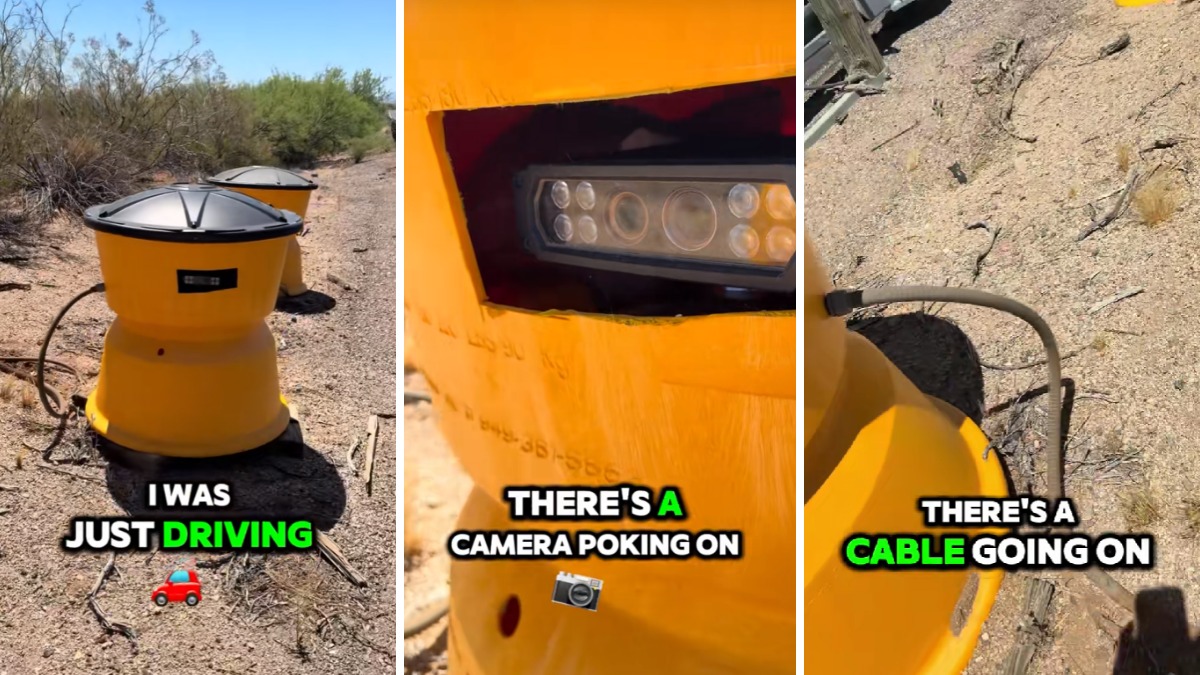
An Arizona driver pulled over after spotting giant barrel-shaped devices with cables and cameras staring at them from the roadside. The viral TikTok video from user @dadsgonelive shows the creator questioning the purpose of the suspicious-looking devices, which appear to be Flock Safety cameras or similar automated license plate readers.
The video starts with the driver noticing the unusual setup while cruising down an Arizona road. “Explain to me what this is,” he says, pointing the camera at the yellow, cylindrical structure. “I was just driving, and I noticed this camera staring at me. There’s a camera poking on both sides. You’re not slick. What is this, Arizona? Explain to me. And there’s a cable going to the backside, runs up here and just goes off in the distance.”
While the exact nature of the devices wasn’t confirmed in the video, comments quickly pointed to Flock Safety cameras. These automated license plate readers, or ALPRs, are designed to capture license plates, vehicle details, and sometimes even images for law enforcement use. They’re often mounted on poles or hidden in discreet setups, and they’ve sparked major privacy debates in Arizona and across the country.
The roadside surveillance is a cause for concern
Flock cameras are particularly controversial because they enable mass vehicle tracking without warrants in many cases, a practice that’s drawn public pushback similar to the skepticism in the TikTok video. The concerns aren’t just theoretical. A recent incident in Minnesota highlights the real-world consequences of these systems.
According to FOX 9, automotive journalist Joel Feder found himself surrounded by four police cars with lights and sirens blaring after a Flock camera misread his license plate. The system flagged his Range Rover as stolen due to a data entry error, where his plate, 3410 DTM, was misread as 34 DTM. Officers approached with hands on their holsters, though they never drew their weapons, and Feder was able to prove the car wasn’t stolen.
The mix-up stemmed from a similar plate reported missing in Los Angeles, with the numbers entered incorrectly into the national database. Flock Safety cameras scan an astonishing 20 billion vehicles every month, with a reported accuracy rate of 93%.
That still leaves room for errors, though
With 1.4 billion potential misreads or false alerts monthly, the system can lead to unnecessary police stops. Flock responded to the Minnesota incident by emphasizing that alerts should be treated as investigative leads, not definitive proof. “An alert should be one part of an investigation, not the whole basis for a stop,” the company said.
“We consistently advise law enforcement agencies that alerts should be treated as investigative leads, and that officers should independently verify the license plate, vehicle details, and surrounding circumstances before taking any enforcement action.” The broader implications of these surveillance tools are hard to ignore.
Flock cameras are part of a growing network of automated license plate readers used by law enforcement to detect stolen vehicles, wanted suspects, or other flagged plates. But the technology has faced criticism for enabling warrantless tracking and potential misuse.
Recently, a Milwaukee police detective was accused of misusing Flock data to track two innocent people. The ACLU has been vocal about the risks, noting that even small errors can have serious consequences. John Boehler, policy counsel for the ACLU of Minnesota, pointed out that Joel Feder was lucky. “He’s lucky that the stop only involved their hands on the guns and no drawn guns,” Boehler said.
More cons than pros?
Minnesota law restricts the use of automated license plate readers to emergencies, known as exigent circumstances, unless a warrant is obtained. “That would be an unlawful use to track an individual without a warrant,” Boehler added. “The growing use of these technologies and their growing ability should concern people because, as Joel learned, whether or not you’re doing something wrong doesn’t stop you from being stopped through these technologies.”
Feder himself noted that the same misread plate alert had triggered stops for other cars with similar dealer plates in Minnesota. “We’ve got a confluence of issues of human error; it happens, humans make errors, it got amplified by a nationwide surveillance system,” he said.
The pushback against Flock cameras isn’t limited to Minnesota. Last month, the City of Columbia Heights voted to remove all of its Flock cameras due to resident concerns over privacy and the potential for misuse. It’s a sign that public unease about these systems is growing, especially as more people become aware of how they can go wrong.
The TikTok video from Arizona is just one example of how everyday drivers are questioning the presence of these devices on their roads. Whether it’s a Flock camera or another type of ALPR, the debate over surveillance, privacy, and accountability isn’t going away anytime soon.
(Featured images: @dadsgonelive on TikTok)
Have a tip we should know? [email protected]
Follow The Mary Sue:
