


Couple Stopped at Walmart’s Hispanic Heritage Month Display. Then One Troubling Detail Caught Their Attention: ‘How This Even Got Approved’
Beauty has always been political.
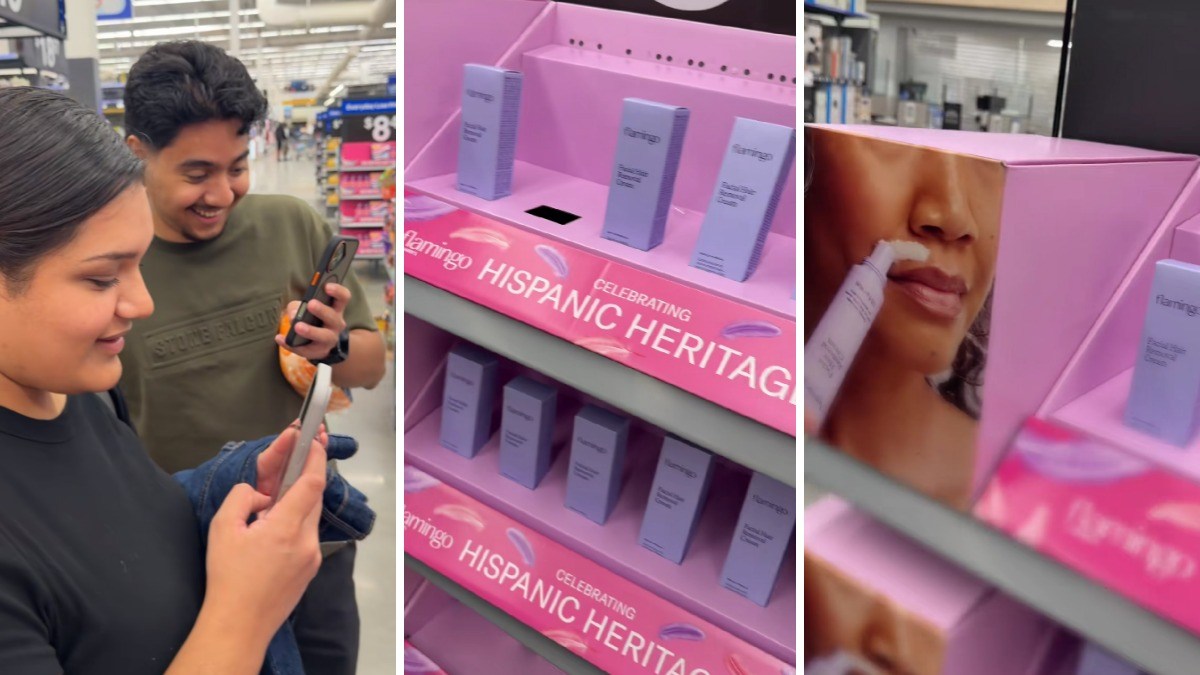
A video by Maria Delmoral, @maria.delmoral_ on TikTok, is making waves after she and her partner stumbled upon a display at a Walmart that was supposedly intended to honor Hispanic Heritage Month. Instead of a celebration, they found a product placement that felt incredibly out of touch: a hair removal cream specifically marketed for the upper lip.
The video, which has racked up over 4.1 million views, 625k likes, and thousands of comments, captures the couple looking at the display with clear disbelief. As Delmoral highlights the product’s position in the Hispanic heritage display, the video raises a glaring question about corporate oversight: how did this branding ever make it through the approval process?
The clip also features an audio track containing the frustrated reaction, “Oh, my God, bro. Oh, hell no, man. What the f—, man? Get your a— on my…”. It highlights a marketing strategy that seems to rely on the tired, harmful stereotype that Hispanic women naturally possess excess facial hair that needs to be managed.
Viewers were quick to point out the irony
It’s crazy that Walmart and hair removal brand Flamingo was using a month meant for cultural pride to sell a product framed around fixing a perceived ethnic trait. Hispanic Heritage month is often celebrated from September 15 to October 15 every year. One user, Jazlosa, summed up the frustration of many, stating, “My black a– shocked at this & wondering how this even got approved & yal in the comments playing ?”
The incident at Walmart isn’t happening in a vacuum. It fits into a broader, more troubling pattern where retail giants attempt to monetize cultural months without actually understanding the communities they claim to represent. When retailers create themed displays to signal inclusion, they often end up reinforcing the very beauty standards that have marginalized women of color for decades.
By positioning a hair removal product in a space dedicated to Hispanic heritage, the store essentially sent a message that Hispanic women need to alter their natural features to fit into a mainstream, Western ideal of beauty. This extremely harmful stereotype has been normalized in beauty industry discourse for years.
This disconnect is something many people are feeling across the industry
An opinion piece in Allure on October 10, 2025, highlighted how the conversation around Hispanic representation in beauty is increasingly tense. Writer Sofía Viera said that while Latinas represent a massive demographic with an estimated buying power of $2.4 trillion, many feel that the industry is becoming more hesitant to celebrate them.
Viera added that the current political climate, including the administration’s focus on rolling back Diversity, Equity, and Inclusion (DEI) initiatives, has clearly impacted how major retailers approach these topics. Companies like Walmart, Target, and Amazon have notably pulled back on their DEI commitments, leaving many to wonder if their heritage month displays are becoming little more than hollow, tone-deaf gestures.
The reality is that beauty is political, and for the Latine community, the lack of genuine representation is hitting home. In recent years, we have seen mainstream beauty trends—like the slicked-back bun or specific lip-liner looks – appropriated from Black and Latine cultures, rebranded, and then sold back to the public as new “clean girl” aesthetics.
When these trends are stripped of their cultural roots, it leaves the community feeling ignored and commodified. As one user aptly noted under Delmoral’s viral video, “Flamingo is hurting feelings while solving problems.” Another commenter, Clara, put it bluntly: “Just because they ain’t wrong don’t make it right.”
The effects are far-reaching
The frustration is compounded by the fact that Latine-owned brands are struggling more than ever to secure the funding and support they need. This even happens during their own heritage month.
Viera says founders of brands like Ceremonia, Maed Beauty, and La Voûte have recently spoken about the difficulty of securing sponsors for their campaigns, often having to pay for them out of their own pockets. It is a stark contrast to the massive, well-funded marketing campaigns of larger corporations that seem to miss the mark entirely.
As Hispanic Heritage Month approaches, this viral moment serves as a reminder of why community accountability matters. Shoppers are no longer just passive consumers; they are documenting these retail decisions in real time and calling out the internal processes that lead to such exclusionary branding.
It is not enough for a corporation to put up a display and call it a celebration. If the industry wants to stop the cycle of stereotyping, it needs to start listening to the communities it claims to serve.
Until retailers prioritize authentic representation over outdated tropes, we can expect to see more of these “accountability moments” popping up on our feeds. It is time for brands to move past the superficial and start proving they actually value the people behind the buying power.
(Featured images: Maria Delmoral @maria.delmoral_ on TikTok)
Have a tip we should know? [email protected]
Follow The Mary Sue:
