


Clothes Ruined by Moths? This Woman’s Solution Is Releasing 10,000 Parasitoid Wasps in Her Closet
It might sound crazy, but it can work.
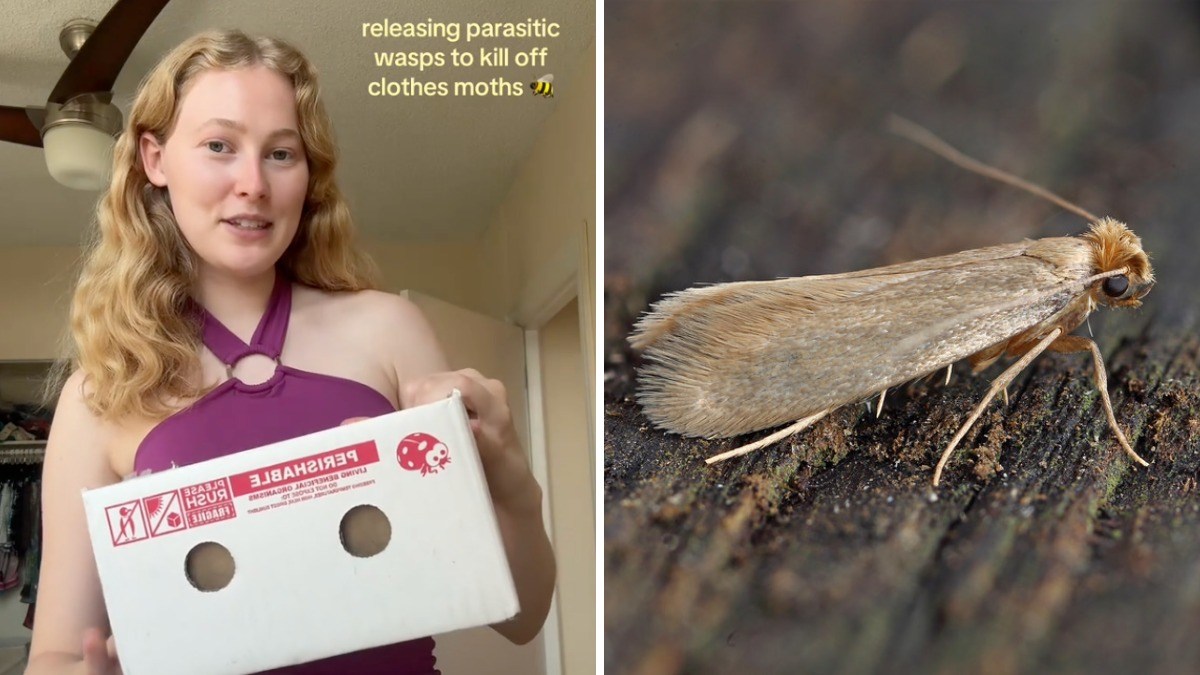
With the price tag attached to clothes these days, it can be aggravating to find holes in cherished items when looking through your closet. That was the case for Julia (@julesisthrifty) when she found her vintage Taylor Swift dress sporting holes after allegedly being eaten by common clothes moths. Her solution, though? Unleashing parasitoid wasps.
“Today I’m going to be releasing 10,000 parasitic wasps into my closet,” Julia said in a video shared on TikTok, although it can’t be independently verified whether the number is accurate. According to Julia, she decided to use parasitoid wasps after viewers suggested she try the method, and while it sounded a “little scary” to her at first, she said she was “super excited” to try the method.
Based on Julia’s research, the parasitoid wasp eggs she bought will hatch slowly and lay their own eggs inside moth eggs, which supposedly “kills off the moths.” She added that the wasps are expected to “die off a couple of weeks” after hatching, once they can no longer find food, which are the moths in this case.
Mothballs are chemically harmful
In the video, Julia can be seen placing the wasp eggs, which she described as looking like “poppy seeds” because of how small they are, in her closet and drawers where she believed the moths resided. As it could take a while for the eggs to hatch, Julia said she would give viewers an update if the solution worked: “I will keep you guys posted on how the wasps do. Fingers crossed.”
Viewers were left confused by Julia’s choice to combat insects with insects, leading them to question the logistics. “i’m so confused…. lol are they going to be flying around your room? how do you get rid of them?” a viewer wrote. Another added, “so what are u gonna bring after to get rid of the wasps.”
Some outright denied her method, saying, “I would literally rather k*** myself than release wasp eggs into my wardrobe.” Others simply asked, “Moth balls weren’t an option?”
While mothballs are a surefire way to kill clothes moths due to their high concentrations of chemical pesticides, the product has a few potential drawbacks. As mothballs vaporize, their fumes can stick to clothing and linger in areas, to the extent that you may need to wash the clothes to remove the smell.
The chemical pesticides found in mothballs can also add to air pollution and contaminate plants and water, according to the National Pesticide Information Center (NPIC). Likewise, mothballs are also harmful to animals. In a separate incident, a woman claimed her neighbor deliberately tried to poison dogs when she found mothballs scattered along her street. So if Julia has any pets, it’s better for her to steer clear of these.
Parasitoid wasps for pest control are said to be revolutionary
Others tried to ease viewers’ worries over using parasitoid wasps. “These ‘wasps’ aren’t the kind you’re thinking of; they are really tiny!! And reproduce asexually with no nest. They literally only live to hijack moth eggs for thier own eggs,” a viewer wrote.
Now, the question is: do parasitoid wasps even work? It’s important to note that these are not the same wasps you would commonly encounter outdoors. According to The Guardian, parasitoid wasps are a sustainable alternative to toxic insecticides and are less than 0.5mm in size, making them difficult to spot.
Julia is correct that this type of wasp prevents moth eggs from hatching by parasitizing them and laying its own eggs inside the moth eggs. Reportedly, this type of pest control is a preferred method to maintain priceless artifacts and textile works in museums and heritage sites from moth infestations. Rentokil’s Paul Blackhurst said parasitoid wasps are a “revolutionary non-toxic solution” that can also effectively eliminate clothing moth infestations without causing damage to delicate items.
Yes, the wasps die on their own too, so you don’t have to worry about killing them. A parasitoid wasp’s life cycle is dependent on the moth eggs they find, so they will continuously provide protection against infestations until there are no more eggs for them to consume, which can take up to several weeks. All in all, it seemed like Julia found a possibly successful method.
Have a tip we should know? [email protected]
Follow The Mary Sue:
