


Black Woman Claims Hospital Staff Turned on Her After She Reported a Receptionist for Allegedly Dismissing Her: ‘You Screamed at Me’
The persistent problem of racial discrimination in hospitals.
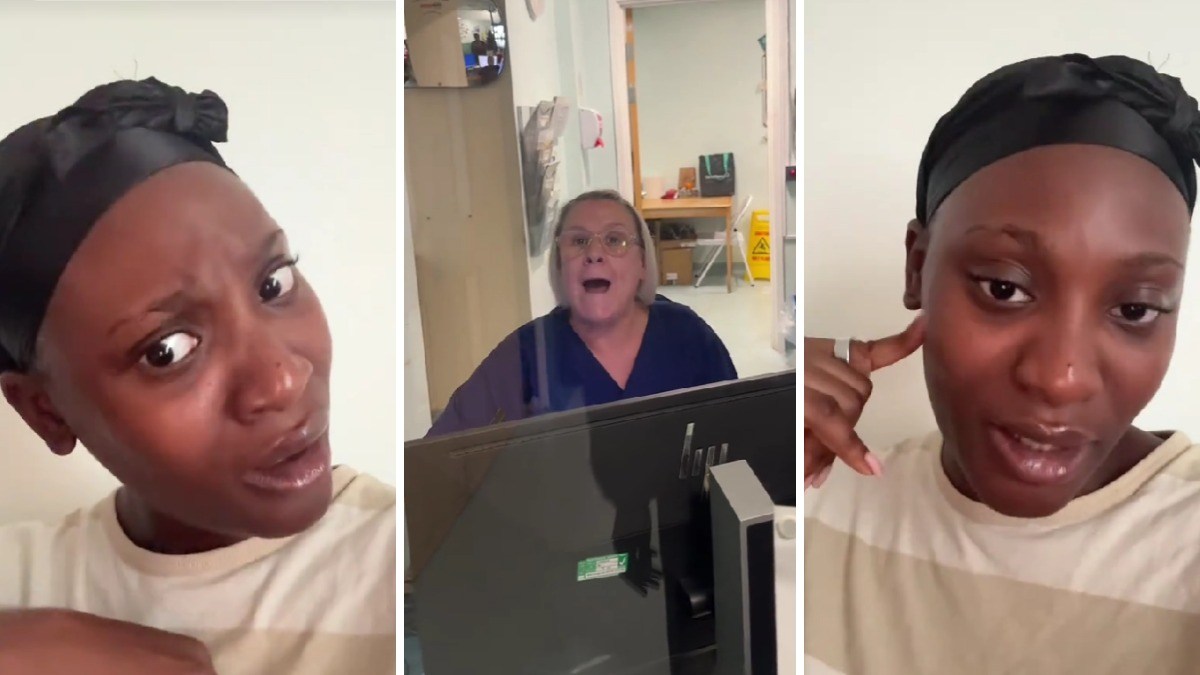
Imagine walking into a hospital seeking urgent help, only to be met with hostility instead of care. A recent viral incident involving Tolu, a Black woman who goes by @tolu.mx on TikTok, has brought this reality to the forefront of public conversation. Tolu, a model and UGC creator, shared a harrowing video detailing her visit to Crumpsall North General Hospital. She was suffering from severe stomach and period pain, to the point where she was vomiting bile and felt physically unable to stand.
When Tolu arrived, she alleges that a receptionist named Ruth was dismissive from the very start. According to Tolu, Ruth told her that an ambulance should only be called if you are dying or having a heart attack. This reaction left Tolu feeling completely invalidated while she was in clear physical distress.
The situation escalated when Tolu later asked for the receptionist’s full name to file a formal complaint. Tolu claims that Ruth began shouting, refused to provide her last name, and eventually even accused her of not having any abdominal pain at that time.
The confrontation intensified when Tolu refused to stop recording
In the video, Ruth is seen demanding Tolu turn off the camera. She threatens to have security remove her from the hospital. Tolu remained firm, refusing to stop, and stated, “You’ve come here and you screamed at me, you told me that I can’t die from abdo.” It is heartbreaking to hear someone who is already in agony over lifelong menstrual issues explain that they are just trying to access medical care.
When the security personnel arrived, Tolu urged them to pull the CCTV footage to see how Ruth treated her. Eventually, other people in the waiting area spoke up to defend Tolu, insisting that she had not done anything to warrant being kicked out.
Tolu’s account touches on broader systemic issues that researchers have been studying for years. A study titled ‘Rationing by Race,’ published in the September 2026 issue of the American Economic Review by Manasvini Singh and Atheendar Venkataramani, sheds light on how resource scarcity in hospitals can lead to increased racial discrimination.
Singh and Venkataramani’s research, which analyzed over 107,000 admissions, found that as hospital capacity becomes strained, the racial mortality gap widens. At the highest levels of hospital occupancy, Black patients faced longer wait times and received less provider effort compared to white patients.
They measured provider effort by analyzing clinical notes
The researchers looked at factors like word length, the use of adjectives, and the subjectivity of the notes. They found that when hospitals were at their busiest, the documentation for Black patients became less detailed and more subjective, which is often a sign of reduced care.
The study noted that Black patients waited 57 minutes longer for a bed than white patients during lower strain, but that gap jumped to 78 minutes when the hospital was at its most crowded. These findings suggest that when the system is under pressure, biases can influence how staff interact with and prioritize patients.
The situation Tolu described at the reception desk mirrors these systemic pressures. Front-desk staff are often the first point of contact in high-volume, under-resourced environments. When staff are burnt out, empathy levels can drop, and interactions can quickly turn into conflicts. However, as many commenters on Tolu’s video pointed out, that is never an excuse for the kind of behavior she endured.
One commenter, who identified as an NHS receptionist, expressed her frustration by saying, “I’d never tell someone they shouldn’t have called an ambulance!! Patients are scared, in pain and full of anxiety! I now work in outpatients and spend all my time comforting my patients.”
It is clear that the public is paying close attention to these interactions
Tolu’s video has garnered over 1.3 million views and nearly 4,000 comments in just four days, with many viewers urging her to file reports on official channels like the CQC website. The incident underscores the power imbalance that exists the moment a patient walks through the hospital doors. While hospital representatives have not issued a detailed public response to this specific video, its viral nature highlights the growing demand for accountability in healthcare.
Singh and Venkataramani suggest that distributing patients more effectively across different hospitals could help relieve the load on individual facilities. They believe that reducing the overall pressure on the system might help close the racial gaps in patient outcomes.
As Singh noted, “Reducing the load on the system will likely have first-order effects, such as relieving stress on clinicians and staff, and, as a bonus, may also reduce racial gaps and disparities in outcomes.”
For now, Tolu’s story serves as a reminder of how quickly a medical emergency can spiral into a fight for basic care and even respect, which shouldn’t even be a question at such critical junctures. When you are at your most vulnerable, you expect the healthcare system to be a place of support, not a source of additional trauma. It is vital that hospitals address these lapses in care, as the consequences of being ignored or dismissed can be truly dangerous for patients.
(Featured images: Tolu @tolu.mx on TikTok)
Have a tip we should know? [email protected]
Follow The Mary Sue:
