


Seven Protesters Face Terror Sentencing for Spray-Painting Trump’s Scottish Golf Resort, a Move Critics Call an Authoritarian Overreach
The cost of dissent.
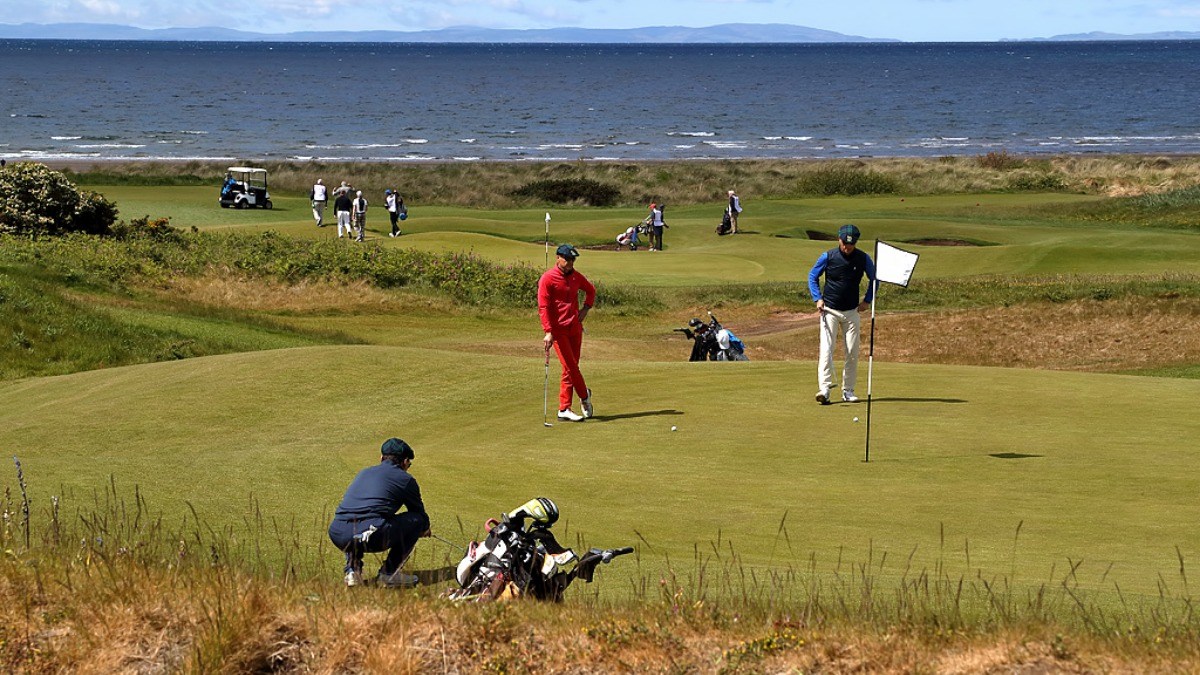
The legal landscape surrounding protest movements in the United Kingdom is shifting in a way that has caught the attention of activists, legal experts, and politicians alike. According to Al Jazeera, seven protesters associated with the group Palestine Action are now facing the prospect of terror-scale sentencing after a demonstration at Donald Trump’s Turnberry golf resort in Ayrshire.
The incident, which took place on March 8, 2025, involved activists spray-painting messages in support of Gaza, digging up turf, damaging sprinklers, and applying weedkiller to the greens at the Turnberry golf resort, a property owned by the president. They painted the words “Gaza is not 4 sale” across the property. Initially charged under standard criminal law for malicious property damage, the situation took a serious turn when a 16-page indictment was filed.
This document asserts that the acts were aggravated by reason of having a terrorist connection. An initial hearing for this case is scheduled to open at the High Court in Glasgow on Monday, August 31. This development comes as the British government continues to navigate its legal battle with Palestine Action, which was proscribed as a terrorist organization last year.
Palestine Action has been vocal about its opposition to the current political climate regarding Gaza
Cofounder Huda Ammori expressed that the prosecution is attempting to appease both Trump and Israeli Prime Minister Benjamin Netanyahu through these severe charges. In a statement, Ammori said, “We used direct action protests to save lives – the opposite of terrorism – by disrupting the flow of arms being used to murder Palestinians.”
She further noted, “By hitting the profits of arms companies and by daring to spray paint on the golf course owned by the demagogue who has enabled Netanyahu’s crimes, we made powerful enemies. The British government chose to appease them by criminalising us as ‘terrorists’.”
The implications of these charges reach far beyond the borders of the United Kingdom. Recently, the United States administration imposed sanctions on Palestine Action and the international movement Masar Badil. The United States Department of the Treasury also targeted Autistici Inventati, an Italian group that provides digital infrastructure for various left-wing and pro-Palestine organizations.
This global trend of applying intense pressure on activists has drawn sharp criticism
John McDonnell, a Labour member of the British parliament and former shadow chancellor of the exchequer, described the potential terror link in the charges as profoundly embarrassing for Britain. He highlighted that Trump has announced he is following the British lead by proscribing Palestine Action as a terrorist group.
“Andy Burnham has inherited this mess from the previous government,” McDonnell stated. “This must be the wake-up call to drop this absurdly authoritarian ban, before Starmer’s blueprint is adopted by repressive governments around the world to criminalise protest and suppress political dissent.”
This focus on terror-linked sentencing for property damage is not a universal rule, however, as recent judicial decisions demonstrate. In a separate case at Preston Crown Court, five individuals from Palestine Action were spared from being sentenced as terrorists for an attack on a Barclays Bank branch in Burnley.
According to the BBC, the group had targeted the bank on August 5, 2024, to pressure the institution to withdraw financial support for Elbit Systems, a weapons manufacturer they claim provides military components to Israel. The activists caused over £200,000 in damage, but Judge Robert Altham, the Recorder of Preston, ruled that section 69 of the Sentencing Act did not apply in their case.
‘For section 69 to apply the damage must amount to serious damage’
Judge Altham noted that while the damage was significant, it did not reach the threshold for serious damage required to trigger the Terrorism Act. He explained, “For section 69 to apply the damage must amount to serious damage. The threshold is a high one, the quality of the act must also be considered.” The judge specifically distinguished this attack from previous actions taken by the group against more sensitive properties, such as arms factories.
As a result, the five defendants will be sentenced for criminal damage rather than terrorism-related offenses. This ruling was met with relief by the defendants and their supporters, who had feared the draconian consequences associated with being labeled terrorists.
Defense counsel Pete Weatherby KC had argued during the proceedings that treating the bank attack as a terrorist offense would lead to dire consequences, including longer jail terms and the loss of automatic early release. He maintained that breaking windows and daubing slogans with paint is very far from terrorism and that ordinary criminal law is sufficient to cover such convictions.
The defendants were not aware their actions could be treated as terrorism until after their guilty verdicts in June. They will now be sentenced on September 4.
Understanding the application of terror laws to political protests is crucial
The contrast between the Turnberry case and the Barclays case highlights the complex and often inconsistent application of terror laws to political protest. While some judges are choosing to interpret the threshold for serious damage narrowly, the prosecution in the Turnberry case is clearly pushing for a broader application of these statutes.
As the hearing in Glasgow approaches, the legal community and the public are left watching how the judiciary will ultimately handle the intersection of direct action, property damage, and the definition of terrorism. The outcome of the upcoming proceedings will likely have a lasting impact on how protest and political dissent are treated under British law moving forward.
(Featured image: Walter Baxter)
Have a tip we should know? [email protected]
Follow The Mary Sue:
