


Server’s $2,000 in Tips in One Week Draws Flak. Now, He’s Considering a Career Change To Escape the Hidden Costs
Fighting a broken system.
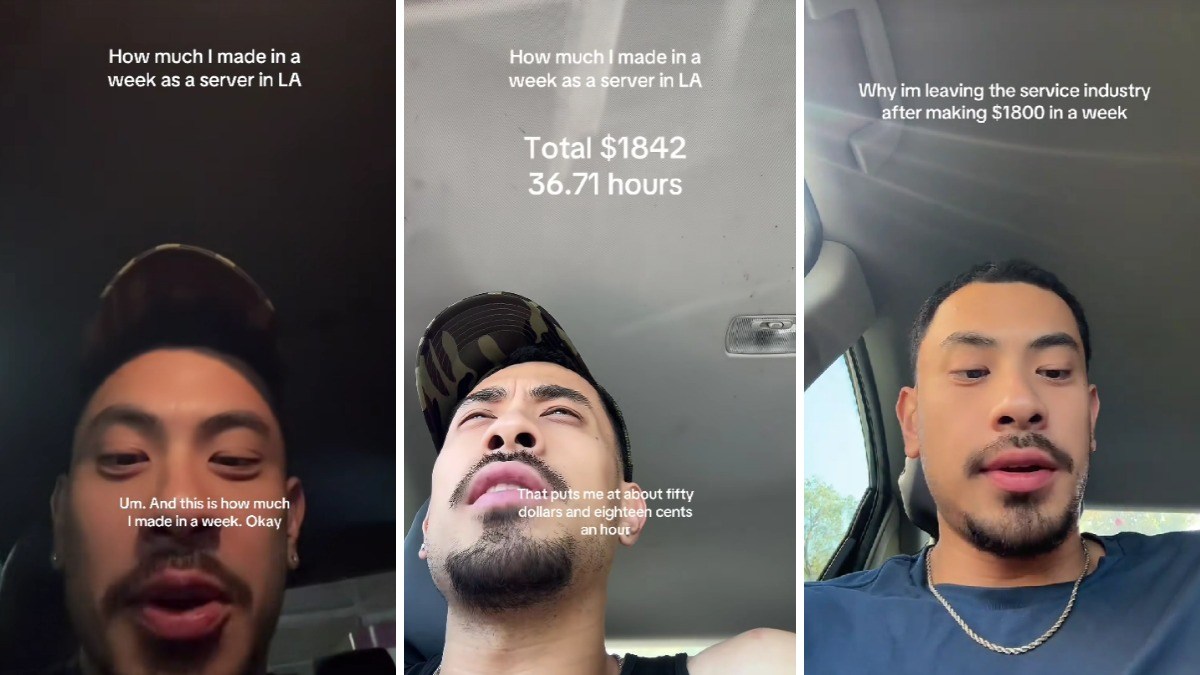
A Los Angeles server just shared a viral video breaking down his $2,000 tip haul in a single week, and the internet is losing it. The numbers are eye-popping – $50 an hour in tips alone – but instead of celebrating, X users are calling tipping culture “out of control.” Now, the server is walking away from the industry entirely, citing the hidden costs of the job as his breaking point.
According to Daily Dot, the video, posted by TikTok creator Key (@incognitokey), shows his earnings over six days, excluding his hourly wage and after tip-out. His lowest day was a Friday, where he worked 3.68 hours and made $43 in tips. The high point? A Saturday shift where he pulled in $546 after 8.58 hours.
By the end of the week, he’d racked up $1,842 in tips over 36.71 hours, averaging $50.18 an hour. In the caption, he clarified this wasn’t his usual take-home pay – just an unusually busy week. “I don’t get all weeks like this,” he said. “I just got scheduled mad crazy this week.”
To nobody’s surprise, the internet didn’t care about context
@WallStreetApes, a verified X account, reposted the video with the caption “tipping culture has really gotten out of hand in America,” framing his earnings as proof of excess. The comments exploded. Some users called it “a lot of money” for one week, while others defended him, arguing he earned every dollar. One user wrote, “He must be a great server; (there’s) nothing wrong with that.”
The backlash clearly stung. Shortly after, Key posted a follow-up video announcing he was leaving the service industry. He doubled down that the viral week was his best of the year, not his norm, and pushed back against critics undermining his work. “Each one works hard,” he said, before revealing the demanding nature of the job had finally pushed him out. His followers wished him luck, hoping he’d share updates on his next career move.
The reaction to Key’s video may appear to be about the impact of tipping. However, it has more to do with the brutal reality behind those numbers. While $2,000 in a week sounds like a windfall, it doesn’t account for the instability, stress, and financial trade-offs that come with restaurant work.
The Food Institute reports that a 2026 survey of hourly restaurant workers paints a grim picture: 63% say they’re constantly or frequently stressed, and 61% regularly skip meals because they can’t afford food. The industry’s reliance on tips creates a feast-or-famine cycle, where a “mad crazy” week like Key’s is the exception, not the rule.
The financial strain is relentless
The same survey found that 75% of restaurant workers live paycheck to paycheck, and 79% have used financial workarounds like payday loans or overdrafts in the past three months. One respondent described walking two miles to buy cheap groceries because they couldn’t afford gas. Another admitted selling personal belongings to cover bills.
The unfortunate reality is that these aren’t isolated incidents; they’re the norm. “The people serving our meals every day are, in many cases, unable to afford meals themselves,” said Tal Clark, CEO of Instant Financial, which conducted the study. “That signals that something is fundamentally broken.”
The disconnect between workers and management is glaring. A third of restaurant employees say their employer doesn’t care about their financial well-being, and 81% believe on-demand pay should be a standard benefit. But the issues go deeper than paychecks.
Predictable schedules, fair work distribution, and real breaks are rare luxuries in an industry built on hustle. “The restaurant industry has spent years normalizing levels of stress and exhaustion that would be completely unacceptable in almost any other sector,” said chef Isaac Bernal Carbajo. “Over time, that creates workplaces where employees stop feeling passion and instead simply feel used.”
But there is hope
Gen Z is leading the charge for change. Younger workers are far less willing to tolerate the toxic dynamics that older generations accepted as “part of kitchen culture.” They value work-life balance, sustainable conditions, and respect – and to their employers’ horror, they’re not afraid to job-hop to find it.
“The operators I see struggling most are still running people management like a financial transaction,” said hospitality expert Benjamin Smith. “The ones holding onto good staff are treating emotional intelligence as a real skill, something trainable and measurable.”
For Key, the viral tip week was the final straw. The money was great, but the grind wasn’t worth it. His story is a microcosm of an industry where workers are celebrated for their hustle but left to fend for themselves when the bills pile up. Tipping culture might make things look lucrative for those in the service industry from the outside, but the hidden costs – financial, physical, emotional and mental – are pushing more workers to walk away.
If you’ve ever stiffed a server because “they make enough in tips,” this is your wake-up call. The next time you’re dining out, remember: that $2,000 week might be the exception, but the stress, skipped meals, and financial instability are the rule. And for workers like Key, no amount of tips is worth the trade-off.
(Featured image: by Key @incognitokey on TikTok)
Have a tip we should know? [email protected]
Follow The Mary Sue:
