


‘Taking No Hints’: Bartenders Confront a Persistent ‘Creep’ Bothering a Woman, Until His Response Leaves the Entire Bar in Stitches
Better safe than sorry.
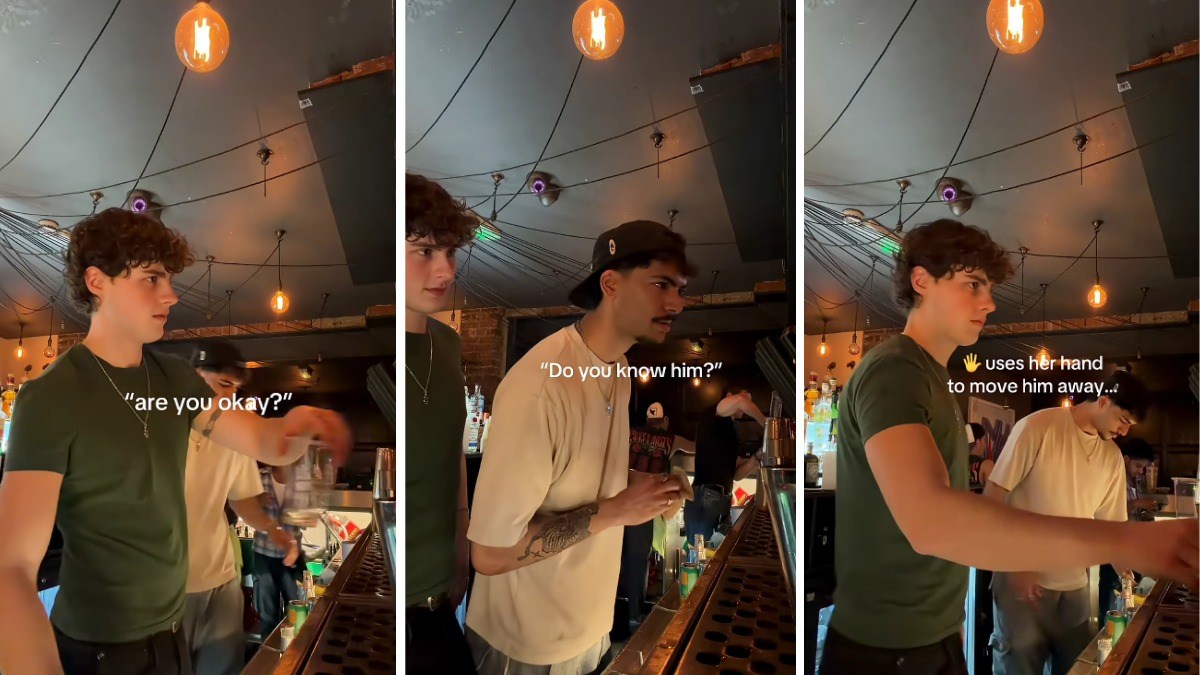
A viral video has turned a tense moment into a masterclass in bartender vigilance. London-based bartender and model Sam Finch, @samfnch on Instagram, shared the clip on April 13, 2026, that shows him and his colleague Sef stepping in when a man keeps dancing too close to a woman who clearly is not enjoying it. The punchline, when it lands, flips the entire situation on its head.
The video starts with Finch saying the woman ordered a gin and tonic. Almost immediately, a man approaches and starts dancing against her. Her body language is unmistakable – she shifts away, pushes him with her hand, and generally looks uncomfortable. Finch notices right away and checks in with her. She gives a thumbs-up, but something still feels off. He turns to Sef and asks, “Do you think she knows this guy?”
Sef initially thinks they might be friends, but they keep watching. Eventually, they decide to step in more directly. Sef asks the woman if she knows the man, and when the man approaches the bar, the bartenders confront him. They stay professional but firm. Sef asks, “Do you guys know each other?” The man’s answer is the moment everything changes: “She’s my sister.” The woman confirms it with a shocked, “OMG yes, he’s my brother!” The group bursts into laughter.
The clip exploded online
On Instagram alone, it has 32.9 million views, 2.9 million likes, and over 231,000 reshares. On TikTok, it has surpassed 18 million views, nearly 3 million likes, and close to 100,000 saves. The YouTube Short version has racked up about 9 million views and more than 430,000 likes. The video takes a scenario that feels uncomfortably familiar to anyone who has ever been in a bar and turns it into a moment of shared relief.
The tension of unwanted attention dissolves into laughter, and the humor works because the “creepy” behavior turned out to be typical sibling teasing. What looked like a potential threat from the outside was actually a brother being protective in his own unfiltered way. The woman had someone close enough to deter real threats while still being someone she could push away if she wanted.
The video is more than just a funny moment, though. It highlights how bartenders can play a crucial role in keeping patrons safe. Women’s safety in bars is a major concern, with many reporting feeling uncomfortable or unsafe due to persistent advances. Bartenders have a unique vantage point – they see body language, control the space, and can intervene without escalating drama.
Finch and Sef’s approach is a textbook example of how to handle these situations. They observed carefully, checked in more than once even after a polite reassurance, consulted each other, and acted when doubt remained. Their method proves that it’s better to risk a little awkwardness than to ignore a potential problem. Their vigilance creates a safer environment and builds trust with patrons.
The comments reflect how much this awareness resonates
Many praised the bartenders for their attentiveness and for looking out for the woman. Some said the timing and the way everyone burst into laughter made the whole thing even funnier. The refrain “better to be right than to be sorry” popped up repeatedly, along with comments calling the bartenders – and the brother – “green flags.”
The video ends with the bartenders apologizing, Sef saying, “Now I see the brother and the sister.” The sister asks, “You were gonna kick him out, weren’t you?” Finch replies, “Yeah, literally.” Sef wraps it up with, “Sorry. Great relationship,” as everyone laughs and the siblings head back to the dance floor.
A 2023 report by UCLA Health explores how similar vigilance is becoming a formal part of bartender training in some places. In West Hollywood, for example, a 2021 ordinance requires bartenders and servers at alcohol-serving businesses to undergo bystander intervention training to help prevent sexual violence. The training, provided by the UCLA Health Rape Treatment Center, had already reached over 3,000 employees.
The goal is to teach workers how to recognize warning signs and intervene in ways that don’t require dramatic confrontations. A simple question like “Are you OK?” or making eye contact with a potential aggressor can be enough to change the course of an evening. Body language, facial expressions, and tone can signal when something is wrong. The training also highlights that assailants often don’t want to be caught, so even small gestures can deter them.
Another tool gaining traction in bars is the ‘angel shot’
According to Axios, if you hear someone order an “angel shot,” they’re not asking for a drink – they’re asking for help. The coded order lets bartenders, servers, or bouncers know that the patron is feeling threatened. The specifics of the order can vary: an “angel shot with lime” means the patron wants the police called, “neat” means they need someone to walk them to their car, and “on the rocks” is a request for an Uber or taxi.
The concept is an offshoot of the “Ask for Angela” campaign that started in the U.K. in 2016, where patrons could use the name “Angela” to signal for help. A Chicago law passed last fall aims to make sure more hospitality workers know how to respond to an “angel shot” order. The law’s sponsor, Ald. Brian Hopkins, learned about the code when a woman in his ward ordered one at a bar. The bartender knew what it meant and got an off-duty police officer involved.
Finch’s video, the West Hollywood training, and the angel shot code all point to the same truth: bartenders and bar staff are often the first line of defense in keeping patrons safe. It’s a reminder that looking out for one another in nightlife settings isn’t overreacting but basic care.
(Featured images: Sam Finch, SammFinch on YouTube)
Have a tip we should know? [email protected]
Follow The Mary Sue:
