



Man Buys a Clock at Goodwill for $6. Then Strangers Follow Him to His Truck – and Try to Give Him 16x the Price
Best purchase ever?
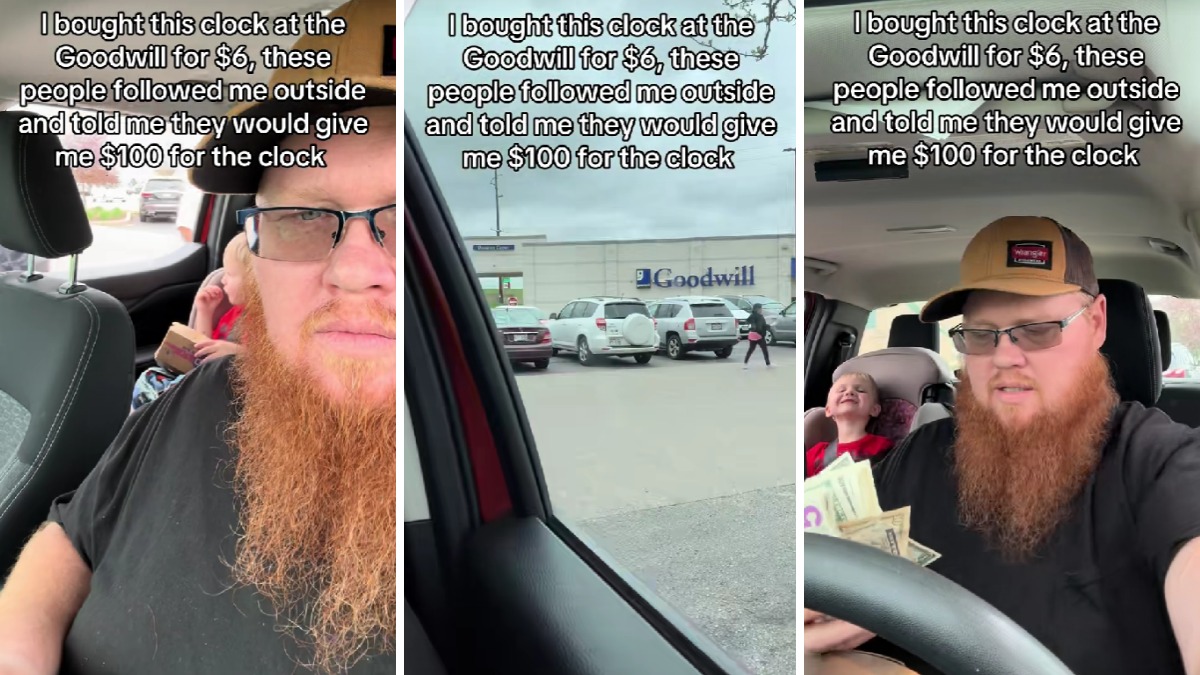
A man just struck what might be the luckiest thrift store find ever after buying a clock at Goodwill for six bucks. The real kicker, though, came when strangers followed him to his truck and tried to buy it from him for $100. That’s when things got even wilder. The whole saga unfolded in a TikTok video posted by @thickdad86. In the clip, he explains how a group of people trailed him through the store after he grabbed the clock, even though they hadn’t bought anything themselves.
As he walked to his truck, they made their move, offering him $100 for the clock he’d just paid $6 for. But the real shock came when he opened it in his car and found a massive stack of cash hidden inside.
His reaction says it all: “I literally just. Literally just paid six f—ing dollars for this clock. And look it, look it. Look at this. Look at this. I have this. Look at. I’m literally sitting right here. The f—ing goodwill. Look it. I’m done. Dude. Dude, I’m. I’m literally, like, in shock right now. This. This is. This is insane, I literally, like. I can’t believe this is happening right now.”
The video has since gone viral, with viewers split over whether it’s real or staged
Some commenters were immediately suspicious, with one writing, “WHY ARE YOU OPENING THAT IN PUBLIC!” Another joked, “My family’s been looking for that. My grandmother’s savings. Can you return it please?” A few even shared their own unbelievable thrift store finds, like one person who claimed to have bought a purse full of gold jewelry. But Goodwill employees in the comments weren’t buying it. One said, “I worked at goodwill and we check through everything. I don’t believe it.”
The whole situation feels like something out of a movie, but it’s not the first time thrift stores have been at the center of wild resale stories. According to Business Insider, the secondhand market has exploded in recent years, with the U.S. secondhand apparel market alone expected to hit $79 billion by 2030. That growth has brought in a flood of professional resellers who treat thrift stores like treasure hunts, flipping their finds for profit.
Some, like Chris Hatfield, spend five days a week digging through Goodwill bins in Texas, aiming to scoop up 150 to 200 pounds of clothes and other items daily. He and his wife sell their finds on Whatnot, a livestreaming auction site, where they average $11.21 per item. Their goal? A thousand dollars in profit every single day.
Hatfield’s approach is all about speed and volume
He doesn’t wear gloves so he can feel the quality of the items, while his wife uses what he calls “the claw machine” strategy – grabbing anything that looks decent. It’s a far cry from the romanticized idea of thrifting as a casual treasure hunt. Instead, it’s a full-blown industry, complete with its own influencers, courses, and even fistfights over inventory.
The rise of professional resellers has sparked debate about whether they’re providing a valuable service or just driving up prices and creating artificial scarcity. Critics argue that they scoop up in-demand items, making it harder for regular shoppers to find affordable goods. But resellers like Hatfield see it differently.
He estimates that about three-quarters of his customers are other resellers, and he’s fine with that. “I’m not trying to get max dollar because I know the next day I’m going to be right back here digging,” he says. Still, he admits the bin-diving can get aggressive, especially when a swarm of resellers is competing for the same items.
The resale economy isn’t just about clothes, either
Some resellers focus on high-ticket items, like the Florida couple who bought a steam oven at a thrift store for $1,000 and flipped it on eBay for $15,000. Their rule? “I don’t buy anything unless I can 10x it.”
Others, like Crystal Maus in South Dakota, have turned reselling into a full-time business, listing 350 items a week and grossing $15,000 to $20,000 a month. She sources her inventory from online auctions, liquidations, and buy-sell-trade stores, proving that the barrier to entry is low if you know what you’re doing.
But not everyone is in it for the long haul. Some resellers, like Rob and Melissa Stephenson, have pivoted to selling courses that teach others how to flip items for profit. Their free intro video series promises to help students make $100 in seven days. “There’s so much stuff everywhere, there is not any near future where we’re creating crazy, crazy competitors,” Rob says.
Meanwhile, influencers like Joshua Varnell and his wife Hayley have built massive followings on YouTube by documenting their reselling adventures. Their channel, Hairy Tornado, has nearly half a million subscribers, and they make more money from content than actual flipping these days.
The growth indicates zero signs of slowing down
With trend cycles speeding up and AI making it easier to list and sell items, the industry is only getting more competitive. But for all the debate over whether resellers are heroes or villains, one thing is clear: thrift stores are no longer just places to score a cheap sweater or a vintage record.
Back to the TikTok clock story. It’s likely that the men following him around were thrifters or resellers looking for their next successful deal. Real or staged, the video is a perfect example of how thrift stores have become the ultimate wild card in the resale game. You never know what you might find, or who might be watching when you do.
(Featured images: @thickdad86 on TikTok)
Have a tip we should know? [email protected]
Follow The Mary Sue:
