


Thai Researchers Digging in a Local Fossil Site Just Uncovered a Dinosaur With a Neck Length That Defied Every Expectation
Another long-necked giant unearthed.
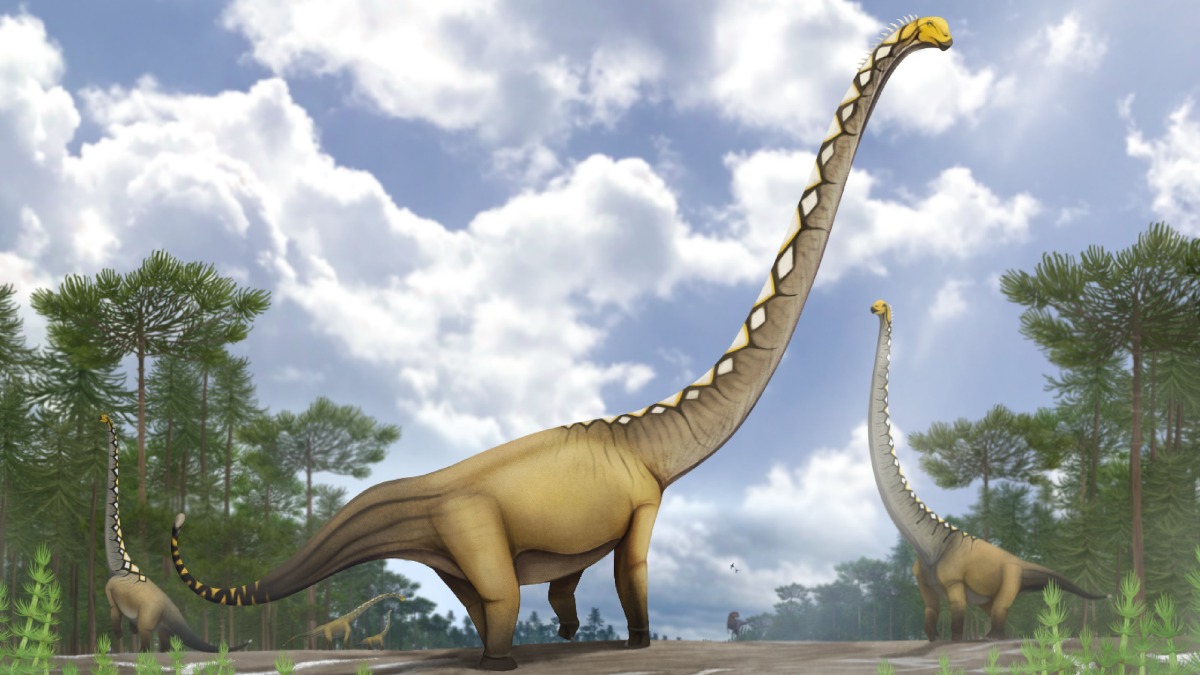
Thai researchers just hit the paleontology jackpot with a discovery that’s rewriting what we thought we knew about long-necked giants. Meet Uragasaurus kalasinensis, a newly identified species with a neck so absurdly long it could stretch the length of a cricket pitch. According to the BBC, this plant-munching titan roamed what’s now northeastern Thailand around 150 million years ago, and its remains are forcing scientists to rethink where these dinosaurs actually lived.
The discovery hinges on a single vertebra – a bone from the dinosaur’s upper back – dug up at the Phu Noi fossil site in Kalasin Province. That might not sound like much, but in the world of paleontology, one well-preserved bone can be enough to define an entirely new species. Dr. Apirut Nilpanapan, lead researcher from Mahasarakham University, said the vertebra’s unique features left him so stunned he “smashed his computer” in excitement.
Uragasaurus is the first confirmed member of the Mamenchisauridae family ever found in Southeast Asia. Until now, these long-necked dinosaurs were almost exclusively linked to China, where fossils of similar species like Mamenchisaurus and Omeisaurus have been uncovered. The fact that Uragasaurus popped up in Thailand suggests these giants had a much wider range than previously thought.
The vertebra itself is a marvel of prehistoric engineering
CT scans revealed a bizarre internal structure filled with tiny, irregular air chambers – what scientists call “camellate” pneumatization. Think of it like a sponge made of bone, where air sacs replaced marrow to keep the neck lightweight without sacrificing strength.
This adaptation was crucial for Uragasaurus, whose neck likely stretched around nine meters long. For context, that’s roughly half its total body length, which researchers estimate at up to 20 meters. If you’ve ever struggled to parallel park a compact car, imagine maneuvering a creature the size of a bowling lane with a neck that could peek into a third-story window.
The name Uragasaurus kalasinensis is a nod to both its physical traits and its cultural roots. “Uraga” comes from a Sanskrit word meaning “snake” or “one that moves on its chest,” a fitting description for a dinosaur with a serpentine neck. The second half of the name honors Kalasin Province, where the fossil was found.
TECH Times reports that it’s also a subtle hat tip to the Naga, serpent deities from South and Southeast Asian mythology. If you’re picturing a dinosaur with a neck that slithers through the treetops like a mythical beast, you’re not far off.
This discovery didn’t happen overnight
The Phu Noi site, where Uragasaurus was uncovered, has been a goldmine for paleontologists since 2008, when a local resident stumbled upon fragments that looked like serpent scales. Since then, researchers have pulled over 6,000 fossils from the area, with more than 90% belonging to dinosaurs.
The site already yielded another record-breaking find this year: Nagatitan chaiyaphumensis, a 27-meter-long sauropod that holds the title of Southeast Asia’s largest dinosaur. Weighing in at 27 tons – roughly nine adult Asian elephants – Nagatitan is a reminder that Thailand’s prehistoric past was packed with giants.
What’s fascinating about Uragasaurus is how it fits into the bigger picture of dinosaur evolution. The Mamenchisauridae family is known for its ridiculously long necks, which could contain up to 19 vertebrae. These dinosaurs weren’t just tall; they were built to reach vegetation at heights no other herbivores could access.
It raises questions about how these dinosaurs spread across ancient continents
The fact that Uragasaurus lived in Thailand while its relatives thrived in China suggests there were land connections between these regions during the Late Jurassic period. Similar fossils found in Tanzania hint that Mamenchisauridae had a much broader range than the fossil record previously suggested. It’s like finding a missing puzzle piece that suddenly makes the whole picture clearer, or way more complicated.
Nilpanapan and his team spent over a decade comparing the Phu Noi fossils to other known species before confirming Uragasaurus as something entirely new. That’s not unusual in paleontology, where the difference between a new species and a known one can come down to a single bone feature.
The Phu Noi site isn’t done surprising us yet. Researchers are already studying another fossil from a nearby location that might belong to a second Mamenchisauridae species, potentially from the Early Cretaceous period. If confirmed, it would mean these long-necked dinosaurs stuck around in Thailand for millions of years, evolving alongside other species.
The site has also helped clarify the age of the Phu Kradung Formation, which scientists now believe is firmly Late Jurassic in its lower sections. That’s a big deal for dating other fossils found in the same layers. For now, Uragasaurus kalasinensis stands as a testament to how much we still have to learn about Earth’s prehistoric past. It’s a humbling reminder that the fossil record is full of surprises, and sometimes, all it takes is one bone to rewrite history.
(Featured image: A. Nilpanapan S. Manitkoon, V. Suteethorn; K. Lauprasert; Artwork by Pakorn Chotchaiyaporn)
Have a tip we should know? [email protected]
Follow The Mary Sue:
