


Trump Just Pulled the Rug Out From Under Thousands of Federal Workers With a Shocking New Executive Order
Restoring accountability?
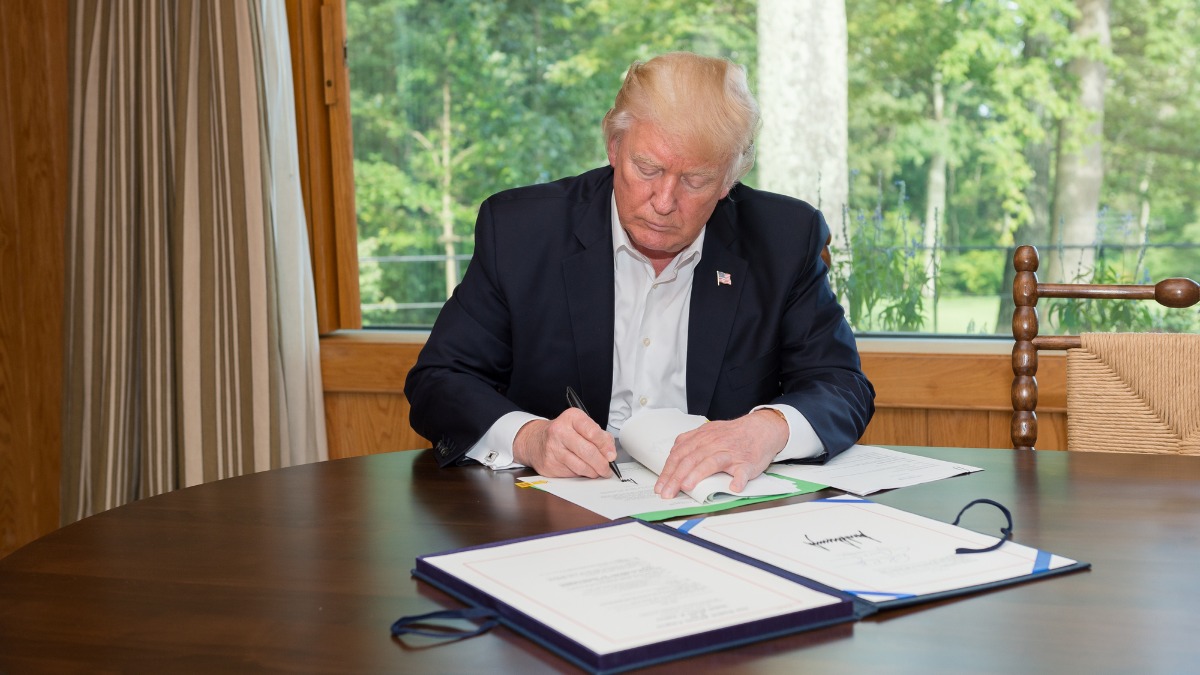
President Donald Trump just turned 8,000 federal workers into at-will employees with a new executive order, meaning the government can now fire them without giving a reason. The move strips civil service protections from senior-level staff, including policy office leaders, regional heads, and public affairs officers.
If this sounds familiar, it’s because Trump tried something similar during his first term with a plan called Schedule F. This time, the administration is calling it Schedule Policy/Career, or Schedule P/C for short. The change affects about 8,000 workers at the GS-15 level, the highest tier of the civil service. That’s a smaller number than the 50,000 positions the Office of Personnel Management once estimated could be reclassified, but the administration hasn’t ruled out expanding it later.
For now, the federal government has around 4,000 political appointees who already serve at the president’s pleasure. According to NPR, the rest of the workforce, roughly 2 million people, could previously only be fired for cause, like poor performance or misconduct, with formal appeals processes in place. That’s no longer the case for these 8,000 workers.
The move is expected to restore accountability and the democratic process
OPM Director Scott Kupor framed the move as a way to restore accountability and the democratic process. “This is very much about accountability,” he told reporters. “It’s also about a restoration, in our mind, of the democratic process.”
Since the president is elected by the public, Kupor argued, the employees carrying out policy should be willing to follow the president’s directives. He insisted no loyalty tests would be used and that whistleblower protections would remain intact, though agencies would now be responsible for enforcing those rules without the usual appeal rights for employees.
Critics say the move is a direct attack on the nonpartisan nature of the federal workforce, a principle that dates back 140 years. After President James A. Garfield was assassinated by a disgruntled jobseeker in 1881, Congress passed laws to protect federal workers from political interference. Those protections were designed to prevent corruption and ensure continuity between administrations.
Democracy Forward, one of the groups suing the Trump administration over the rule, called the move unlawful. “This attempt to fire civil servants was unlawful when the president first tried this in his first term, and it’s still unlawful now,” said Skye Perryman, the organization’s president.
Experts warn against risk of further politicization of the government
Don Moynihan, a professor at the University of Michigan’s Ford School of Public Policy, warned that the change will deepen the politicization of government. “It creates bubbles around policymakers,” he said.
“If you were a career civil servant and there is bad news that you want to share with the president, you’re less likely to do so if you think, ‘The minute I share that bad news, I’m going to get fired.'” He pointed to recent examples of political appointees who were fired or sidelined for contradicting the president, like the head of the Defense Intelligence Agency after a report challenged Trump’s claims about U.S. airstrikes in Iran.
The Trump administration’s legal strategy seems calculated. By starting with a smaller group of policy-focused roles, they’re betting on a stronger case in court.
Moynihan expects the issue to end up before the Supreme Court, where the conservative majority has already signaled openness to expanding presidential power over the executive branch. During oral arguments last year, Chief Justice John Roberts called a 90-year precedent limiting that power “a dried husk.” A decision on that case is expected soon.
Some are drawing similarities with how the private sector operates
Kupor, a former tech executive, also compared the change to how the private sector operates. “Outside of the federal government, all other organizations, whether for-profit or non-profit, are led by a CEO, who sets the priorities for the organization and ultimately effects those priorities through the hiring of employees who are accountable to the CEO’s mission,” he stated.
But critics say the comparison doesn’t hold up. Michael Martinez, a former OPM deputy general counsel now with Democracy Forward, argued that government work is mission-driven and meant to serve the public, not a CEO’s agenda. “That’s really for the American people, so that they can rely on the information they’re getting,” he said, whether it’s economic data or weather reports.
Moynihan warned that politicizing federal jobs could drive away experts and hurt institutional performance. “That’s partly because people who have expertise decide, ‘I’m not going to stick around if the input that I provide to policymakers is going to be ignored,'” he said.
Historically, the government’s ability to attract talent has relied on the promise that their work matters. If that’s no longer the case, recruiting could become a lot harder. For now, the 8,000 workers reclassified under Schedule P/C are left waiting to see how far this change will go, and whether the courts will let it stand.
(Featured image: Official White House Photo by Andrea Hanks)
Have a tip we should know? [email protected]
Follow The Mary Sue:
