


Oklahoma residents emerge from cellars to a nightmare of splintered wood and twisted metal after powerful tornado claims their homes
The storm isn’t over.
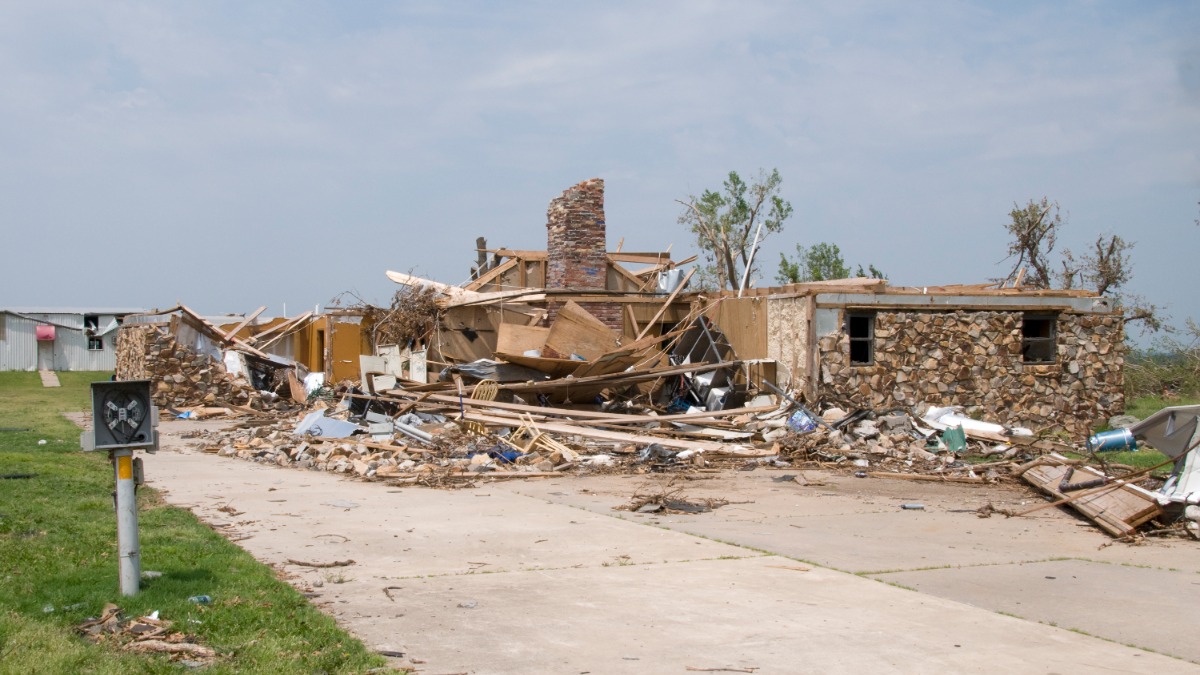
Oklahoma residents emerged from their storm cellars Thursday night to a heartbreaking scene – splintered wood, twisted metal, and homes torn apart by a powerful tornado that left 40 properties damaged. Miraculously, no lives were lost. According to AP, the EF-4 twister, packing winds of 170 to 175 mph, carved a nine-mile path through Enid, a city of about 50,000 people roughly 85 miles north of Oklahoma City.
For 30 to 40 terrifying minutes, it ripped roofs off houses, peeled walls away like tin foil, and scattered debris across neighborhoods. Yet, thanks to well-practiced emergency plans and reinforced shelters, residents walked away with only minor injuries. Raeann Hunt was one of those who took cover as the storm barreled toward her home. She described the moment she peeked outside, her voice still tense with the memory. “It is headed right for us,” she recalled thinking.
Inside her 8-by-8-foot concrete cellar, the noise was deafening – roaring winds, metal slapping against the door, and shattering glass. When she finally emerged, her one-story brick home was in shambles. Windows were blown out, the roof was damaged, but she, her husband, her brother-in-law, and a neighbor were unharmed.
It’s a scenario that plays out all too often in tornado-prone Oklahoma
Residents here know the drill: when the sirens wail, you don’t hesitate. You grab your phone, flip on the TV, and head for the safest spot in the house, preferably underground. Storm cellars like Hunt’s are a lifeline in this part of the country. Basements are rare in Oklahoma due to the red clay soil and high water tables, which make them expensive and difficult to install.
Instead, many homes are equipped with reinforced concrete safe rooms or storm cellars, designed to withstand even the most violent winds. Justin Hunt, another Enid resident, put it bluntly: “Especially in Oklahoma, we have great meteorologists.” Those meteorologists had been tracking the storm system for days, issuing warnings that gave people time to prepare. It’s a system that works.
The destruction was staggering. Commercial buildings just south of Enid were reduced to piles, their concrete foundations the only evidence they’d ever existed. Utility poles were snapped like twigs, power lines draped with chunks of debris so large they looked like they’d been torn from a construction site.
One home had its metal roof peeled back like a can of sardines, while another had an entire wall ripped away, exposing furniture still neatly arranged inside. Trees were stripped of bark and limbs, standing like skeletal reminders of the storm’s fury.
Oklahoma Gov. Kevin Stitt said during a news conference, “Usually when we come to a neighborhood that’s been hit this bad, there’s one or two deaths.” “We’re just so thankful there wasn’t a loss of life.”
His relief was shared by the entire community
First responders and volunteers had already begun the daunting task of cleaning up. Police, fire departments, and the Oklahoma Highway Patrol conducted multiple home searches, rescuing residents who’d been trapped in the wreckage. Enid Mayor David Mason summed up the city’s resilience in a post online: “Supplies have poured in already. This is who Enid is in challenging moments – we continue to show up for one another.”
Dave Lamerton was one of those showing up. By Friday morning, he was already at his son Joseph’s woodworking shop just south of Enid, sifting through the wreckage with family members and a group of volunteers who’d driven in from Kansas to help.
The tornado had “swung right through here and just hit us directly,” he said, gesturing toward a massive pile of debris pushed to the edge of what was left of the building’s foundation. “We’ve got stuff on the property we can’t even find,” he added, shaking his head at the sheer scale of the destruction.
Meteorologists described the storm as a textbook example of a high-end tornado. One striking image from the event shows the twister with dark clouds of debris fanning out in a V-shape on either side, a telltale sign of its intensity.
Mark Fox, the meteorologist in charge of the National Weather Service’s office in Norman, explained that the violent motion of the winds picks up dirt, debris, and even parts of homes, creating that signature look. “If you start seeing things like this, you know it’s a violent tornado,” he said. The National Weather Service was still assessing the damage Friday, sending out crews to survey six potential tornadoes in the Enid and Braman areas of north-central Oklahoma.
The storm didn’t just hit Enid
Nearby Vance Air Force Base, about 80 miles north of Oklahoma City, also took a beating. Fences were knocked down, equipment was damaged, and the base was closed until further notice while crews worked to restore power and water. Everyone assigned to the base was accounted for, and no injuries were reported, according to Ashley D. Hendricks, the 71st Flying Training Wing Public Affairs Chief.
Unfortunately, the weather wasn’t done yet. More storms were possible through Friday night across south-central and southeast Oklahoma, with strong to severe thunderstorms expected to develop Saturday, including in the Enid area. It’s a grim reminder that tornado season is far from over.
The storm system wreaked havoc in other states, too. In Kearney, Missouri, north of Kansas City, officials reported downed trees, debris blocking roadways, and damage to homes after storms rolled through Thursday night. No injuries were reported, but crews were still working Friday to clear the roads and assess the damage.
(Featured image: Patsy Lynch/FEMA)
Have a tip we should know? [email protected]
Follow The Mary Sue:
