comScore
  1. Mediaite
  2. Gossip Cop
  3. Geekosystem
  4. Styleite
  5. SportsGrid
  6. The Mary Sue
  7. The Jane Dough
  8. The Braiser

Today in things that make us scream incoherently
When Flying To The Olympics, Women Are Second Class To Men


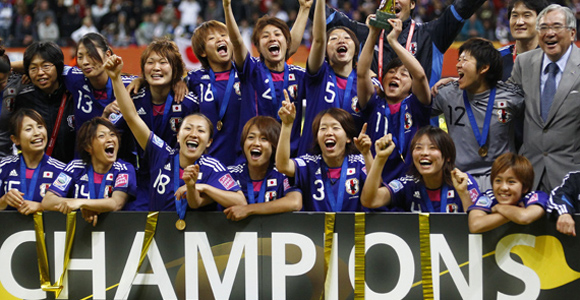
Japan’s women’s soccer team scored a huge win for their country last year when they beat the United States for the World Cup. But apparently that amounts to nothing. They flew to Europe earlier this week along with the men’s team in anticipation of the London Olympics. The men had seats in business class. The women sat in coach. And they aren’t the only team seated this way. What gives? 

You can try to come up with an excuse as to why this happened that doesn’t involve sexism but you’ll probably come up empty. IHT Rendezvous of the NY Times reported that according to Japanese Football Association, the men and women’s teams left on the same flight. “I guess it should have been the other way around,” said Japanese lead player Homare Sawa, “Even just in terms of age, we are senior.”

And in terms of talent, the women are on top. They’re ranked #3 in the world while their counterparts sit at #20.

IHT Rendezvous writes, ”Similar treatment was given to the Australian women’s basketball team, The Sydney Morning Herald reported on Thursday. The men’s team, known as the Boomers, was seated in business class, while the women, the Opals, were in premium economy seats.” The women’s team has taken home silver medals in the last three Olympics while the men have never medaled.

In the case of the Australians, a spokesperson told the reporter each team decided how to spend their own budget but that excuse has not been given for the Japanese. “The Japan Football Association has been funding male footballers to fly business class since 1996. The women’s plane tickets had also been upgraded, but only to premium economy,” wrote BBC News. “The association has said that seat upgrade for the male players was in recognition of their professional status, local media report.”

Good to see players are being awarded for all their hard work. How about a little equality next time?

(via IHT Rendezvous, image by Kai Pfaffenbach)

Previously in London Olympics

Are you following The Mary Sue on Twitter, Facebook, Tumblr, Pinterest, & Google +?

TAGS: | | | | | |


  • http://www.lucywoodhull.com/ Lucy Woodhull

    The men obviously need more room for their penes.  That’s just science!

  • http://pulse.yahoo.com/_IGRK4BKTKC5RGO56RXTUEVFJSM ainok

    When I saw this article originally it was just about the Japanese team, and I was actually impressed by the women speaking up on their own behalf at all.

    I once had a conversation with my English-language group in Japan where one of the older women told me her mother’s opinion about the difference between Bush’s wife and Clinton’s wife. She said her mother preferred Bush’s because she was out of the political arena and basically was there to serve lemonade to the visiting dignitaries. This was in contrast to Hillary Clinton, who she saw as too forward, in direct contrast to the ideas held by her generation of how a woman ought to behave.

    I’m only mentioning it because that sort of thing still seems to define the way women in Japan see themselves, even if it’s never stated directly. So I was pretty excited just to see that anyone had said anything at all about it. I hope they continue to kick up a fuss.

  • Cara Arcuni

    My mother absolutely has that opinion about L. Bush and H. Clinton, at least as First Ladies.  Laura Bush knew her “role” better, and Hilary acted inappropriately.

  • http://twitter.com/GeekLock Dingo

    Don’t women sports pull in way less money than male sports? Like by a huge margin? 
    I guess that is the reason.

     Which is a shame, women sports are much more fun to bet on, the results are less predictable and much more dynamic.

  • http://www.facebook.com/sdmcpherson Stephen Dudley McPherson

    This sort of thing makes me want to vomit in terror. I’m proud of our women’s basketball team because they’re actually good but the way they were put in economy like that just goes to show that men couldn’t give a crap about women’s sport, even if they’re better athletes. Probably because the women aren’t good looking enough or something.
    I kind of expected it from the Japanese, but the Australians? We’ve got a long way to go.

  • RedStar Wander

    If Japan’s female football team is ranked
    number 3, it might be because lots of countries do not have female national
    teams (at least not a serious one) or local female leagues or even women
    practicing it at college. I am not saying that they aren’t talented, no doubt they are, but in a much less competitive environment
    though.

    Saying women’s number 3 is better than men’s
    number 20 is a bit misleading.

    Nevertheless, the girls should have the comfort
    they deserve.

  • Katie Marinelli

    Well if it really was the team’s decision for the female Australian team, maybe that means they decided to save some money for something else when they get to London. Hopefully something nice for the team. But for the Japan team, it’s sad. The culture is still very misogynistic though the younger generations are trying to change that. It’s part of the reason that they have a population problem. Women are deciding that they want careers and many companies don’t want mothers working because it’s expected that they be housewives. So instead of having children, they’re deciding on careers.

  • http://www.facebook.com/ken.matsushima.75 Ken Matsushima

    It certainly “seems” to have all the elements of a great story about sexism in sports. What a pity that the “story” is a complete mis-representation of what really happened, and its failure to do any fact-checking or research of the background on the issue is a gross injustice to the Japan Olympic Committee (JOC), the Japan Football Association (JFA), the women athletes themselves (particularly captain Homare Sawa), and indeed, all sports fans in Japan
    Yes, the men’s U-23 football team did fly business class from Tokyo to Paris. But this was not the JOC’s decision, nor even at the request of the players (who are all highly-paid pros and easily able to pay the upgrade themselves). On the contrary, as even the most basic fact-check, vetting of journalistic sources, or inquiry to the JFA or JOC would have immediately determined, it is a fixed policy of the JFA, and has been in place for years. While it may be viewed as an “inequitable” situation, in a perfect world, it has nothing to do with sexism, and everything to do with business and economics.
    Japan’s men’s Olympic team is composed entirely of professionals, many of whom play for large and well-known European clubs. Those clubs are massive business corporations with a tremendous amount of political influence (which they are not afraid to use) and a very understandable concern for their bottom line. When they release players for international duty, they fully expect the respective football associations (the JFA in this case) to take full responsibility for the health and welfare of the players – THEIR BUSINESS ASSETS – when on NT duty. Therefore the players are always flown business class, lest they fall victim to the so-called “economy-class syndrome”.
    That’s right. The JFA is concerned that one of these players might get a blood clot on a long flight, and they would take the blame. You think that is some kind of joke? . . . not even close! Just ask Naohiro Takahara who suffered pulmionary embolism related to “economy-class syndrome” in 2005, and almost died. He was flying back to Japan on international duty, got a blood clot in the leg, and as he jogged in a training warmup the next day it detached and moved into his lungs, causing him to experience severe difficulty breathing. He spent a week in hospital subsequent to the incident, and was sidelined from playing football for six months. Many would even argue that it brought an early end to his international career.
    His club at the time (Hamburger SV) was FURIOUS. and even discussed suing the JFA, before they found out that Takahara had opted to fly economy himself, in order to take an earlier flight. Since that time ALL professional footballers are required to fly business class, by JFA policy. This is a formal, written policy that has been in place for years, as the JFA itself noted when the story first surfaced about two weeks ago. The policy is necessary due to the realities of the international football industry – the JFA has to ensure that it does not face a lawsuit from a European club.
    The women in Japan’s Olympic team are all semipros or amateurs, and of course, their teams do not have either the clout or the time and money to run around bringing lawsuits against a local FA for failure to protect the health of their players. Naturally, therefore, the women must settle for the transport method chosen by the Olympic committee (the JOC), which flies all athletes – men AND women ALIKE – in economy class.. 
    Is that unfortunate? Perhaps even a bit “unfair”? I suppose so, but it is also entirely understandable if you consider the position of the JOC and JFA, vis-a-vis players under contract to big, powerful European football clubs. Because the real story here is not about sexism, but about the conflict of professionalism and amateurism in the Olympic Games. When the Olympics dropped its barriers against pro athletes (I believe it was at the US-hosted Olympics in Atlanta), that created a situation that was bound to cause problems and inequities. As soon as pros and amateurs started taking part in the same Games, it was a virtual certainty. Do you think the US men’s basketball players share the same accommodations as amateurs,at the Olympic village? 
    More importantly, though, it was the press, NOT the women, who made this into a big story. When the story first emerged in a domestic newspaper, Sawa was asked about it by a Japanese reporter. No doubt recalling the example of Ryoko Tani – the judoka who had to field similar questions when the existence of such a policy became known in the leadup to the Athens Olympics – responded by making jokes. “You know, youre right! In fact we (the women) are also older than the men’s team so we should get seniority!” Obviously that was intended as a joke. Her comments sufficed to put the story to rest in Japan.
    It was only when a reporter for a non-Japanese news organization got a hold of the story that it turned into an international incident. His lack of Japanese fluency caused him to misinterpret Sawa’s comments as “criticism” rather than a deliberate effort by the Japan WNT captain to downplay the matter. Rather than contact Sawa to verify matters, or to contact the JFA for comment, or even to ask a native speaker whether or not he was misinterpreting the original story, in Japanese, he ran with the “scoop” and quickly set off an international firestorm. Once European papers got hold of the story and failed to provide any of the necessary context, it turned it into a huge international row. This, in turn, has brought embarrassment and criticism down on the women’s team, in both online SNS media and the domestic press in Japan. Sawa is no doubt asking herself HOW ON EARTH her comments could have been so egregiously misreported.
    So now we have a bunch of athletes who surely want nothing other than to be left alone to focus on their task on the football pitch, being subjected to a media frenzy which makes them look bad. Is it any wonder they were so emotionally fragile and unfocused in their 2-0 loss to France, last night? Of course not. In fact, it would be a miracle (and a testament to these ladies’ incredible character and bravery) if they manage to put the incident behind them and win a medal in London. In any event, please dont confuse a matter of professionalism -vs- amateur athletics with an issue of sexism. It does justice to nobody.

  • Anonymous

    Yeah!  Because women aren’t assets to anyone and have totally different circulatory systems that never experience deep-vein thrombosis!  Gosh!  Don’t make this about sexism!

    We understand that there is a difference between amateur and professional athletes.  But perhaps you might consider the following: Why are the male athletes able to support themselves as professionals and thus become valuable to corporate sponsors, but female athletes are not?

    No one is singling out Japanese culture.  This site has featured plenty of articles pointing out sexism all over the globe.

  • http://twitter.com/koberulz koberulz

    Not only did the Australian women’s team decline an upgrade from Basketball Australia, Liz Cambage was offered an upgrade from the airline and declined, and Lauren Jackson has a deal with Qantas that gave her a first class ticket, which she *downgraded* in order to be with the team.

    There’s also the argument that the men, on average, are far taller – which tends to be an issue with basketballers – and that this is the most economic way to do it if you wanted to keep the teams together. Going strictly by height, Jackson and Cambage should replace, say, Patty Mills and Adam Gibson, but that splits teams up.

    That said, it wasn’t mandated that it be how it is, so it really shouldn’t be an issue.

  • http://taste-is-sweet.livejournal.com/ Taste_is_Sweet

    Thank you for putting this in greater detail, but I agree with ‘FixTheFlat’ below that there is nonetheless a point that you’re missing, which is that the fact that internationally women’s teams are never considered as exciting, interesting or entertaining as men’s teams, such that women can almost never become professional athletes at anything. I realize that in this case it was the difference between professional versus amateur treatment, but the basis for the different treatment does lie very much in sexism, and will continue to do so until women can have professional sports careers along with the men.

  • http://www.facebook.com/ken.matsushima.75 Ken Matsushima

    The truth is that Japan’s women football league – though still semipro – is perhaps the most successful in the world. It is called the “Nadeshiko League, and frequently attracts crowds upwards of 10,000. 

    No, that still isnt as big as the men’s game. But a great many men (myself most certainly) are big fans. Women’s sports in Japan are probably more advanced than anywhere else except the US (and even that is open to debate).

     By making a big international row over the “sexism” claims just causes a backlash that doesnt help anyone. The fact is that this is not “sexism” but simply “favoritism”, with amateur males receiving just as poor a treatment as amateur females (and 20% less leg room than the women footballers, who got upgraded to premium economy due to their higher status as “semipros”). The danger with crying “sexism” at every perceived slight is that when you make the accusation against a case that was NOT sexism, you diminish your credibility on every other one of your complaints. Circumspection is ALWAYS the best policy

    (and for those tempted to ask “did he say “circumcision” is the best policy” – I will leave that judgement up to you…)

  • Anonymous

    It is also deeply rooted in Japanese culture.  The men are “providers for the women” so the men get the “Better treatment” In Old Japan even when a couple is walking the woman walks behind the man and carries everything.  Also in old Japanese culture even my father-in-law never did any house chores since it was considered that women do that and for a man to be seen doing womanly things would be embarrassing. Since In old Japanese culture the men provide for the household so they get the better treatment at home and everywhere else. But now things are changing

X