


comScore
  1. Mediaite
  2. Gossip Cop
  3. Geekosystem
  4. Styleite
  5. SportsGrid
  6. The Mary Sue
  7. The Jane Dough
  8. The Braiser

Curiouser and curiouser!

Researchers Find Hints of Dolphin Culture, Social Network Tendencies


Does anyone else ever get the feeling that dolphins just have the best of it? Aside from us destroying their environment (which is kind of a bummer), dolphins just seem kind of like what humans might be like if we just let everything go and relaxed. They’re already similar to us in some pretty striking ways; they even have genes that are homologous with humans. Now, new research is suggesting that dolphins may also form what we humans call “cliques,” and all based on what kind of functional fashion their fellow dolphins are wearing.

Many female dolphins wear marine basket sponges on their nose–it’s a convenient tool with which to scour sandy places for fish. It is also, for some dolphins, a fashion status symbol of sorts. According to researchers, the dolphins whose noses are frequently adorned with sponges (spongers, as they are called) associate more with each other than with dolphins who don’t use the tool. Bare noses are just so last season.

Behavioral biologist Janet Mann of Georgetown University was initially surprised by these findings; spongers are for the most part solitary, and were not thought to have much interest in having a social life. But, like with any teen comedy with the prerequisite makeover sequence, give someone the right accessories and there are no limits to the social heights to which they can soar. Mann and her colleagues have been observing the dolphins for 22 years now, and according to Mann they have discovered a pattern: ”it seemed [the spongers] were going out of their way to hang out with other spongers.”

The sponger legacy is a hunting tactic that is rather complex, and passed down from mother to offspring–and it is notable that such a socially learned behavior is what is drawing these dolphins together even when they’re not related. It’s one of those things that was considered a very human thing to do.

Basically, it’s a cultural first in the animal kingdom. Now we just have to wait for the animated dolphin version of Mean Girls.

(via Yahoo News)

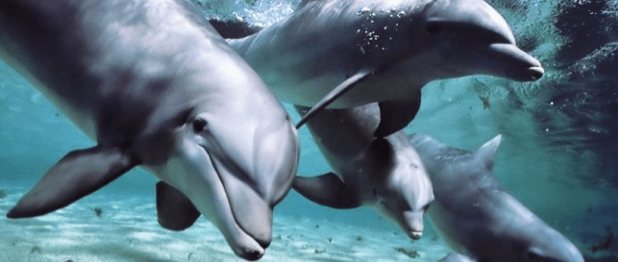
(Image via Digital Trends)

TAGS: | | | | |


  • Anonymous

    “Man has always assumed that he was more intelligent than dolphins because he had achieved so much…the wheel, New York, wars and so on…while all the dolphins had ever done was muck about in the water having a good time. But conversely, the dolphins had always believed that they were far more intelligent than man…for precisely the same reason.”–Douglas Adams

  • http://profile.yahoo.com/F6WDMXYFH6S5NTOYGNP6WPXGFA Sarah

    “A million sponges aren’t cool. You know what’s cool? A billion sponges.”

    Sorry, I saw “Social Network Tendencies” and couldn’t resist.

  • Tristan Zimmerman

    “They’re already similar to us in some pretty striking ways; they even have genes that are homologous with humans.”

    Really? Genes homologous with ours? I’m shocked. Or I would be if I didn’t understand what “homologous” meant and consequently didn’t realize that all organisms share homologous genes. If you don’t know enough biology to understand that clause, it’s meaningless. And if you do know enough biology to understand that clause, it’s even more meaningless.While The Mary Sue’s science reporting is generally terrible, that sentence really takes the cake.

    Love the pop culture and nerd coverage, though!

  • Anonymous

    Hm.

    Option 1 – point out the error in terminology in the article.

    Option 2 – Option 1, and suggest a more correct term.

    Option 3 – Option 1, but be more of a dick about it.

    Just pointing out there was more than one way to handle that.

    Love the way you ended with a compliment, though!

  • http://twitter.com/diefrankenmaus Kate

    So now we know that individual dolphins not only participate in rape and hate crimes (killing porpoises for no reason), but in typical “mean girl” shunning as well. Sounds human to me! 

  • Jenny Cabotage

     Also, in fairness to the Mary Sue, this post links to a blog post about dolphin DNA which seems to suggest that dolphins have more DNA in common with humans than they should. This is probably why she made the comment about homology.

    Unfortunately, I tried to hunt down an actual scientific article that supported what that blog post said, and I just can’t find anything reliable. The closest thing I could find was this:

    http://rspb.royalsocietypublishing.org/content/early/2012/07/18/rspb.2012.0869.short

    This is a study that says dolphin genomes have been evolving in ways that are more similar to elephants and primates than other (less smart!) mammals. Also dolphins have brain genes that have been going under a lot of natural selection, and the human homologs of these genes are probably pretty important for human intelligence. This is really interesting because it seems that smart mammals, even ones that are somewhat distant evolutionary relations, might have evolved in similar ways. Makes sense since they have behaviors similar to us too!

  • Tristan Zimmerman

    VBartilucci, I can’t help but grin at your last sentence. I see what you did there…

    EDIT: And while you’re right that I was a dick about the whole thing, I stand by what I had to say: while the majority of the Mary Sue’s content is great, their science reporting is, almost without fail, genuinely terrible. This article (which is awful for far more than just that sentence; it’s just the most egregious example) is one of the worse I’ve seen on the blog. Honestly, these articles may well do more harm to people’s understanding of science than good. That is to say, many people reading this article probably now know less about dolphins than they did before.

    Which, I suppose, is impressive in its own right.

  • Anonymous

    Yes, and if dolphins are able to discover and pass down tool-using techniques, they might be at the very beginning of a long road of technology.  Perhaps the invention of the “fishing sponge” will be compared on Fishipedia, thousands of years in the future, to the human mastery of fire.

  • Anonymous

    Opposable thumbs are very handy with the tool making though. As is the ability to use fire and the chemical/physical transformation that causes. Dolphins are at a huge disadvantage from that perspective. They’re never going to have a bronze age no matter how intelligent they become, and electricity is a no-go too. Even if they reach the same level of human intelligence and sentience, they shall ever know the joys of the Internet or the written word. So sad. Terrestrial life forms’ cultural possibilities > aquatic life forms’ cultural possibilities.

  • Anonymous

    Larry Niven, in his Known Space stories, writes about dolphins becoming declared a sentient species, and wearing prosthetic devices to mimic hands.  While they have names in their own language, they have become enamored of the names human have given them over the years, resulting in some interesting in the crew lists on many ships.

    He writes that (tho I’ve no idea how true it is) the bones in a dolphin’s fins are very similar to the bones in a human hand, albeit immobile, which suggested that they may have at one time had manual dexterity.

  • Anonymous

    There’s a saying about the choice between doing something, or complaining about it.

    http://kurtisscaletta.files.wordpress.com/2010/07/243050-zoom.gif?w=500&h=107

  • Anonymous

     @ VBartilucci, the only way dolphins will ever get prosthetic hands is if humans give them to them. We don’t appreciate the dexterity that comes with opposable thumbs, for realz. Having similar bone structure (whether its true or not) doesn’t really matter. ‘Almost’ only counts with horseshoes and nukes. Moreover, oral language is great and everything, but it’s hard to pass down (and therefore build upon) existing knowledge through oral traditions. Historically, that’s one of the reasons why the printing press was so important to technological advancements. You can’t have fire, paper, or electricity in an aquatic environment. Clay tablets are also difficult, and the material would be scarce. Physiologically and environmentally, dolphins are at a serious disadvantage, even if they are sentient.

     This seems like a silly conversation, but it’s still fun :)

  • Anonymous

    If there’s one thing that’s a recurring theme in Sci Fi (and to a degree, in real life) it’s that people love uplifting other races. 

    If we found a way to communicate with dolphin and found out they were sentient (ie, we got a response more complex than “fish, please”), after the apologies for all the nets and poor royalty arrangements for their various appearances in entertainment, we’d be falling over ourselves to build them stuff so they could work for us, and with us, and in that order

X