9 Female Characters We Wish We’d Been More Like In High School
Because teenagerdom is a mess, but some people handle it better than others.
Full Trailer For ABC's Agents of SHIELD
Disney Not Backing Down On Merida
BSG S1 Finale Newbie Recap
Doctor Who Recap: "Nightmare in Silver"
Game of Thrones Episode 7 Recap
by Kellie Foxx-Gonzalez | 12:31 pm, July 25th, 2012
Getting into anime, let alone keeping up with it, can be quite difficult in the United States -- much of the good stuff isn’t aired on cable, it takes dedication to keep up with fansubs, and it’s often hard to weed out the good, women-friendly titles from the hypersexualized harem anime. There’s also that whole bit about torrenting being illegal...plus, wouldn’t it be nice to have a bunch of good shows concentrated into one or two easy-to-use places?
So, in order to make your life easier, I’ve compiled a list of 10, feminist-friendly anime to legally watch on Netflix and Hulu, which is either free, something you already pay for, or only $8 bucks a month! Of course, there’s always places like Crunchyroll that legally stream anime for $7/month, but this list is more geared to nerds that haven’t quite decided whether or not anime is for them.
So, with that said, let’s jump right into our list!
Ghost In The Shell: Stand Alone Complex follows Major Matoko Kusanagi, a cyborg squad leader of the police taskforce Public Security Section 9, as she investigates a series of mysterious hacking incidents perpetrated by the Laughing Man. This cyberpunk series deftly explores the consequences of technological advancement, political corruption, and questions of consciousness and humanity, all the while thrilling us with the adventures of Matoko and her team. The best part? Matoko is an excellent female character -- she’s a strong, capable leader, she’s queer, and she manages to express a unique brand of femininity that isn’t centered around men caring for her.
Check this out if you’re into William Gibson-esque philosophical cyberpunk dramas featuring capable, queer female leads.
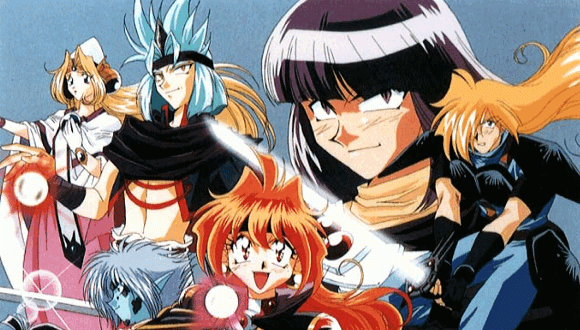
Before you discount Slayers on the basis of its old, now shoddy animation, hear me out: if choose not to watch this series, you’ll be missing out on one of the most feminist comedy/adventure shows of its time. Slayers centers on Lina Inverse, a powerful sorceress who loves treasure and causing trouble. What makes Slayers particularly fun is that it is totally cognizant of adventure anime tropes and often seeks to subvert them -- for example, in the first episode Lina is about to blow up a gang of bandits when an attractive young man rushes in to save her. Although it’s obvious that she totally could have handled it herself, she begins to scream like a typical damsel in distress because it’s what her attractive savior is expecting, and she’s looking to impress him. It’s an old anime, but it’s aged well and it’s a fun, fantastical adventure led by a bubbly, funny, and super powerful girl. What more could you want?
Check this out if you’re into adventure, comedy, and treasure-stealing fire mages.
Fullmetal Alchemist follows Edward and Alphonse Elric as they search for the the Philosopher’s Stone in order to restore their bodies, which were left in varying states of disrepair after a failed attempt to bring their mother back from the dead using alchemy. FMA’s setting is evocative of a post-industrial revolution Europe, and the series uses elements of steampunk and magic to tell its tale of political corruption, state militarization, genocide, and human loss. As an added bonus, the series includes some pretty fantastic women characters: Winry Rockbell is a capable mechanic who fixes Edward’s automail arm and Riza Hawkeye, an accomplished sniper is a level-headed badass.
Check this out if you’re into magical steampunk meditations on state violence and the strength of familial bonds.
Upon first glance, Ouran might seem like a pretty typical romantic comedy anime geared toward women -- you’ve got a shy girl, a dashing but complex male love interest, and a high school setting, the perfect elements of a romcom. However, we have to give this series a little more credit than that. Ouran follows Haruhi Fujioka, a poor female student on a scholarship at a prestigious private academy. On the prowl for a place to study, Haruhi stumbles upon the school’s Host Club, a group of six male students who entertain women, and promptly breaks their expensive vase. In order to pay them back, short-haired, androgynous Haruhi must work as a host. When you think about it, this series is remarkably queer -- not only do the school’s women absolutely fawn over Haruhi, the entire premise of a host club seems to disrupt the male gaze. In this universe women gaze at men and masculine women. Furthermore, when the hosts clamour to win Haruhi’s heart, she’s often still in masculine clothing, queering the desires of her straight male counterparts.
Check this out if you’re into the idea of a queer heterosexual romcom. Or if you just like the idea of a host club.
Another is totally creepy! When Koichi Sasakibara transfers to his new school, he can tell there’s something his new classmates aren’t telling him -- specifically, why he seems to be the only person to acknowledge that Mei Misaki, a mysterious girl who sits in the back of class, even exists. I won’t spoil anything for you, but Another’s story is complex, creepy, and ends with more than its fair share of deaths, so if you get too attached to characters, perhaps this show isn’t for you. For those willing to brave this beautiful blend of weirdness and despair, you’re in for a real treat. Another has enough twists and turns to keep the plot interesting, but also leaves time for its interesting characters to shine, specifically the class outcast Mei -- she is so much more than a one-dimensional gothic-lolita-esque girl.
Check this one out if you’re into horror and M. Night Shyamalan twists, with a bit of campy violence thrown into the mix.
Born from a series of light novels, Kino’s Journey centers on, well, Kino, an androgynous young girl who, accompanied by her talking motorcycle Hermes, travels the world but stays in a town for no more than three days and two nights, as the last thing she wants is to settle in and settle down and give up her life of adventuring. Each town that Kino visits has its own set of troubles that often symbolizes deeper questions of oppression, beauty, and freedom. For example, one town she visits is entirely run by machines, the product of a society that adapted the ability to feel each other’s every emotion. The consequence? An utter inability for human co-existence, the burden of intimately knowing one another’s pain too large to bear. Although Kino’s Journey is very easy to watch -- the landscapes are beautiful, the animation is minimalistic yet visually stunning -- the ideas that it contends with are not that easy to escape.
Check this anime out if you’re into heavy-hitting, deep philosophical musings conveyed through the journey of a young girl and her motorcycle.
Le Chevalier D'Eon revolves around Lia de Beaumont, a woman who is viciously murdered and found floating in a casket along the Seine. D'Eon, her younger brother, takes it upon himself to investigate her murder, and things get quite complicated when her soul enters his body so she can exact her revenge. Le Chevalier D'Eon is interesting because of the supernatural way it handles violence against women -- Lia, who is the victim of a brutal murder, does not have the agency to take revenge, but her brother, a man, does. So in a way, Lia is mobilizing his male privilege to her own end, an interesting take on gender and power.
Check this anime out if you like loose French history, horror, and tales of revenge enacted by the ghosts of vengeful women.
NANA follows the lives of two young women that share the same name, Nana, as they try to establish themselves in Tokyo. Nana Osaki is the lead singer of a punk band who leaves her bassist boyfriend to pursue her true love, her band Black Stones. Nana Komatsu is a rather childish woman who falls in love at the drop of a hat. NANA catalogues the ups and downs of their lives, and it is certainly refreshing to see an anime that manages to depict women in a complex light -- these ladies aren’t perfect, but neither am I and I’m glad to see a set of women protagonists I can relate to.
Check out NANA if you like punk rock, romance, and media that explores the strength and importance of friendships between women.
I would suggest Rideback to even the most stubborn skeptics of feminism in anime. This series follows Rin Ogata, a former ballerina who breaks her foot, quits dancing, and joins her school’s RideBack club, where she learns to ride a transforming motorcycle-like robotic vehicle. It’s not just a sport, though -- under the clenched fist of a tyrannical government, Rin is forced to use her riding skills to fight for the freedom of herself, her friends, and her family. Naturally, this show is a shoe-in for this list: it seems to posit that ballet, an art often associated with women, can prepare the body for battle just like any other sport, and that women are perfectly capable of appreciating the power of mecha when it comes to toppling tyranny with force. I am totally in love with this anime, it places a woman in the center of a genre that usually caters to men with such ease that you have to wonder why aren’t all action anime like this.
Watch this series if you like robots, fast-paced action sequences, and a lady protagonist that manages to be graceful and deadly.
You might not have heard much about the anime Wandering Son, and that's a shame, because it has some of the most poignant and sincere depictions of young people grappling with their gender identity that I've seen anywhere. Shuichi Nittori is a child who was assigned as a boy at birth – she desperately wants to be recognized as the girl she knows she is and often wears girl's clothing, despite receiving ridicule from her classmates.
Wandering Son stands as an beacon of light in an art form often plagued by depictions of trans* characters used for comedic purposes, or as silly plot devices. Instead of a silly story that makes light of gender identity, the viewer is presented with both serious and lighthearted tales of Shuichi undergoing puberty, growing body hair, getting pimples, and experiencing a deepening voice, all while trying to reconcile her gender with the world.
Check this out if you're into slice-of-life, queer dramas about puberty, friendships, and childhood love!
Edit: I originally included this series in the top 10 list, which was the wrong move as it's not anime and the discussion of race I offered wasn't fully contextualized and fleshed out. However, this animated series is still extremely important on the basis of it featuring characters with darker skin, something very rare in not only most animated series, but all media, so if you haven't already, watch it!
Why A List Actors Star in Horrible Horror Films
The 10 Most Hilariously Wrong Jeopardy Answers
'Real World' Stars: Where Are They Now?
Vampire Diaries Gets a Spin off