


Woman Asks Her Late Father a Question in a Dream. Then She Wakes Up Remembering Only His Disturbing Answer: ‘You Weren’t Supposed To Ask’
It’s DreamTok time.
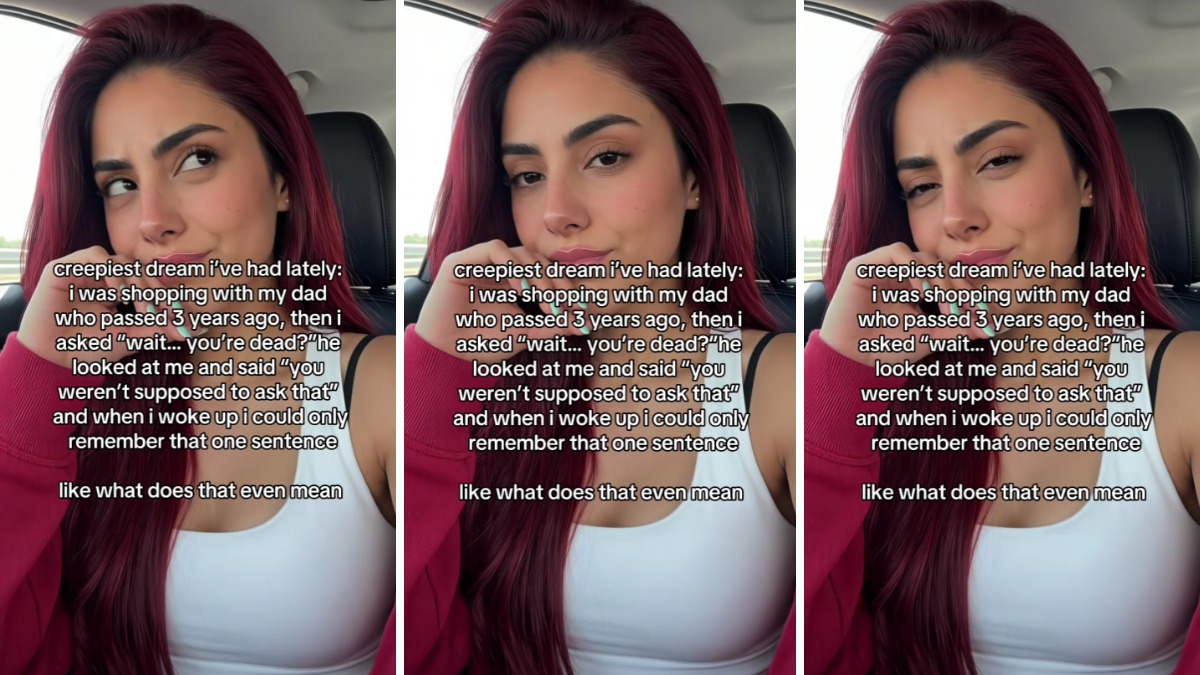
A woman recently shared a chilling dream about her late father that left her with more questions than answers. In a six-second video posted in June 2026, Piper, @piperpoorhani on TikTok, described a vivid dream where she was shopping with her father, who passed away three years earlier. When she realized the situation made no sense and asked him, “Wait, you’re dead?” he looked at her and replied, “You weren’t supposed to ask that.”
That single sentence was all she remembered upon waking, leaving her unsettled and wondering what it could possibly mean. Piper’s video went viral, racking up over 3 million views, nearly 100,000 likes, and thousands of comments. Her caption, “ead relative dreams always feel way too real,” captured the eerie realism of these experiences, a sentiment many viewers echoed.
Her post fits neatly into the ‘DreamTok’ niche, where creators share strange, emotional, or seemingly prophetic dreams and invite interpretation from their audience. For Piper, this dream was more than just a fleeting memory. It was a moment that blurred the line between grief and the subconscious, leaving her, and her followers, with a lingering sense of unease.
The responses to Piper’s video varied
Some shared personal anecdotes, while others shared warnings and theories. Some viewers saw it as a classic grief dream, where the subconscious processes loss through hyper-realistic encounters with the deceased. Others linked it to lucid dreaming, where acknowledging a deceased person in a dream can “break the illusion” and abruptly end the experience.
One commenter warned, “as someone who can control their dreams, DONT EVER ASK THAT,” while another speculated, “He is alive in another timeline.” Another person added some humor to the situation, saying, “I always get kicked out of my dreams for asking questions.”
Piper often posts about dreams. Her bio on TikTok states, “dreams aren’t predictions they’re feelings your brain didn’t finish.” It’s a sentiment that resonates with many who see dreams as a way for the mind to process emotions, memories, and even unresolved grief. But what makes dreams of deceased loved ones feel so real?
Science has some theories
According to PsyPost, a study published in the journal Dreaming explored the connection between sleep patterns and lucid dreaming, particularly in individuals with trauma symptoms. The research, led by Arnaud Delorme at the Institute of Noetic Sciences in Novato, California, found that specific sleep characteristics can predict the likelihood of experiencing a lucid dream.
For people with post-traumatic stress disorder, lucid dreaming can be a double-edged sword. It can offer a way to confront and reprocess traumatic memories in a safe, controlled environment. However, it can also feel overwhelmingly real. The study involved 27 adults with chronic PTSD, including combat veterans and accident survivors. Participants wore a brainwave-recording headband, an electroencephalogram, while they slept at home.
Each morning, they filled out a survey detailing their dream experiences from the previous night, noting whether they had achieved lucidity – meaning they recognized they were dreaming and, in some cases, could control the dream’s events. Over 120 nights of sleep data, participants reported lucid dreams on 23 occasions.
The findings revealed that lucid dreaming was more likely to occur on nights with shorter sleep onset latency (meaning participants fell asleep faster), greater wakefulness after initially falling asleep, and lower low-delta activity during REM sleep. Delta waves, which cycle at one to two times per second, are typically associated with deep, restorative sleep.
Lower delta activity during REM sleep suggests a lighter, less consolidated state of rest, which may create the cognitive conditions necessary for lucidity. Essentially, when the brain isn’t in a deep sleep, it’s more likely to maintain the self-awareness needed to recognize a dream for what it is.
For people with PTSD, this kind of awareness can be therapeutic
Chronic nightmares are a common PTSD symptom, and lucid dreaming offers a way to confront those fears without becoming emotionally overwhelmed. By recognizing that a nightmare isn’t real, individuals can shift the narrative, turning a terrifying experience into an opportunity for emotional regulation.
But the research also comes with caveats. The number of nights where participants reported lucid dreams was relatively small, which means some connections between sleep metrics and dreaming might have been missed. Delorme cautioned that the findings are exploratory and should be viewed as promising predictors rather than definitive conclusions. He also warned against intentionally disrupting sleep to induce lucid dreams.
While fragmented sleep was associated with more lucidity, chronic sleep interruption can worsen overall well-being and exacerbate trauma symptoms. “Our findings do not imply that fragmented sleep is necessarily beneficial or that people should intentionally disrupt their sleep to increase lucid dreaming,” he said. “The observed associations are correlational and do not establish causation.”
The study’s methodology also had limitations
The brainwave-recording headband used a single sensor channel, which restricted the researchers’ ability to pinpoint exactly where in the brain the activity was happening. Additionally, the algorithm used to classify sleep stages relied on the same brainwave frequencies that were later analyzed, creating a slight circularity in the data interpretation.
Future research will need larger samples, more lucid dream events, and more detailed assessments of dream recall and lucidity strength to build on these findings. Despite these limitations, the study offers valuable insights into the physical signs of lucid dreaming and its potential therapeutic benefits.
For Piper and others who experience vivid dreams of deceased loved ones, the research provides a scientific lens through which to understand these surreal encounters. Dreams of the dead often feel hyper-real because they tap into the same brain mechanisms that allow for lucidity. The mind isn’t just replaying memories. It’s processing grief, fear, and unresolved emotions in a way that feels tangible, almost like a conversation.
(Featured images: Piper @piperpoorhani on TikTok)
Have a tip we should know? [email protected]
Follow The Mary Sue:
