


Texas Fast Food Joint Sells Burgers for $3.10. But That’s Not Why They’re ‘Private Equity’s Worst Nightmare.’
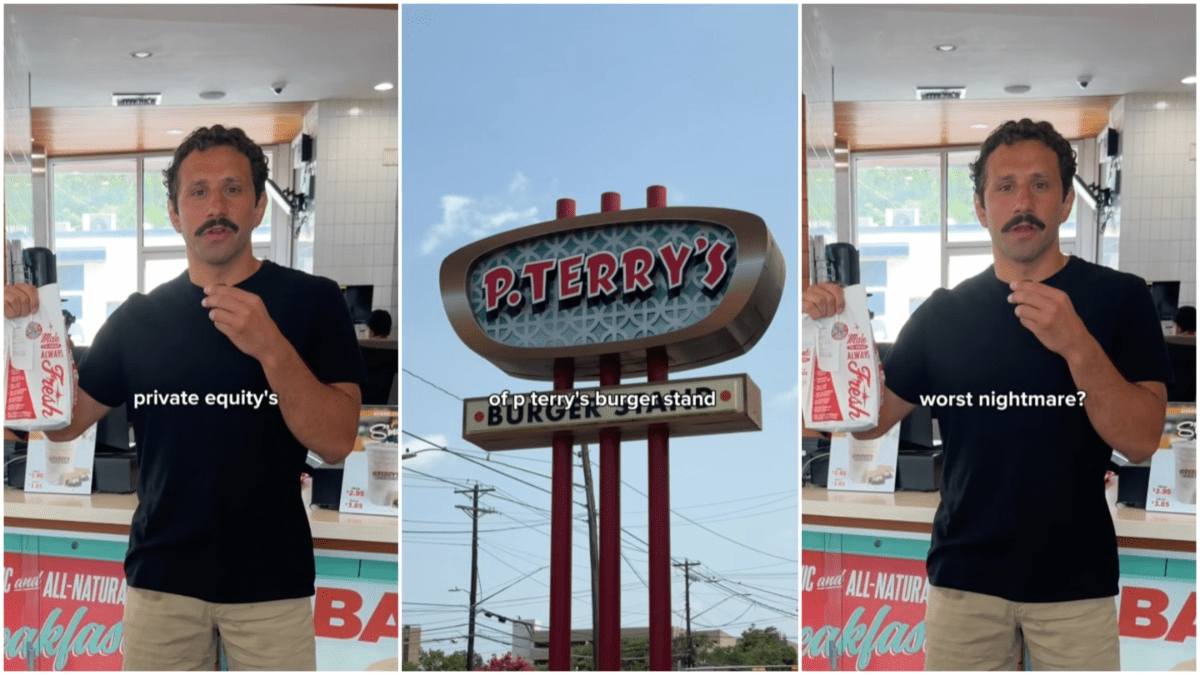
Fast food is supposed to be tasty without costing a fortune, and P.Terry’s got that formula down to a tee with their $3.10 hamburgers. But in a recent interview with Earning Earth on TikTok, the beloved Texas fast-food chain revealed a business decision that made them “private equity’s worst nightmare.”
Myles Amine of Earning Earth interviewed Kathy Terry and Patrick Terry, the co-founders of P.Terry’s Burger Stand. The business opened 21 years ago, with Patrick being 41 back then.
“The result was a 520 square-foot spot that had three windows and no AC,” Amine said. It was a rough start for the couple. As Kathy said, they “wore all the hats” to keep their new business venture afloat during those long, hot days.
“What is the motivation in those early stages?” Amine asked.
“It was sheer determination, you know. Just not wanting to fail,” Patrick said. Years later, the Terry couple’s efforts would pay off. The burger joint would often be lauded for its clean-tasting burgers and fries—less greasy than the average—as well as its signature shakes. Even USA Today would recognize P.Terry’s as one of “America’s Top 15 Regional Fast Food Chains.” Southern Living also had high praise for the burger joint, hailing it as “America’s Best Burger Chain.”
“The Terrys went from hand-pattying their burgers to 38 locations and 1800 employees. But when it came time to cash in, they had something different in mind,” Amine stated in the feature interview. There has been hefty discourse about wealth disparity online.
Social media users have been up in arms, especially after Elon Musk reached his trillionaire status. Not all were pleased by the announcement, with many critics disillusioned by capitalism. But P.Terry’s model appears to offer a different way forward. They had both scaled up in growth, while acknowledging the efforts of their employees along the way.
A fast food chain that cares about its workers
“A lot of business owners today are selling their companies to private equity, but you guys decided to sell it to your employees. What led to that decision?” Amine inquired.
Kathy said that at first, they laughed at the first opportunity to sell their business. She and Patrick joked that they could buy a private island with that money but decided against it.
“That would be really lonely,” Kathy concluded.
“In the end, we realized that giving our employees something back, more than just a salary or Christmas bonus, was something we just should do. And so, Kathy took this project on years ago and went through all the different gyrations to get to where we ended up,” Patrick explained.
“Instead of selling to investors, they put the company into a trust for their employees. Profits get shared with the people who work there. The culture they built now belongs to the people who built it,” Amine expounded upon the model.
Essentially, the Terry couple opted for an employee ownership trust. The couple could have gone with a lucrative exit strategy and left the business at the whims of for-profit entities. They’ve given the employees a stake in P.Terry’s and its future in an unusual move.
“1800 employees, 38 locations, a die-hard customer base—are you living the dream?” Amine asked, and Patrick had a clear answer.
“It’s pretty great being P.Terry,” Patrick responded. He continued, “The future’s so bright, I gotta wear shades.”
(featured images: Earning Earth)
Have a tip we should know? [email protected]
Follow The Mary Sue:
