


Secretary of War faces Senate grilling over $1.5T budget even as GOP senators quietly await his exit
On shaky ground.
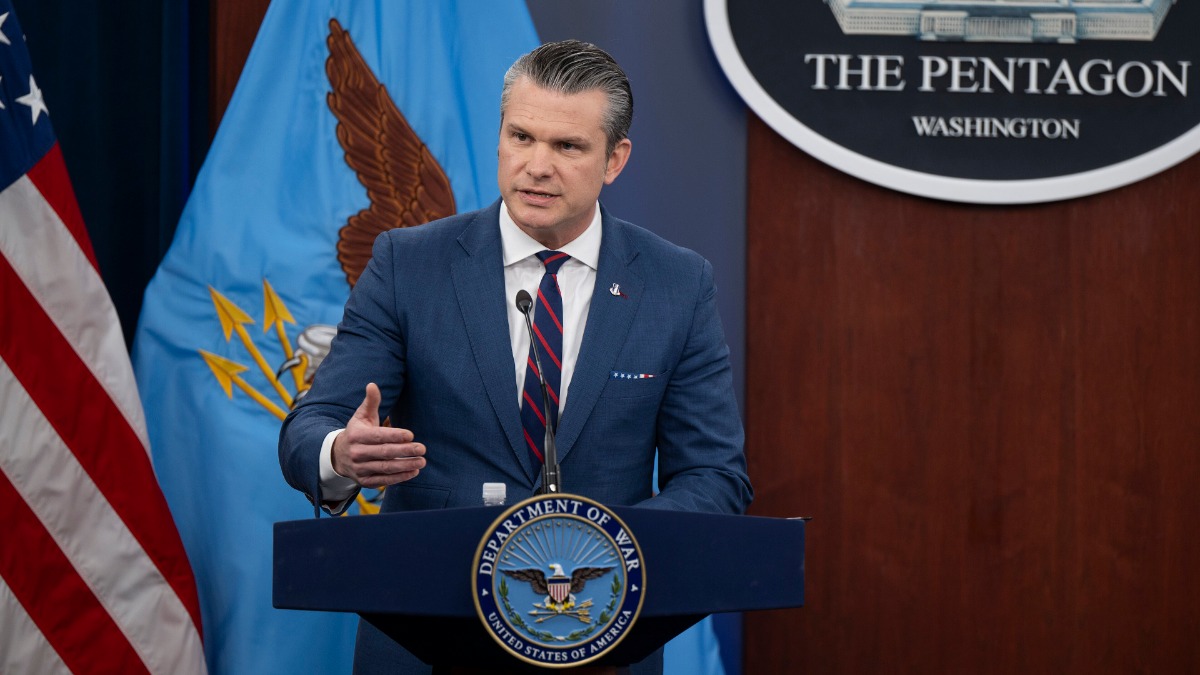
Secretary of War Pete Hegseth is heading to Capitol Hill this week to defend the Pentagon’s $1.5 trillion budget request, but the real drama might not be the numbers. It’s the growing chorus of GOP senators who are done waiting for him to leave.
According to The Hill, Hegseth will testify before the Senate Armed Services Committee on April 30, joined by Joint Chiefs Chair Gen. Dan Caine and acting comptroller Jules W. Hurst III. The budget he’s pitching is massive, with $750 billion earmarked for the “Golden Dome” missile defense system, $102 billion for aircraft procurement and R&D, and $65 billion to build 18 Navy warships.
There’s also funding for 85 F-35s per year and next-gen systems like the B-21 bomber and F-47 fighter. On paper, it’s a muscular defense plan. In reality, it’s landing in a room full of skeptical senators who’ve already decided Hegseth isn’t the guy to execute it.
The Senate grilling comes at a rough time for Hegseth
A growing number of GOP lawmakers have lost confidence in his leadership, with some quietly pushing for him to “move on.” Multiple senators, speaking anonymously, said if Hegseth were up for renomination today, he wouldn’t get confirmed. The tipping point? The recent ouster of Army Chief of Staff Gen. Randy George, a move that left even his allies stunned.
“The hollowing out of incredible leadership at the Pentagon has been a big concern,” one senator said. “It really came to a tipping point when Gen. George was dismissed.” George wasn’t the only casualty. Navy Secretary John Phelan was fired last week, and other high-profile exits, including Joint Chiefs Chair Gen. C.Q. Brown and Air Force Chief of Staff Gen. James Slife, have left lawmakers questioning Hegseth’s personnel decisions.
Sen. Thom Tillis, who voted to confirm Hegseth last year, now says he’s “missing the mark on personnel” and has “a failing grade” on managerial skills. Tillis pointed out that Hegseth’s prior experience managing “30 or 40 people” in the Minnesota Army National Guard didn’t exactly prepare him for running the Pentagon.
“Now he’s got an organization that’s much larger, much more complex than anything he’s done,” Tillis said. “I think he’s making some less-than-ideal personnel decisions.”
Hegseth’s feud with Army Secretary Dan Driscoll, a close ally of Vice President J.D. Vance, hasn’t helped his standing either. Driscoll was out of town when George was pushed out, and senators suspect Hegseth timed the move to avoid pushback.
Driscoll later called George “an amazing, transformational leader” during a House hearing, while House Appropriations Chair Tom Cole called his ouster “a real loss.” Sen. Joni Ernst, who chairs the Senate Armed Services Subcommittee on Emerging Threats, was blunt: “It was a mistake for Secretary Hegseth to dismiss him.”
The Pentagon’s response hasn’t done much to calm nerves
Chief spokesperson Sean Parnell said Hegseth doesn’t comment on departures but argued that reforming the Defense Department requires changing leadership. “It is extremely difficult to reform a department, particularly a department the size of DoD, with the same personnel who were a part of previous priorities,” Parnell said. That’s not reassuring when the Pentagon is in the middle of a war with Iran, and senators are watching key generals get pushed out.
The flu vaccine decision hasn’t won Hegseth any fans either. Last week, he announced that service members would no longer be required to get flu shots, a move that Sen. Roger Wicker called “a mistake.” Wicker, who chairs the Senate Armed Services Committee, said flu shots have a long track record of safety and effectiveness, unlike the more controversial COVID-19 vaccines.
“When I was on active duty and a reservist, I dutifully took my flu shot every year. And as a whole, it made for a healthier armed forces,” he said. It’s a small issue compared to the war and budget fights, but it’s another example of Hegseth making calls that rub lawmakers the wrong way.
Hegseth’s testimony this week will be his first chance to address the Senate since the Iran conflict began, and he’ll have to answer for more than just the budget. Senators want to know why key leaders are being shown the door, why the Pentagon’s personnel decisions feel so chaotic, and whether Hegseth is the right person to steer the military through a war.
Many are looking forward to a post-Hegseth Pentagon
The meeting was originally scheduled for last week but got postponed due to late-night budget votes, which probably didn’t improve anyone’s mood. Some GOP senators are already looking ahead to a post-Hegseth Pentagon. Sources say there’s quiet talk about Trump replacing him, just as he’s tapped new leaders for Homeland Security and the Justice Department.
Sen. Lisa Murkowski, who voted against Hegseth’s nomination, said she was “shocked” by George’s firing. “People are wondering what’s going on over there,” she said. “We’re in the middle of a war. We got to know that things are being managed well. So, not good.”
That’s the real problem for Hegseth. The military’s operations in Iran have gone well. Senators have praised the rescue of downed airmen as a testament to the armed forces’ excellence. But the Pentagon’s internal turmoil is overshadowing those wins. If Hegseth can’t convince lawmakers that he’s got a handle on personnel, the $1.5 trillion budget might be the least of his worries.
(Featured image: SECWAR)
Have a tip we should know? [email protected]
Follow The Mary Sue:
