


Rubio just drew a red line for China in Latin America after Panama-flagged ships mysteriously vanished in the canal
Standing firm.
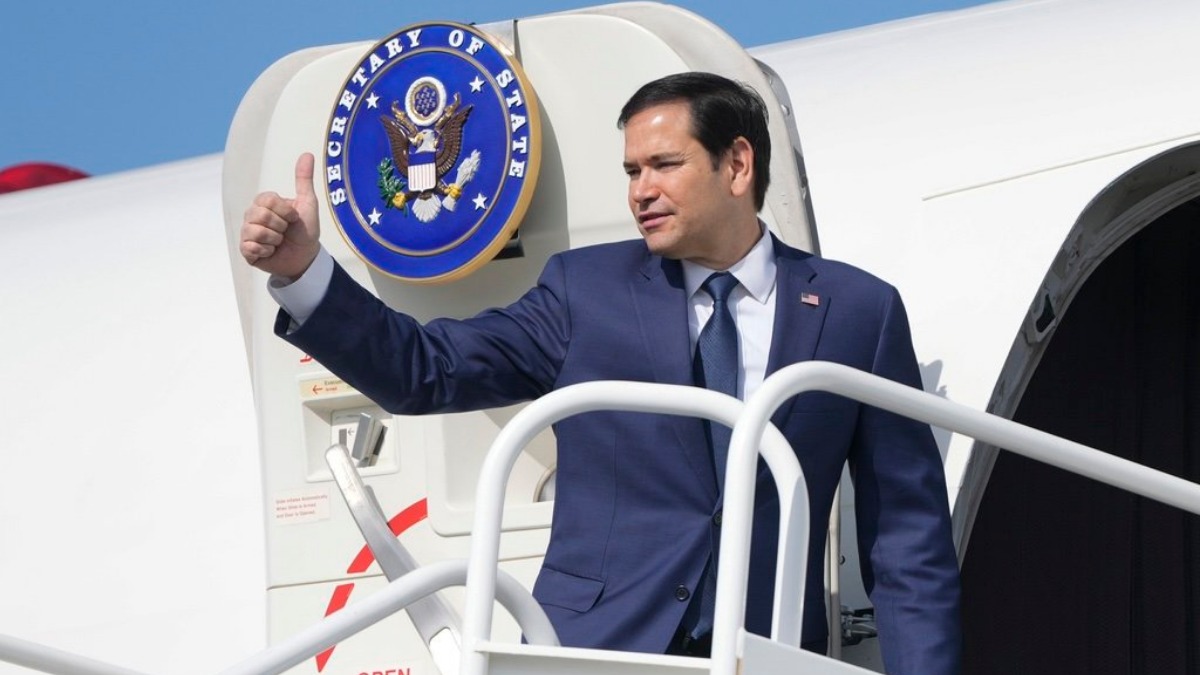
Marco Rubio just issued a sharp warning to China, declaring that “the sovereignty of our hemisphere is non-negotiable” after the U.S. and five Latin American allies accused Beijing of detaining Panama-flagged ships in a dispute over control of the Panama Canal. The confrontation by the Secretary of State escalated into a full-blown showdown over one of the world’s most critical commercial arteries, with both sides accusing the other of politicizing maritime trade.
The joint statement from the U.S., Bolivia, Costa Rica, Guyana, Paraguay, and Trinidad and Tobago called China’s actions a “blatant attempt to politicize maritime trade” and a direct threat to regional sovereignty. The dispute centers on Panama’s Supreme Court decision to invalidate the legal framework behind Hong Kong-based CK Hutchison’s control of the Balboa and Cristobal terminals which flank the canal and handle roughly 5% of global maritime trade.
According to Fox News, U.S. regulators have tracked nearly 70 Panama-flagged vessels detained by Chinese authorities since March 8, a surge American officials say is retaliatory pressure against Panama. China has firmly rejected the accusations, with its foreign ministry calling the U.S. statement “entirely baseless and misleading.”
China in turn, has accused US of ‘slandering others with rumors’
Liu Pengyu, a spokesperson for the Chinese Embassy in Washington, D.C., insisted that Chinese authorities conducted “routine inspections of vessels in accordance with laws and regulations” and accused the U.S. of framing normal port operations as political and security issues.
“It is the United States that has framed normal affairs concerning relevant terminals as issues about politics and security, making pretenses and slandering others with rumors,” Liu said. Beijing has vowed to “firmly defend its legitimate rights and interests” and urged other countries not to be “blinded and utilized by those with ill intentions.”
The standoff has drawn comparisons to another critical maritime choke point, the Strait of Hormuz, where tensions between the U.S. and Iran have disrupted global energy markets. Since February 28, the strait has been effectively closed, with Iran imposing tolls for passage – a move without precedent in modern maritime law.
The U.S. responded with a naval blockade targeting Iranian shipping, leaving around 2,000 vessels stranded and causing oil prices to spike. The situation has raised concerns that major powers are increasingly willing to weaponize shipping lanes, challenging longstanding international norms governing the world’s seas.
Experts warn prolonged disruption to the Panama Canal could have severe economic consequences
Ferdinand Rauch, a professor of economics at the University of St Gallen, told Al Jazeera that even temporary closures could lead to “supply bottlenecks, stock market volatility, inflationary upward pressure, and a measurable dampening of global GDP.”
The canal is a linchpin for trade between the U.S. East Coast and Asia, as well as South American intercoastal routes. If ships were forced to reroute around the southern tip of South America, the added distance would significantly increase costs and delays.
The broader geopolitical context adds another layer of tension. Gordon Chang, a China expert, said that Beijing’s actions in Panama fit a pattern of using economic leverage to expand influence while condemning similar tactics from Washington. “China has used Iran to destabilize the Middle East. In effect, Iran has been China’s proxy,” Chang said, arguing that the U.S. is now pushing back not just against China but also against its regional allies.
He framed the pressure on Iran and the Strait of Hormuz as part of a larger strategy to counter Beijing’s global ambitions. “Closing the Strait of Hormuz is a two-fer, starving Iran’s regime and shaking China’s already fragile economy,” Chang said.
China, however, has accused the U.S. of hypocrisy, pointing to Washington’s own history in the region. Lin Jian, a spokesperson for China’s Ministry of Foreign Affairs, questioned who had “occupied the Panama Canal for a long time, invaded Panama with its military, and arbitrarily trampled on its sovereignty and dignity.”
He argued that the U.S. is the one politicizing ports and disregarding the sovereignty of regional countries. Panamanian President Jose Raul Mulino has tried to ease tensions, welcoming the “solidarity of friendly countries” while emphasizing that Panama values “respectful relations with all nations.”
The wider erosion of maritime norms have experts asking if this is the new normal
Abdul Khalique, professor, Liverpool John Moores University, warned that “rising geopolitical rivalry” is increasingly spilling into maritime chokepoints, leading to “higher baseline risk, politicized shipping lanes, and more frequent disruptions.” Governments and firms are already adapting by diversifying supply chains, revising risk premiums, and investing in alternative routes.
However, James Kraska, professor of international law, U.S. Naval War College, remains optimistic that the Strait of Hormuz crisis will be resolved through negotiation. “My personal view is that the straits will be open through some sort of negotiated agreement between Iran and the United States,” he said, citing strong international opposition to unilateral closures of major sea lanes.
Stephan Maurer, professor, UPF Barcelona School of Management, said the Panama Canal’s disruption would hit South American countries the hardest, but the U.S. and Canada would also face severe consequences. Trade between the U.S. East Coast and Asia, as well as Europe and the West Coast of South America, would be particularly affected. While trade would adapt, the immediate impact would be costly and disruptive.
(Featured image: Embassy of the United States of America to Italy)
Have a tip we should know? [email protected]
Follow The Mary Sue:
