


Michigan Woman Compares an Old Pair of Old Navy Pants to a New One. Then She Realizes Something Is Seriously Wrong
A problem that’s personal and universal.
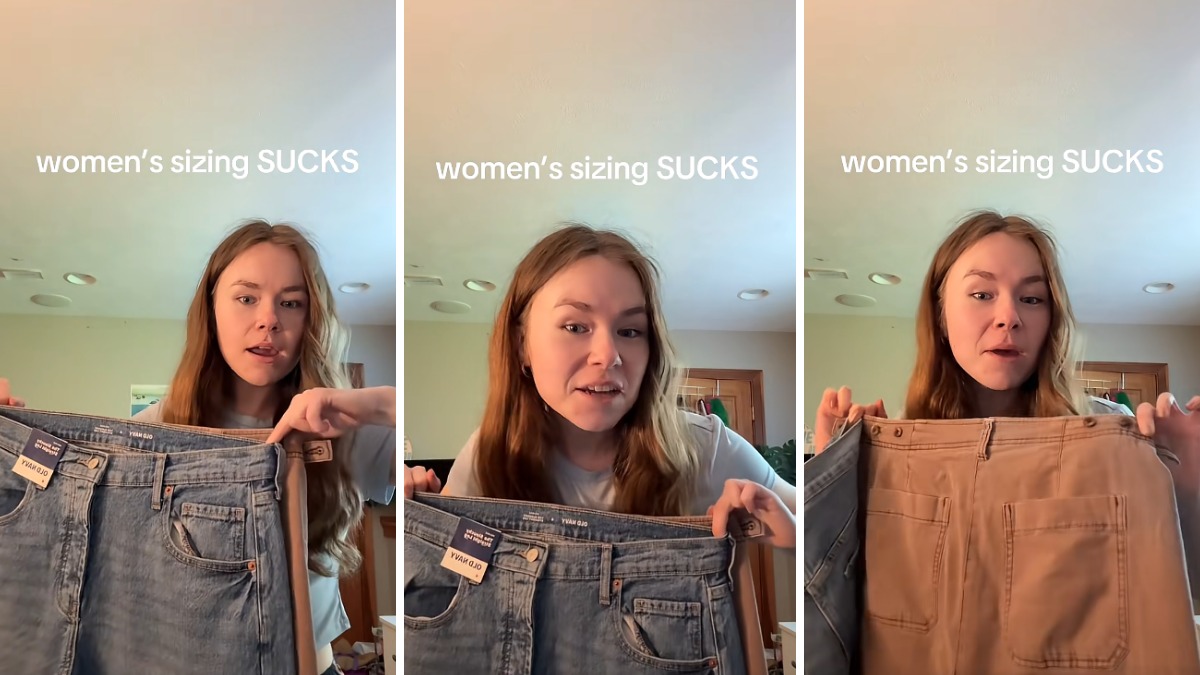
A Michigan TikToker just proved how broken women’s clothing sizes really are, and the internet is losing it. Sami, @samis.dump on TikTok, posted a video in May 2026 that’s now racked up over 5 million views, and it’s easy to see why. She holds up two pairs of Old Navy pants that look almost identical in size – one brown pair from a couple of years ago labeled a size 14, and a newer blue pair marked a size 4. That’s a 10-size difference for what’s essentially the same fit.
“If you just want proof of how bad a woman’s sizing is, these pants look about the same, right?” Sami says in the clip. “They’re 10 sizes different. The brown pair is 10 sizes bigger than the blue pair. Are you kidding me?!” The video’s caption tags Old Navy with a mix of frustration and affection: “PLEASE FIGURE OUT YOUR SIZING i love you with my whole heart but WHAT IS THIS i need consistency.”
It’s a sentiment that clearly resonated. Thousands of commenters shared their own horror stories about sizing chaos, with one writing, “somehow I’m a M, L, XL, XXL, and XXXL all at the same time.” Another joked, “What size are you?” with the reply, “Yes.” The problem isn’t just Old Navy, though. It’s an industry-wide issue where brands tweak measurements over time, leaving shoppers guessing whether a size 8 will fit like a 12 or a 4 depending on the season or store.
The inconsistency is annoying and expensive
Inconsistent sizing fuels a culture of mass returns, costing fashion retailers an estimated $255.91 billion a year. Shoppers often order multiple sizes of the same item just to find one that fits, only to send the rest back. It’s a cycle that wastes time, money, and resources, and it’s why Sami’s video struck such a nerve.
The number on the tag has become almost meaningless, reflecting a brand’s arbitrary decisions more than the person wearing the clothes. And with online shopping dominating, the problem isn’t going away anytime soon. But could technology actually fix this mess? A wave of startups and tools are betting on it.
A BBC report from 2025 states that companies like 3DLook, True Fit, and EasySize use smartphone photos to scan your body and suggest the best size at checkout. Virtual fitting rooms, like Google’s virtual try-on or Doji, let you create digital avatars to see how clothes might look before buying.
Then there are AI-powered shopping agents like Daydream, which recommends outfits based on descriptions, or Phia, which scans thousands of websites to compare prices and even predict sizing trends. These tools aim to cut down on the guesswork, but they’re still working within a system where sizing varies wildly from brand to brand.
UK startup Fit Collective is trying to tackle the problem earlier in the process
Founded by Phoebe Gormley, a tailor with no formal data science background, Fit Collective uses AI to analyze returns, sales figures, and customer feedback to help brands adjust their patterns before clothes even hit stores. For example, the system might recommend shortening a hem by a few centimeters to reduce returns.
Since launching in 2025, Fit Collective has raised £3 million in pre-seed funding, reportedly the largest amount ever secured by a solo female founder in the UK. “As far as we know, we are the first solution comparing all the manufacturing data and the commercial data,” Gormley says. The goal isn’t just to save money for retailers but to make shopping less frustrating for customers.
Not everyone is convinced technology alone can solve the problem, though. Paul Alger, Director of International Business at the UK Fashion and Textile Association, points out that people aren’t mannequins. “People are unique, and so are their fit preferences,” he says. “Most of us are a different shape and size – around the world, people have different body shapes.”
Then there’s the issue of vanity sizing
Vanity sizing is when brands deliberately make sizes larger to appeal to shoppers’ egos. “Once these sizing norms are established in a collection, brands will usually refer back to them each season so they are effectively creating their own brand sizing,” Alger explains. It’s a practice that makes consistency nearly impossible.
Sophie De Salis, sustainability policy adviser at the British Retail Consortium, says retailers are starting to take the issue seriously, both for cost-saving and sustainability reasons. “Smarter sizing tech and AI-driven solutions are key to reducing returns and supporting the industry’s sustainability goals,” she says.
With returns now a major concern in boardrooms, more brands might finally start rethinking how they approach sizing. But even with these tools, there’s no magic fix. The fashion industry has spent decades normalizing inconsistent sizing, and undoing that won’t happen overnight.
(Featured images: Sami @samis.dump on TikTok)
Have a tip we should know? [email protected]
Follow The Mary Sue:
