


Massachusetts Black man stops at Dunkin’. Then a stranger shames his handicap placard and gets more than he expected: ‘Can’t mind their business’
“When you don’t mind your business, it makes you look foolish”
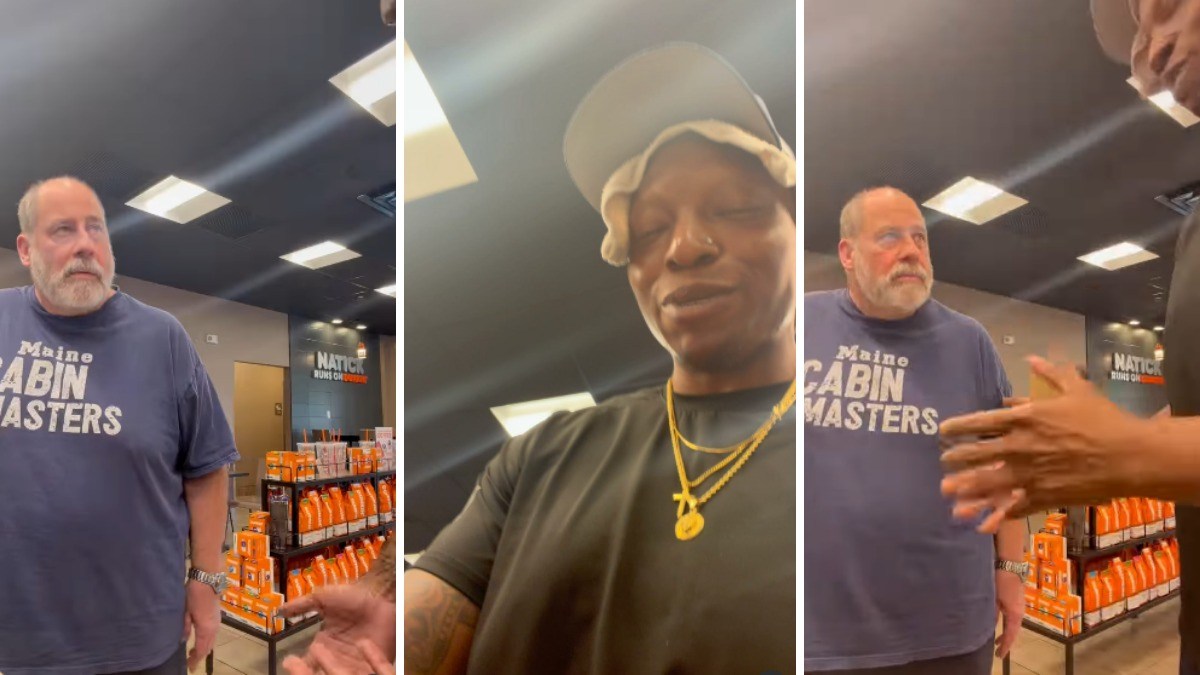
A handicap placard should have answered the question before a stranger ever asked it. But one Massachusetts man still found himself having to explain something that was never anyone else’s business.
A Black man says he stopped at a Dunkin’ in Natick, Massachusetts, when a white man questioned why he was parked in an accessible spot despite having a handicap placard. The encounter did not go quite the way the stranger may have expected.
Instagram user @datpurplemf recorded part of the confrontation and decided to challenge the stranger’s assumption instead of letting the comment slide. What the man apparently did not know was that there was a reason for that placard.
Why wasn’t the placard enough?
“Let me show you something,” he began before addressing what the white man had apparently assumed about him. He explained that he had been in a car accident and suffered a broken hip and broken leg. Those injuries may not have been obvious to someone looking at him, but he had a handicap placard displayed.
“So for you assuming, OK, I’m not handicapped,” he told the man while explaining what had happened to him. He then questioned why the stranger had involved himself in the first place.
“Are you OK? Is everything OK today? Are you sure?” he asked. “Because this is what happens when people tell you to stay in your lane.” “When you don’t mind your business, it makes you look foolish,” he added.
By then, he appeared amused by how the confrontation had turned out. “That just made my day,” he laughed. “I appreciate you. Have a good day.” The stranger attempted to respond, but he was no longer interested in continuing the conversation. “Well, I don’t want to talk anymore,” he replied.
Having a placard does not always stop people from being questioned over an accessible parking space. The man said he had only stopped to grab some coffee when the confrontation began.
“I just wanted my coffee,” he wrote alongside the video. His takeaway from what happened was simple: “Stay in ya lane and mind ya bidness.” But the recorded exchange did not capture how the whole thing allegedly started.
The following day, he posted a second video explaining what happened before he pulled out his phone. According to him, the stranger had made a particularly confusing statement: “Just because you have a handicap placard doesn’t mean you can park in a handicapped parking space.”
He was still baffled while recounting the comment. “My brain melting on the low ski,” he joked in the follow-up clip before questioning the logic behind what he had allegedly been told.
Viewers were just as confused, with many pointing out that a disability does not have to be immediately visible. “Can’t even be disabled in peace,” one person commented. “Handicap placards/plates aren’t ONLY for wheelchair-bound ppl,” another wrote.
Others echoed his frustration. “White folks can’t mind their business even if they were paid to mind their business,” one person wrote, while another summed it up simply: “This is why minding your business is free.”
A disability does not always come with an obvious sign. Even using medical equipment in public can bring attention someone never asked for.
So who actually qualifies for a placard?
Massachusetts guidelines make clear that disability placards are not limited to people who use wheelchairs. A person may qualify if they cannot comfortably walk 200 feet without stopping or experience pain, weakness, or exhaustion while walking. People who rely on certain mobility aids or specialized transportation assistance may also qualify.
A valid placard allows an eligible person to park in designated accessible spaces. There is no requirement that their disability must also be immediately obvious to a stranger.
The placard already gave him the right to use the space. His medical history should not have needed an explanation to a stranger to prove it.
Have a tip we should know? [email protected]
Follow The Mary Sue:
