


Margaret Hamilton, pioneering computer scientist who helped Apollo 11 get to the Moon, dies at 90
RIP to a trailblazer.
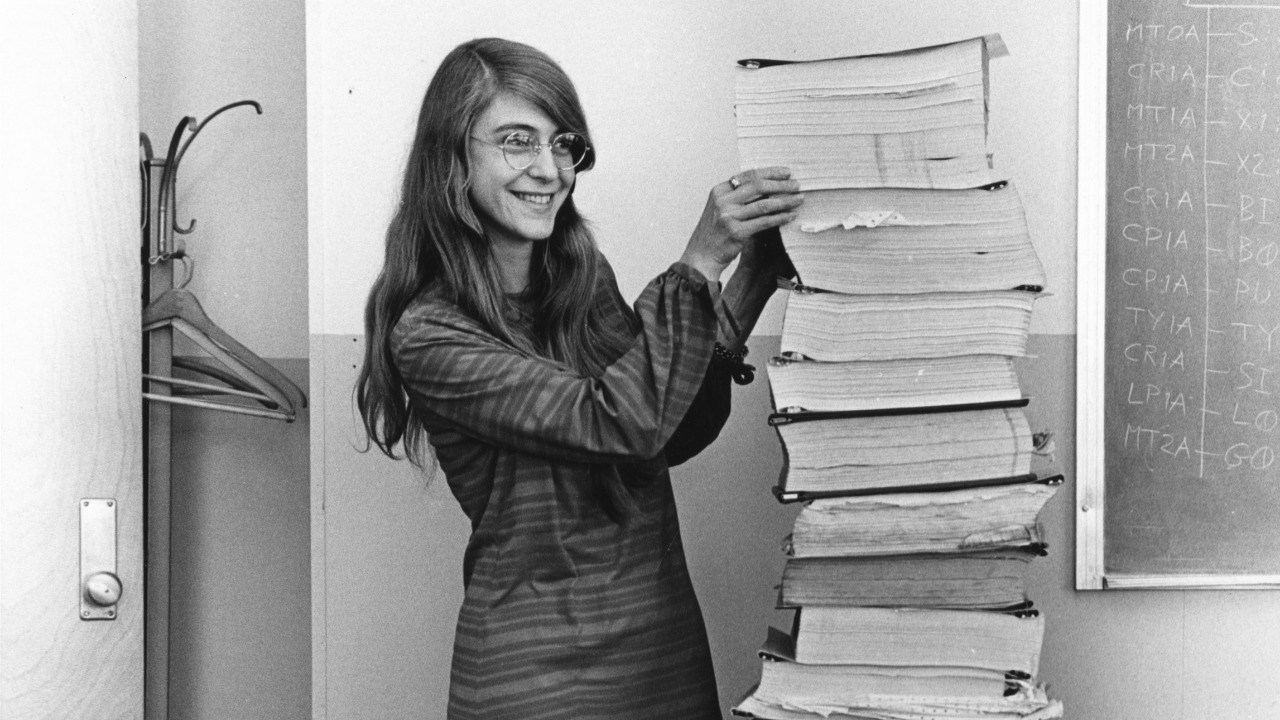
Margaret Hamilton, the trailblazing computer scientist whose software helped Apollo 11 reach the moon, has died at the age of 90. The Massachusetts Institute of Technology released a statement on October 7 that stated she had passed away on September 30. No cause of death was given.
Hamilton was instrumental in pioneering software engineering as a distinct field and led MIT’s Instrumentation Lab team during the Apollo program. That program resulted in 12 people landing on the moon between 1969 and 1972.
Hamilton had a storied career
Hamilton originally went to the University of Michigan to study math in 1955 before moving to Earlham College, where she majored in math and minored in philosophy. She began working at MIT in 1959, though it was only supposed to be temporary. Six years later, after her then-husband saw an advertisement, she applied to MIT’s Instrumentation Lab to develop software that would “send man to the moon.”
She explained to The Guardian in 2019, “I was attracted both by the sheer idea and the fact that it had never been done before. I was the first programmer to join and the first woman they hired.”
Over time, Hamilton became director of the lab’s Software Engineering Division and was responsible for Apollo’s on-board flight software.
When speaking with MIT News in 2009, she said, “From my own perspective, the software experience itself (designing it, developing it, evolving it, watching it perform and learning from it for future systems) was at least as exciting as the events surrounding the mission. Looking back, we were the luckiest people in the world; there was no choice but to be pioneers.”
Eventually leaving MIT in the mid-’70s, she went on to write 130 publications before founding Higher Order Software and Hamilton Technologies and advocating to make software engineering its own field. She reportedly said about the latter, “I fought to bring the software legitimacy so that it — and those building it — would be given its due respect, and thus I began to use the term ‘software engineering’ to distinguish it from hardware and other kinds of engineering.”
She also earned awards throughout the years
Hamilton earned several awards throughout her lifetime. Some of these included the Intrepid Lifetime Achievement Award, the NASA Exceptional Space Act Award, and the Computer History Museum Fellow Award. She was also a member of the National Aviation Hall of Fame and was included in the “Women of NASA” LEGO set.
Additionally, Hamilton was awarded the Presidential Medal of Freedom in 2016 by former President Obama. At the presentation, he praised her work and said, “She symbolizes the generation of unsung women who helped send humankind into space. Her software architecture echoes in countless technologies today[…]Her example speaks of the American spirit of discovery that exists in every little girl and little boy who know that somehow, to look beyond the heavens is to look deep within ourselves, and to figure out just what is possible.”
Have a tip we should know? [email protected]
Follow The Mary Sue:
