


A nurse shares what she has to walk past after her shift ends. Then she reveals what’s behind the fence: ‘THE BODY FARM’
It's exactly what it sounds like.
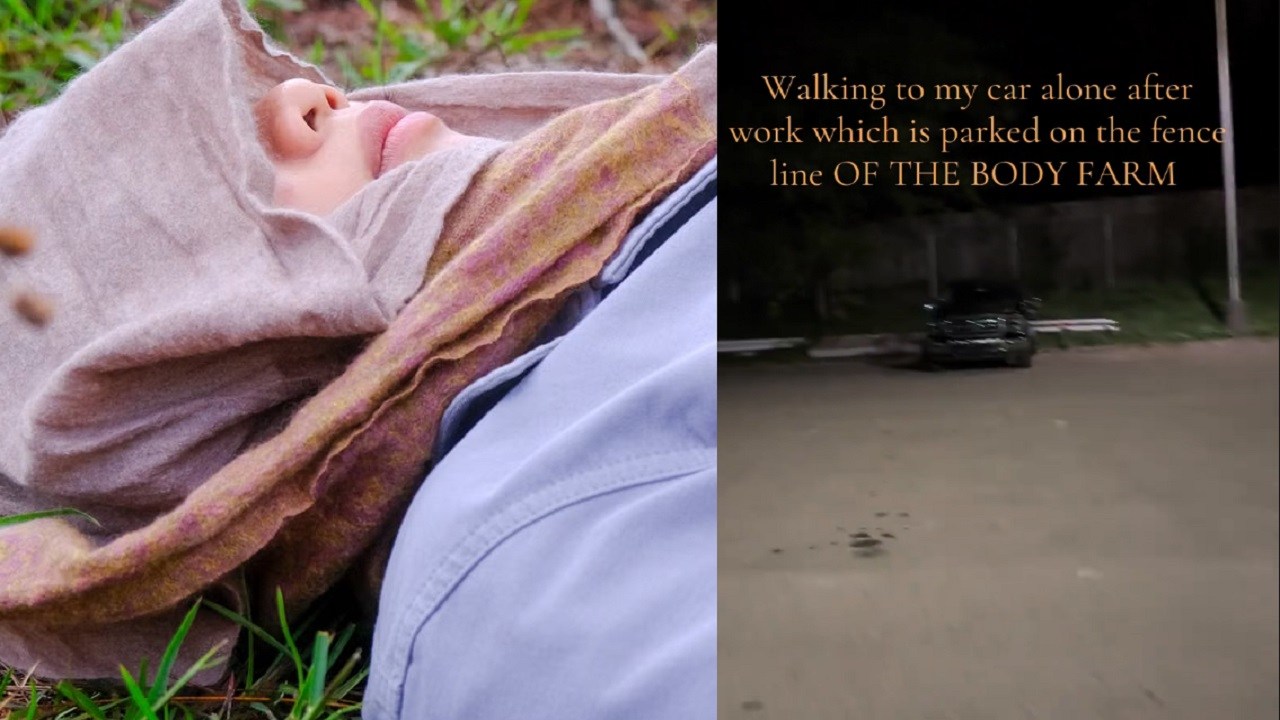
It’s not easy to be a nurse, and your shifts usually include being with people during what might be the worst moment of their lives, or even the most frightening moment. For some nurses, the end of a shift means a moment to relax and unwind before doing it all again.
For Michaela Meier (@michaelameier8), the end of a shift means a walk past the body farm to get to her car. “Walking to my car alone after work which is parked on the fence line OF THE BODY FARM,” she wrote in the video’s overlay text. According to Michaela’s video description, this is just what happens when you work as a midshifter at the hospital that employs her, as there’s no parking when she arrives to work.
Then, her shift ends at night, and she gets to walk in the dark to her car. Unfortunately, the location of the parking lot means that her walk alone to her car includes going along the fence line of the body farm.
Commenters were fascinated by the body farm
Macabre topics tend to draw interest, and the body farm is no exception. One commenter said, “I want to go to the body farm so bad, it seems interesting!” Unfortunately for that person, body farms are important for forensic research, so it’s unlikely that they’ll be able to visit one. However, they might be able to find a museum with an exhibit that’s similar enough to satisfy their curiosity.
For some commenters, this was the first time they learned that body farms are real and exist, as one said, “Body farm. You mean to tell me that’s a real thing?” Not only are body farms real and active, but there are seven of them in the United States, according to the All Criminal Justice Schools website.
Not everybody appreciates body farms
While Michaela might feel that walking by the body farm at night is a little creepy given that she tagged her video as scary, the actual function of a body farm is beneficial rather than frightening. A body farm is necessary for forensic research, as bodies donated to science might be placed in one in different conditions to study how it affects decomposition.
Then, when a body is discovered as part of an investigation, the research from these body farms helps provide a more accurate estimation for the time of death. That added accuracy can be crucial to putting together a timeline and finding answers. If you’re curious about what it’s like to visit a body farm, there’s a section about it in Mary Roach’s book Stiff: The Curious Lives of Human Cadavers.
However, the fascination that Mary Roach and Michaela’s commenters find in the body farm isn’t always felt by the communities around those farms. EBSCO has a paper that touches on some of the issues around the topic of body farms, stating: “While body farms have had a significant impact on forensic anthropology and inspired similar facilities globally, they have also faced opposition from local communities due to concerns about odors, insects, and ethical considerations surrounding the treatment of human remains.”
Most people likely won’t come across a body farm regularly unless they work close to one, like Michaela. However, those who donate their body to science could find themselves on one of those farms after they pass, helping to advance research.
Have a tip we should know? [email protected]
Follow The Mary Sue:
