


A Man Showed Up To Meet a Friend at a Denver Restaurant. Staff Pointed at His Face and Turned Him Away Over a Tattoo
"Same face, same person, suddenly acceptable."
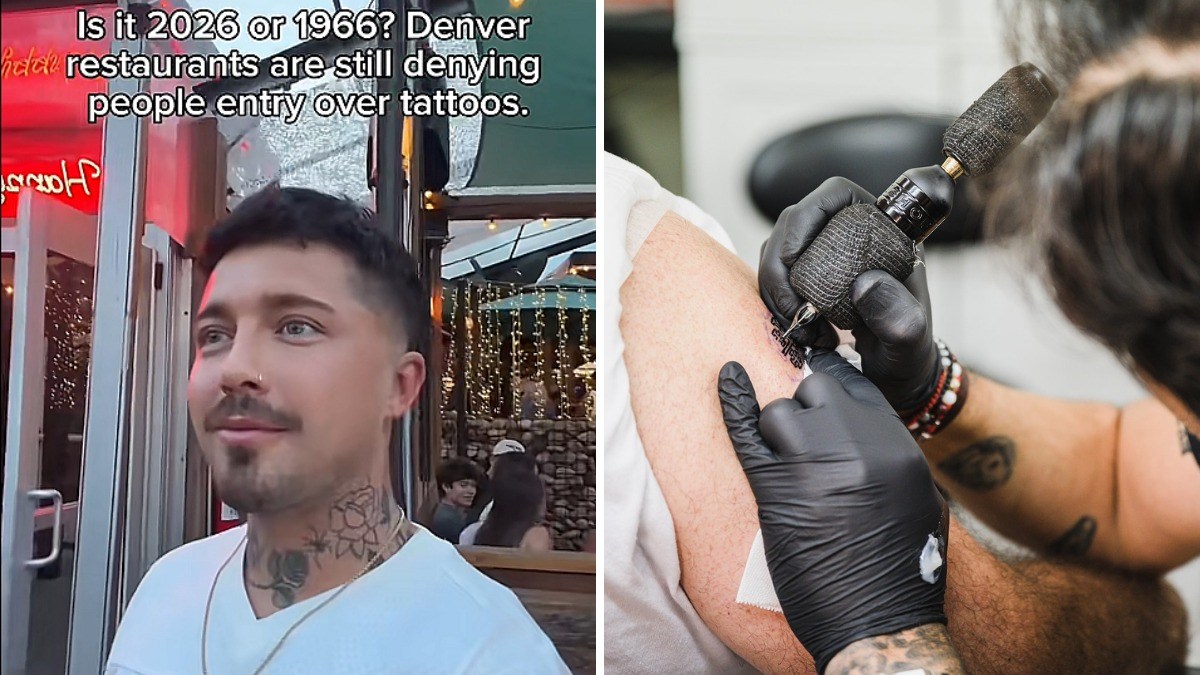
Linson Jamison went to meet a friend at Happy Camper Pizza in Denver and never made it past the door. According to BroBible, staff wouldn’t let him in because of his tattoo. “At Happy Camper in Denver, meeting my friend,” Jamison says in the video. “Walk in and they wouldn’t let me in with my face tattoo.”
Jamison, who posts on TikTok as @linsonjamison, filmed part of the encounter, and in the video, he has someone cover the tattoo with makeup on camera to make the same point another way. “Same face, same person, suddenly acceptable,” he wrote in the caption. There’s no evidence tying Happy Camper’s policy to an actual police directive, but the restaurant is still legally allowed to deny entry over tattoos regardless, since Colorado’s anti-discrimination law doesn’t cover them.
Happy Camper’s own website doesn’t list any tattoo policy at all; the only posted rules relate to being underage. That’s notably different from how other Denver bars handle it. The Mill, another Denver establishment, spells its rule out directly in its house rules, banning “face/neck tattoos or gang-related clothing” as part of a dress code that kicks in after 9 p.m. Whatever Happy Camper’s actual policy is, it isn’t something a customer could have checked in advance.
Here’s why a business can legally get away with this
Colorado’s Anti-Discrimination Act, under C.R.S. 24-34-601, bars businesses from denying service based on disability, race, creed, color, sex, sexual orientation, gender identity, gender expression, marital status, national origin, or ancestry. Tattoos don’t fall into any of those categories, which means a blanket no-tattoo policy is legal on its own.
If a business does violate the law here in Colorado, the penalty isn’t symbolic. Under C.R.S. 24-34-602, a person found to have violated the public accommodation law can be fined $3,500 per violation, payable directly to whoever was discriminated against, on top of any other damages a court awards.
If someone believes a business is applying that kind of rule selectively, based on race or another protected class rather than the tattoo itself, they have 60 days from the incident to file a complaint with the Colorado Civil Rights Division, which enforces the state’s anti-discrimination law across employment, housing, and public accommodations.
A federal court reached a similar conclusion in a case involving Spirit Airlines, ruling that tattoos don’t place someone in a legally protected class on their own. That means a business can generally turn someone away over visible ink without breaking the law, unless the policy is enforced unevenly along protected-class lines.
This isn’t the first time a restaurant has drawn backlash over a face-tattoo policy, either. Texas chain Little Woodrow’s once announced that customers with face and neck tattoos would need to cover them before entering, and the public reaction was severe enough that the company reversed the policy within days.
The outlet reached out to Happy Camper via email for comment.
Have a tip we should know? [email protected]
Follow The Mary Sue:
