


Man Walks Into His Local Walmart in Tennessee and Notices Something About the Walls That Stops Him. This Isn’t a Normal Building
The sustainable option?
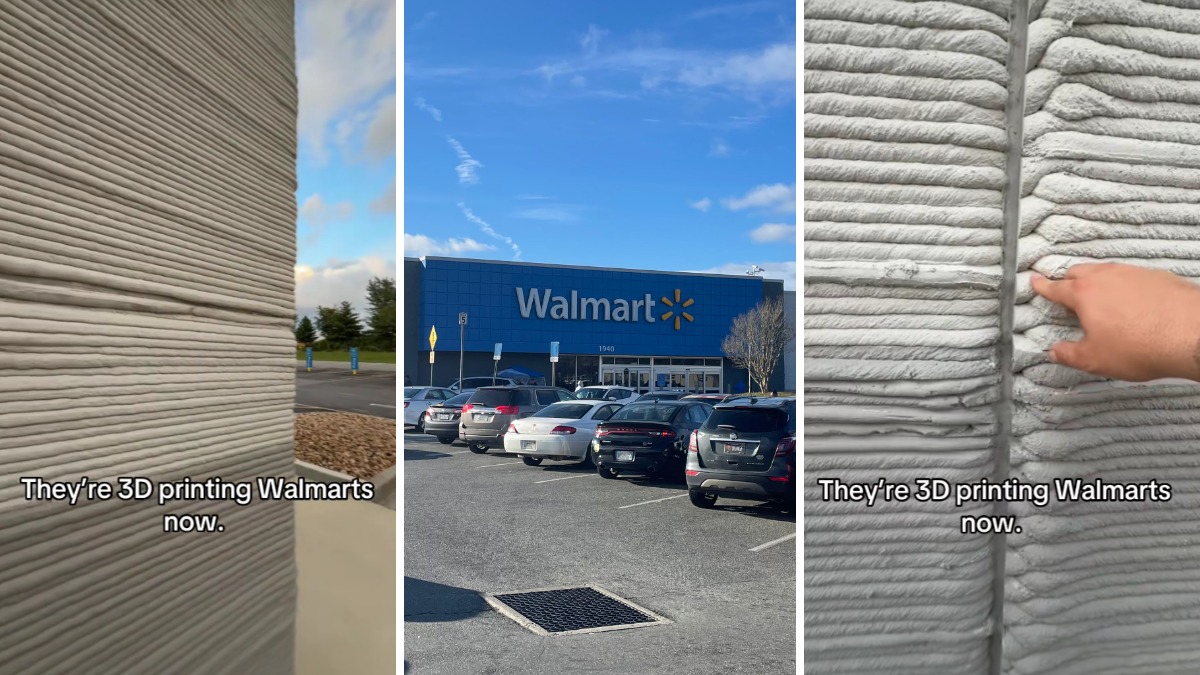
A Tennessee Walmart just became the unexpected poster child for the future of construction. A viral TikTok video posted in July 18, 2026, by Jesse (@jesse18tolife) shows a section of the Athens location built entirely with 3D printing technology, its walls marked by the unmistakable layered texture of robotic construction. The clip, which has racked up over 4.1 million views, has sparked a mix of awe, skepticism, and even a few Big Bad Wolf jokes in the comments.
Jesse’s video is short but effective. He walks around the store, pointing out the visible layers of printed concrete and calling the whole thing “pretty neat.” He hints at the industrial-scale machinery behind the build, though his casual tone makes it feel more like a cool local oddity than a glimpse into the future of retail construction. The comments, as expected, run the gamut.
Some viewers were sarcastic, with one writing, “I’m gonna lie it looks so good.” Others are more cautious. “Do we know the structural integrity of a 3-D house? Because I can’t imagine it’s very stable,” one commenter wrote. And, of course, there’s the inevitable Big Bad Wolf reference: “i feel like the big bad wolf could blow that down.”
The skepticism isn’t entirely unfounded
However, this Walmart isn’t just a one-off experiment. It’s part of a much larger push to bring 3D concrete printing (3DCP) into the mainstream. According to Yahoo! Tech, Alquist 3D, the company behind the technology, is working with construction firm FMGI to build more than a dozen Walmart expansions across the country using their A1X robotic arm printers.
The Athens location was one of the first, and it’s already proving that 3D printing isn’t just for small-scale prototypes or novelty projects. This is commercial construction at scale, and it’s happening now. The A1X is a beast of a machine, built on a KUKA robotic arm with a 1.25-inch nozzle that extrudes a special concrete mix packed with fibers to prevent cracking. Unlike the massive gantry systems of early 3D concrete printers, the A1X is designed for mobility.
It can be hauled by a pickup truck in a standard trailer and set up on-site in about an hour. For larger jobs, multiple printers can work in tandem to speed up construction. The machine is both fast and precise. It can print walls up to 20 feet high in a single pass, using a “vase mode” geometry that eliminates the need for support structures.
That said, it’s not a magic bullet. The A1X can’t print roofs, and utilities like plumbing and electrical still need to be installed manually. But for walls and structural elements, it’s a game-changer.
What’s the trade-off?
Andrew Lycas, Alquist’s CTO, said that 3DCP is a major upgrade over traditional cinder block construction. It’s faster, requires fewer workers, and produces less waste. The trade-off is material cost. The special concrete mix is more expensive than standard materials, which eats into some of the savings. But when you factor in labor shortages and the speed of construction, the math starts to make sense.
Lycas also pointed out that 3D printing shines in extreme conditions. Traditional construction often grinds to a halt in freezing temperatures or scorching heat, but the A1X keeps going. In January, Alquist built a 4,400 square-foot addition to a Walmart in Lamar, Missouri, in just 17 days. The temperature dropped to 24°F with high humidity, but the printer didn’t skip a beat.
The Tennessee Walmart expansion was one of the first major tests for the A1X, and it wasn’t without its challenges. The team started printing in August, when daytime temperatures soared past 110°F. After a few frustrating setbacks, they switched to nocturnal printing, which not only kept the workers cooler but also kept the concrete within its optimal temperature range of 40 to 95°F.
Once the kinks were ironed out, the 8,000-square-foot expansion took just 140 hours to print. That’s a fraction of the time it would take with traditional methods, and it’s a clear sign that 3D printing is ready for prime time.
The implications go beyond Walmart
If 3D printing can handle commercial construction at this scale, it could revolutionize everything from housing to infrastructure. The technology is already being used to build affordable homes, and the potential for reducing waste and labor costs is huge.
Some of the TikTok commenters even speculated that widespread adoption could help lower housing prices by cutting down on construction costs. “If they start making more houses like that, maybe the housing markets will go down,” one wrote. “And it’s less trees being cut down to make wood out of.” It’s an optimistic take, but not entirely unrealistic. 3D printing could make construction faster, cheaper, and more sustainable.
Some of the skepticism in the TikTok comments reflects broader concerns about the durability and safety of 3D-printed structures. But the early results are promising. The Walmart expansions are holding up just fine, and Alquist’s machines are proving they can handle real-world conditions. The company has even sold 14 A1 Series systems, marking the largest U.S. deployment of 3DCP technology to date.
The A1 Series isn’t just for large-scale projects, either. The smaller A1 model is designed for educational settings, where it’s being used to train the next generation of construction workers. Alquist has partnered with Aims Community College to develop a curriculum around 3DCP, giving students hands-on experience with the technology.
(Featured images: Winnebaggo and Jesse-18tolife @jesse18tolife on Tiktok)
Have a tip we should know? [email protected]
Follow The Mary Sue:
