


Argentina Coach Scaloni Breaks Protocol in Arlington to Honor the Only Man Who Has Seen Every World Cup Since 1958
A living legend.
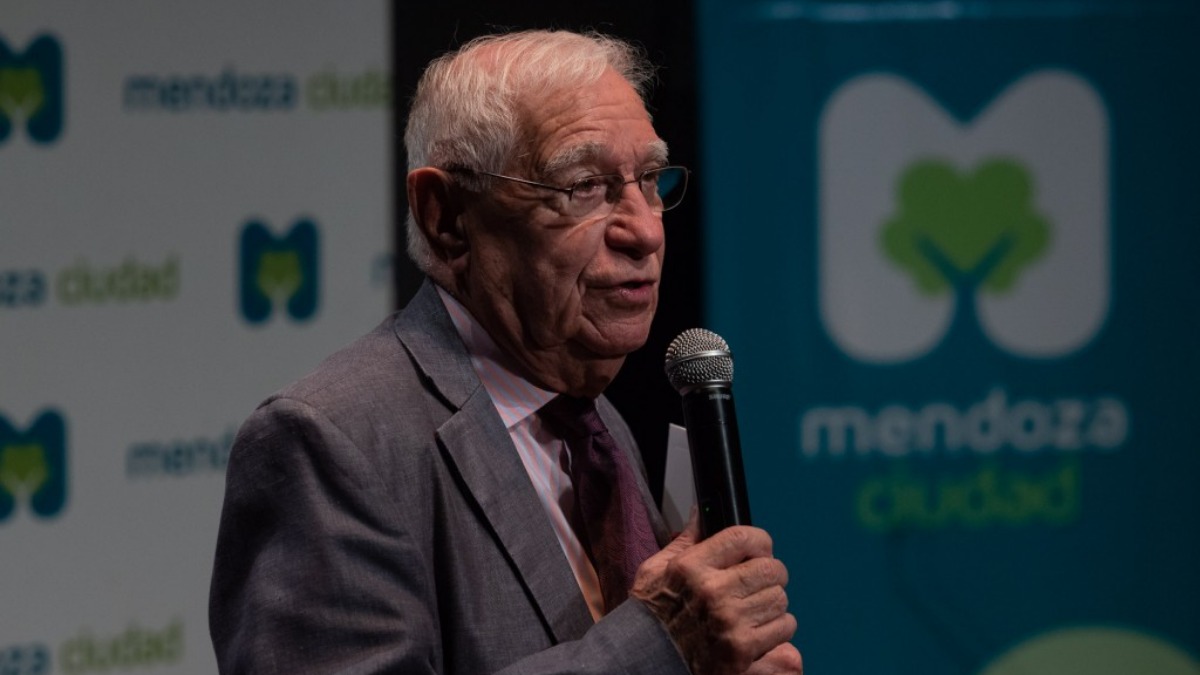
Argentina head coach Lionel Scaloni just gave soccer fans one of those moments you’ll remember forever. According to NDTV, before the team’s final group-stage match against Jordan at the World Cup on June 27, 2026, Scaloni broke protocol in Arlington to honor Enrique Macaya Márquez, the 91-year-old journalist who has covered every single World Cup since 1958.
The press conference started like any other. When Macaya Márquez was called on for the first question, he went straight to the heart of the matter, asking if Lionel Messi would start, per Footmundo. Before answering, Scaloni took a moment to acknowledge the man sitting in front of him, a living legend of football journalism. “Enrique, it’s a pleasure, a pleasure that you asked me the question, a pleasure to see you here,” Scaloni said.
The coach added, “Thank you for coming. I think we were just talking about how many World Cups you’ve been to: 18 World Cups, incredible. It’s truly a pleasure to be able to answer your question, especially because we’ve known each other for so long. When I played in Argentina, I watched him constantly, and every time he spoke, for those of us who lived through that era, he was a legend, and he still is.”
Scaloni’s words carried weight
Macaya Márquez isn’t just another journalist. He’s a walking archive of football history, a man who has seen Pelé’s rise, Maradona’s magic, and now Messi’s reign. For Scaloni to pause and recognize that, in front of the world’s media, was a masterclass in respect. And then, just when you thought it couldn’t get any better, Scaloni answered the question.
Messi would start on the bench, but Scaloni made it clear he was only giving that answer because it was Macaya asking. “I’m answering because I sincerely believe you deserve it,” he said. “The best decision, so that his teammates can play and so that he can play for a while, which is good for him and the rest of the team. We’ll see how many minutes.”
The moment didn’t end there. After the press conference, Scaloni walked over to Macaya Márquez, embraced him, and posed for photos. It was a simple act, but one that spoke volumes about the bond between the two. For Macaya, this wasn’t just another assignment. It was another chapter in a career that has spanned nearly seven decades, a career that has seen him report on every World Cup since Sweden in 1958.
Macaya Márquez’s journey is nothing short of extraordinary
At 23 years old, he covered his first World Cup in Sweden, reporting on a Brazil team that would go on to captivate the world, thanks in no small part to a 17-year-old Pelé. Back then, he was a special correspondent for Radio El Mundo. Today, at 91, he’s still at it, working as a commentator for DSPORTS Radio, according to FIFA.
When he reflects on that young journalist who covered his first World Cup, he says the foundation of his work hasn’t changed. “Yes, I very much keep the memory of that young journalist alive. I continue to be interested in everything, and the foundation hasn’t changed – knowledge rather than curiosity,” he said.
The way he approaches his work has evolved, though. “It feels different,” he explained. “You become more seasoned, you have more experience, you handle things in a different way. And as for the work itself, technology helps provide different interpretations, but those interpretations still require a journalist’s knowledge.”
That knowledge has made him a revered figure in football circles. In Dallas, where the press conference took place, everyone wanted a photo with him. Even FIFA President Gianni Infantino highlighted his presence during the tournament’s opening remarks, recognizing his distinguished career.
His approach to journalism is rooted in humility and clarity
He’s always been cautious about talking in absolutes, preferring to focus on the subject at hand, whether it’s a match or a player. “I’ve never lost sight of the subject I’m assessing,” he said. “It’s very satisfying; people appreciate my approach in a field where everyone has an opinion and often expresses it with absolute certainty, perhaps even a closed mind, as if things couldn’t be any other way.”
That mindset has allowed him to adapt to the changes in the game over the decades. He’s seen ball control improve, players become faster and more athletic, and technology transform how journalists work. But some things never change. “One thing that never changes is that mistakes are costly and that success is sometimes rewarded excessively,” he noted.
When asked about the greatest players he’s seen at the World Cup, Macaya Márquez refuses to rank them. “I have seen so many extraordinary players of different eras and in different circumstances showing their mettle; it’s impossible to apply a single yardstick to determine who’s the greatest,” he said.
But there’s one memory that stands above the rest
“The first memory that comes to mind when reflecting on the 18 editions of the FIFA World Cup I have covered is when Argentina won the World Cup obviously,” he said. “Of course, your broadcasts, your work, your personal performance are also important. There are many things, but when your own national team are crowned the winners, you can’t help but partake in the celebration. It makes you happy, because you spent your whole life hoping to witness them winning the World Cup.”
That connection to Argentina’s success is part of what makes Scaloni’s tribute so special. For Macaya Márquez, covering the World Cup isn’t just a job. It’s a lifelong passion, one that has seen him witness the highs and lows of the game. And for Scaloni to recognize that, in such a public and heartfelt way, was a reminder of why football is more than just a sport. It’s a community, a shared history, and a celebration of the people who make it all possible.
(Featured image: Mendoza Municipality)
Have a tip we should know? [email protected]
Follow The Mary Sue:
