


Michigan Woman Has an Interesting Way of Combatting AI: “Stealing” from AI Artists
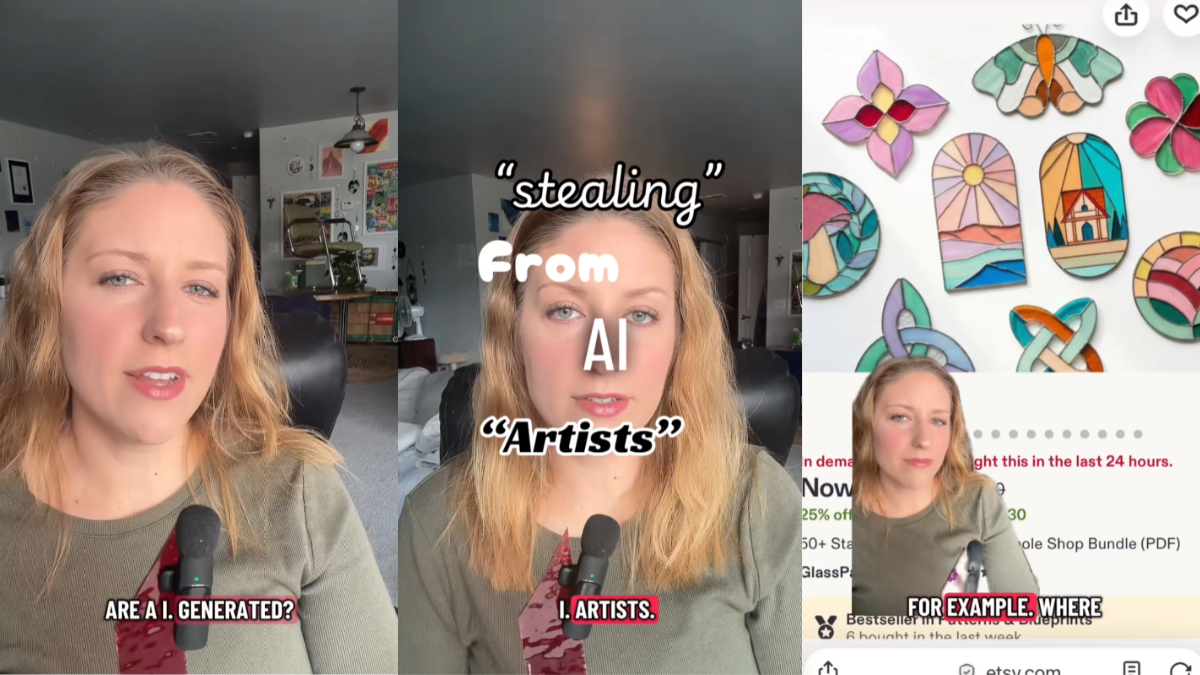
AI is everywhere, including art markets where people are looking for handmade, human creations. Evie Eddins (@twocatscreatives), a graphic designer and artist from Michigan, shared the clever, yet unusual, way she’s combatting the sale and use of AI art.
“Welcome to my latest business venture: ‘stealing’ from AI artists,” she shared on TikTok. She noticed that many stained glass patterns being sold online are now AI-generated. The reason artists often purchase these patterns is so that they can be guided with layout and cutting.
But if they’re just patterns, how could Eddins tell that they’re AI art? Eddins showed a reference photo on Etsy and pointed out the missing jump rings. Without the jump rings, there would be no way to hang and display the cut glass. She also pointed to the mushroom pattern on her reference photo.
Eddins claimed that it would be impossible to cut the red cap of the mushroom—this is because of the cap’s sharp angle. It would be difficult to recreate the shape, as the glass might shatter during the cutting process. She further showed other patterns that seemed “impossible” to use as patterns for stained glass art, proving that these are AI-generated works.
How she’s fighting AI art
“Now, here’s the brightside: you don’t own the copyright to an AI-generated image, because you didn’t make anything,” she said. AI art generated solely by the machine is not eligible for copyright protections. Simply put, using AI art as an inspiration to create real, human work won’t be a source of legal trouble.
“So, I went through and redrew every single pattern by hand and made an almost identical listing, except I actually drew the stained glass patterns,” Eddins said, revealing her grand scheme. But she has more ideas in mind.
“If I’m feeling really petty about it, I’ll report the AI-generated listing for copyright infringement and have it taken down, because they are now copying all of my designs,” she said.
Eddins hadn’t pushed through her second plan, but would it hold up if she did sue? If she copied the AI art, but AI art feeds off human art that, at times, was sourced from unconsented scrapping, who would be at fault? Can the case against the AI creator be dropped? It all seems like a complicated rendition of the chicken and the egg problem. Nevertheless, TikTok applauded Eddins’ uncanny way of pushing back against AI-generated content.
Online frustration over slop content
One TikTok commenter wrote, “If nothing else, you’ve created a GREAT law school exam question.”
Another commenter said, “The fact that Etsy refuses to eliminate AI enrages me.”
Someone else raged, “AI crochet patterns are everywhere on Etsy too!!!”
A TikTok user also said, “Cookbooks have also been ruined by AI. I collect cookbooks, and it’s impossible to screen out AI cookbooks on Amazon now.”
But one praised Eddins for her effort, saying, “Excellent use of free will. I hope you make a ton of money.”
At the heart of the issue is that the AI-generated patterns may not even be usable for their intended purpose. From stained glass art all the way to cookbooks, TikTok users have had their fair share of complaints.
At the heart of the issue is that the AI-generated content may not even be usable for their intended purpose. From stained glass art all the way to cookbooks, TikTok users have had their fair share of complaints about the rapid spread of AI slop on platforms like Etsy that were once hailed as pro-artist.
(featured images: Evie Eddins)
Have a tip we should know? [email protected]
Follow The Mary Sue:
