


Starbucks Under Fire After a Customer’s Drink Test Reveals the Ugly Truth About Their Ice-To-Drink Ratio
Prime example of shrinkflation.
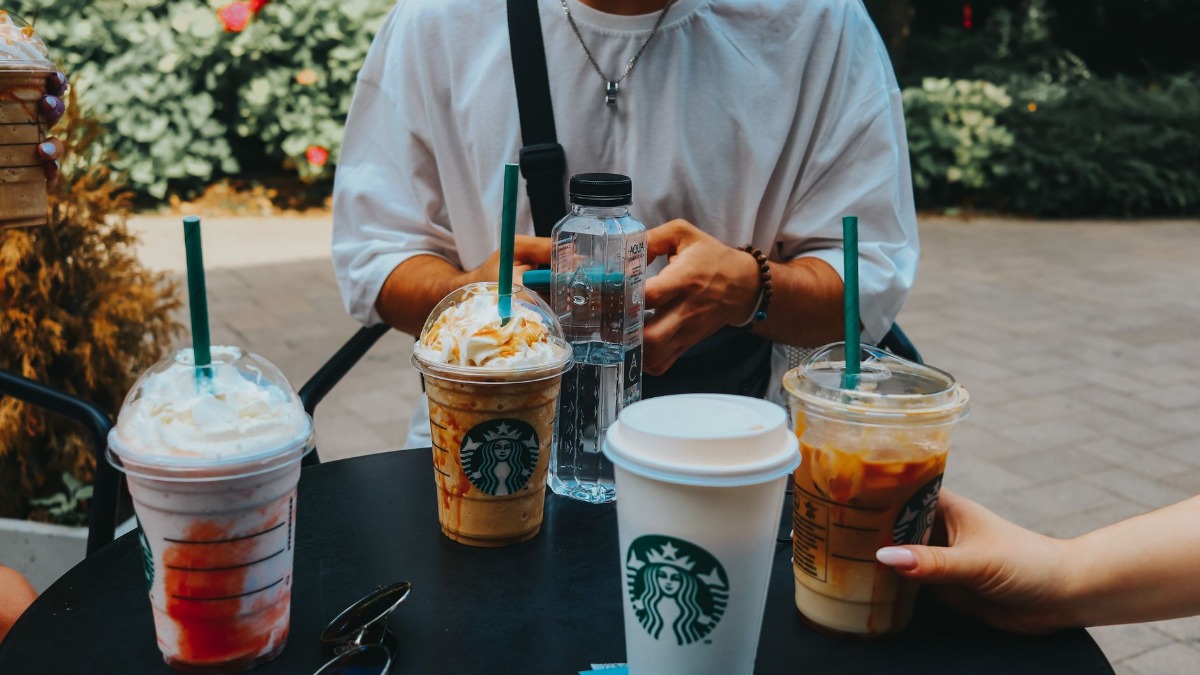
Starbucks is facing fresh backlash after a viral video exposed just how much ice goes into their iced drinks, leaving customers feeling shortchanged. A woman’s simple experiment, reposted by @WallStreetApes on X, showed that a venti-sized iced beverage contained more ice than actual liquid. When she poured the drink into a cup after removing the ice, it barely filled half the container.
The clip sparked outrage online, with many calling it a prime example of shrinkflation – where companies give you less for the same price. The video didn’t just confirm what some customers had long suspected. It also reignited a debate about whether Starbucks should adjust its default ice-to-liquid ratio. Some users on X and TikTok argued that the issue isn’t new and that fast-food chains have been quietly cutting corners for years.
According to The Daily Dot, one commenter said, “This has been an issue for over a decade everywhere, not just Starbucks. Ask for light or no ice.” Another suggested a workaround, “I always order no ice… then ask for a cup of ice.” Starbucks does allow customization, so customers can request less ice or even none at all. But not everyone wants to jump through hoops just to get a full drink.
This latest controversy comes at a tough time for the coffee giant
According to an AP report from earlier this year, Starbucks has been losing ground in the U.S. as competition heats up from rivals like Dunkin’, Dutch Bros, and even fast-food chains like McDonald’s. According to data from food industry consulting firm Technomic, Starbucks’ share of spending at U.S. coffee shops dropped from 52% in 2023 to 48% in 2025. That might not sound like a huge dip, but in a market as crowded as coffee, every percentage point matters.
The problem isn’t that Americans are drinking less coffee. In fact, the National Coffee Association reports that 66% of Americans now drink coffee daily, up from 62% in 2020. The issue is that there are more options than ever before. The number of chain coffee stores in the U.S. has jumped 19% over the last six years, reaching over 34,500 locations. Starbucks, once the undisputed king of coffee, now has to fight for every customer.
Some of the biggest threats come from drive-thru chains like Dutch Bros, Scooter’s Coffee, and 7 Brew, which are expanding rapidly. Dutch Bros, for example, has just over 1,000 locations but plans to double that number by 2029. The chain focuses on speed, convenience, and value. Its medium drinks are 24 ounces, compared to Starbucks’ 16-ounce grande. Dutch Bros also beat Starbucks to the punch with protein coffee drinks, rolling them out nearly two years earlier.
Then there’s Luckin Coffee, a Chinese chain that’s making waves in the U.S. with its app-based promotions and low prices. On a recent afternoon in New York, one of Luckin’s tiny, no-seating stores was packed with customers picking up mobile orders.
Xunyi Xie, a visitor from Delaware, stopped by to try a $1.99 Velvet Latte. He admitted that while he usually makes his own espresso, he’d consider switching to Luckin if a location opened on his commute. When asked about Starbucks, his response was blunt, “I think it’s overpriced.”
Starbucks is in the middle of a major push to revamp its stores
It is adding 25,000 seats to U.S. cafes by this fall. The goal is to make locations more inviting, with warmer designs and better service. Starbucks also plans to open over 575 new U.S. stores in the next three years, including smaller-format locations that can fit into spaces where a full-sized café wouldn’t work. And the menu is getting an update too, with new high-protein snacks and pastries aimed at winning back customers.
But some analysts wonder if these moves will be enough. Neil Saunders, a retail analyst at GlobalData Retail, pointed out that Starbucks is already pretty saturated in the U.S. “They’re a very mature business.” That means growth has to come from taking customers from competitors or convincing existing ones to spend more, which is a tough sell when rivals are offering bigger sizes and lower prices.
Starbucks’ average ticket price in 2024 was $9.34, compared to $8.44 at Dutch Bros and $4.68 at Dunkin’. The company didn’t raise prices in 2025 and has promised to be careful about future increases. But equity analyst Ari Felhandler warned that competing on price is a losing game. “Keep your prices the same and try to justify them,” he advised. Starbucks seems to be taking that advice, focusing instead on improving the in-store experience.
Mike Grams, Starbucks’ COO, emphasized that the company isn’t trying to be like its competitors. “We offer something that most people don’t, which is a legitimate space to sit down, enjoy and use it for a variety of different reasons,” he said. That’s the “soul of Starbucks,” according to Grams – cafes where people can linger, work, or meet friends, not just grab-and-go kiosks.
Not everyone agrees
Chris Kayes, a professor at George Washington University’s School of Business, isn’t sure that strategy will be enough to keep Starbucks on top. “In some ways, I think they are a victim of their own success,” he said. “I do think that the aura of Starbucks as being something special and unique and exciting isn’t there anymore.” Younger customers, in particular, are drawn to novelty and are more willing to try new chains that offer something different.
So where does that leave Starbucks? The company is sure its store redesigns, new menu, and focus on the in-store experience will bring back customers. But in a market where competitors are offering bigger drinks, lower prices, and faster service, that may not sell. And the ice-to-drink ratio controversy only adds to its problems.
(Featured image: Ejov Igor on Pexels)
Have a tip we should know? [email protected]
Follow The Mary Sue:
