


Florida cop confidently writes up woman for driving with a device in her right hand. He just misses one tiny detail
Distracted driving? More like distracted policing.
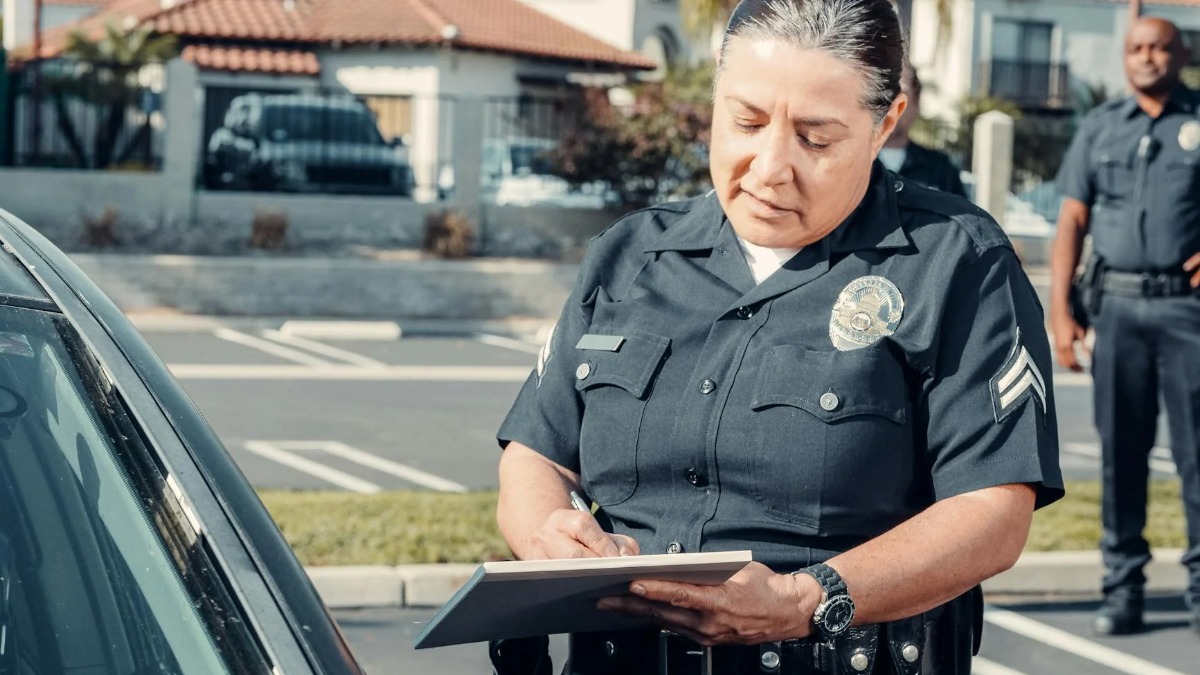
Katie, who goes by @slightlyoff.balance on TikTok, posted a video of a traffic stop incident on February 11 that quickly racked up over 39.5 million views, according to BroBible. In the clip, a Palm Beach County Sheriff’s Office deputy explains Katie’s receiving a citation for holding a wireless communication device while driving. The officer specifically states he saw the phone in her right hand.
Katie, who is missing her right hand, pushes back. The officer doubles down, telling her to take it up in court if she wants to contest it. She plans to do exactly that. The ticket, issued under Florida Statute 316.305(3)(a), carries a $116 civil penalty. But legal experts say the citation likely wouldn’t hold up in court, even if Katie had two hands.
Florida’s statute doesn’t ban simply holding a phone while driving. It targets manually typing or entering letters, numbers, or symbols into a device. That means officers need to prove the driver was actively using the phone, not just holding it.
The law is narrower than most people realize
According to Yahoo Finance, Attorney Ted Hollander of the Ticket Clinic said that neither the school zone nor the construction zone box was checked on Katie’s citation, which are the only places where holding a phone is illegal under current law. “Whether she’s holding it in her right hand or her left hand, it really doesn’t matter,” Hollander said.
“If you are not in a school zone or a construction zone, you are allowed to hold a cell phone.” Another attorney, Donahue, called the statute “really explicit” and noted that texting-while-driving citations are rare in Palm Beach County because they’re so difficult for officers to prove.
Katie’s case highlights a common misunderstanding – both among drivers and law enforcement – about what Florida’s distracted driving law actually prohibits. The confusion isn’t just academic. A distracted driving ticket can cost far more than the initial fine.
According to an analysis by The Zebra, a single violation raises insurance premiums by an average of 23%, or about $357 per year. Since insurers typically penalize drivers for three years, that $116 ticket could end up costing over $1,000 in higher insurance costs alone.
The numbers get worse depending on where you live
California drivers face an average 51% premium hike after a distracted driving ticket, while New York drivers see just an 11% increase. Nationwide policyholders, for example, see their annual premiums jump from roughly $1,548 to $2,119, a 37% increase. For anyone already struggling with high insurance costs, a single ticket can wipe out years of savings.
Katie’s decision to fight the citation could save her thousands in the long run. Traffic ticket attorneys typically charge between $200 and $500 to handle a case, a fraction of the three-year insurance hit. A lawyer could negotiate the violation down to a non-moving offense or get it dismissed entirely, keeping points and premium spikes off her record.
But experts warn that drivers shouldn’t assume every traffic ticket is worth fighting. If the officer has clear evidence of texting or typing, contesting it might not be worth the effort. Florida’s distracted driving laws are also in flux. While the current statute is relatively lenient, lawmakers have tried to tighten it. In the 2025 legislative session, SB 1318 – the “Florida Hands-Free Driving Law” – passed unanimously through multiple Senate committees.
The bill would have banned all handheld device use while driving statewide, not just in school and work zones. It died when its House companion failed to advance, but advocates expect the effort to resurface. More than 30 states already have similar hands-free laws on the books.
Distracted driving is a growing problem in Florida, where a crash occurs every 44 seconds
Preliminary data for 2024 shows nearly 300 people died and over 2,200 suffered serious injuries due to distracted driving in the state. Nationally, the numbers are even more alarming. The National Highway Traffic Safety Administration reported 3,275 deaths and 324,819 injuries from distracted-driving crashes in 2023. The economic cost of those crashes was estimated at $98 billion annually, a figure that balloons to $395 billion when quality-of-life losses are factored in.
Florida’s current fine structure is among the most lenient in the country. A first texting offense carries a $30 base fine, a non-moving violation with no license points. A second offense within five years bumps to $60 with three points. Court costs and fees push the actual total higher, which is how Katie ended up with a $116 ticket.
Compare that to Oregon, where first offenses can reach $1,000, and it’s clear Florida’s penalties are light. But even a small fine can have outsized consequences when insurance premiums are factored in.
Katie’s video has sparked plenty of jokes online
One commenter wrote, “She won’t even need a lawyer. She can handle this situation single-handedly.” Another, a court reporter, added, “I don’t know if I could keep a straight face for this one.” A third joked, “That cop is 100% not showing up to court.”
The humor aside, the case underscores a serious issue. Many drivers and even some officers don’t fully understand the laws they’re enforcing. For Katie, the choice is clear. She’s requested body camera footage from the Palm Beach County Sheriff’s Office and plans to fight the citation in court. Given the legal and financial stakes, it’s hard to blame her.
(Featured image: Kindel Media on Pexels.)
Have a tip we should know? [email protected]
Follow The Mary Sue:
