


Woman Orders Her Childhood Favorite From McDonald’s. Then She Opens It and Questions the Meal Size: ‘Look at the Size of This Thing’
Double the price but half the size.
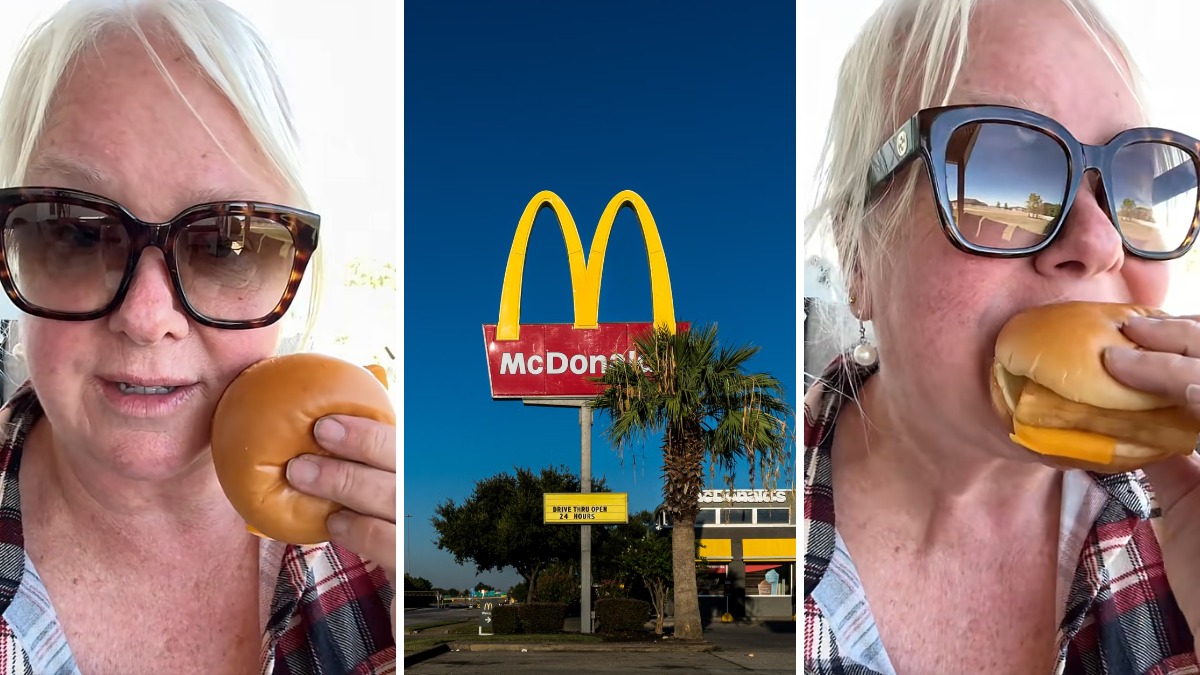
A woman’s video has reignited the debate over McDonald’s portion sizes after she opened her childhood favorite, the Filet-O-Fish, and was stunned by how small it looked. Angie Batis, @angiebatis on TikTok, holds up the sandwich, saying, “Look at the size of this thing.” She added it was “double price and half the size.” The moment struck a nerve with viewers, many of whom echoed her frustration over what they see as shrinkflation at the fast-food giant.
Batis explained in the video that she’d been ordering the Filet-O-Fish since she was about 10 years old, making the sandwich’s apparent downsizing even more disappointing. She noted how light the box felt when she picked it up. “It literally is a hair bigger than what a slider is,” she said, referencing her partner’s comment that it looked like a miniature version of the sandwich. Despite her shock, she still finished the meal, pairing it with a “dirty Dr Pepper.”
Comments flooded in, with users sharing their own gripes about McDonald’s portion sizes and pricing. According to the Tasting Table, the Filet-O-Fish has been a staple on McDonald’s menu for over 60 years, first introduced by a Cincinnati franchisee in 1962. Originally made with halibut, the sandwich now uses Alaskan pollock, a change that most customers have accepted without much fuss.
In recent years, complaints about the Filet-O-Fish size have grown louder
McDonald’s has repeatedly insisted that the Filet-O-Fish hasn’t changed, pointing to its signature half-slice of American cheese and consistent build as proof. Yet, skepticism remains, with many customers convinced that the portions are shrinking while costs keep rising. On Reddit, users have posted side-by-side comparisons of the Filet-O-Fish over the years, with some claiming it now looks like a child’s toy.
One user wrote, “I know my hands haven’t gotten larger, but it literally looked like a child’s toy food sandwich. It was so, SO small.” Another added, “The fish filet barely reached the outer edges of the bun, and the bun was only about the diameter of a baseball. When did this happen?!” The sheer volume of complaints suggests that something about the Filet-O-Fish isn’t sitting right with customers.
The frustration over portion sizes isn’t limited to McDonald’s. Wendy’s has faced similar accusations about its chicken nuggets, with customers claiming they’re getting fewer pieces for the same price. The phenomenon of shrinkflation, where companies reduce the size of products while keeping prices the same, has become a widespread concern.
In the case of fast food, it’s possible that other menu items have grown larger over time, making the Filet-O-Fish seem smaller by comparison. Or, as some suggest, the rising cost of meals is making customers more critical of what they’re getting for their money. Either way, the Filet-O-Fish’s iconic status isn’t enough to shield it from scrutiny.
McDonald’s is also facing broader backlash over its ties to political conflicts
Since its Israeli franchise provided free meals to IDF soldiers early in the Palestinian genocide, McDonald’s has been targeted by the Boycott, Divestment, and Sanctions (BDS) movement. Activists accuse the company of complicity in the genocide, adding another layer of frustration for customers who feel the chain is prioritizing profits over ethics.
According to Dazed Digital, the BDS movement, which draws inspiration from the struggle against South African apartheid, calls for economic pressure on Israel through boycotts, divestment, and sanctions. Launched in 2005 by Palestinian civil society groups, the movement has gained traction in recent years, particularly among younger consumers.
It targets corporations seen as supporting Israel’s occupation of Palestinian land, including major food chains like McDonald’s, Burger King, and Coca-Cola. For many, the movement has reshaped how they think about their food choices, turning everyday meals into political statements. The shift has turned once-loved foods into symbols of consumerist ignorance. A McDonald’s bag or Starbucks cup has become a social signal, revealing who is politically aware and who isn’t.
The BDS movement challenges the idea that ethical consumption is impossible under capitalism
Writer Amber Husain, in her book Tell Me How You Eat: Food, Power and the Will to Live, says, “BDS is, not in fact, a matter of mere consumer choice; it is rather a consumption-based movement, on the grounds of winnable targets.” The goal is to create collective action that pressures corporations and governments to change. For some, this means volunteering at community kitchens or finding ways to eat that prioritize others’ well-being over personal convenience.
The debate over McDonald’s Filet-O-Fish highlights how deeply intertwined food, politics, and economics have become. For Batis, the sandwich was a nostalgic treat, a link to her childhood. But in 2026, even a simple fast-food order can feel loaded with meaning. Whether it’s the size of the portion, the price on the menu, or the company’s political entanglements, customers are paying closer attention to what they’re consuming – and what it represents.
(Featured images: Angie Batis @angiebatis on TikTok and Eddie O. on Pexels)
Have a tip we should know? [email protected]
Follow The Mary Sue:
