


She Finds $200 Headphones for $100 at Best Buy. Then a Manager Wouldn’t Let Her Go: ‘I End Up Handing Him My Phone’
An unnecessary complication.
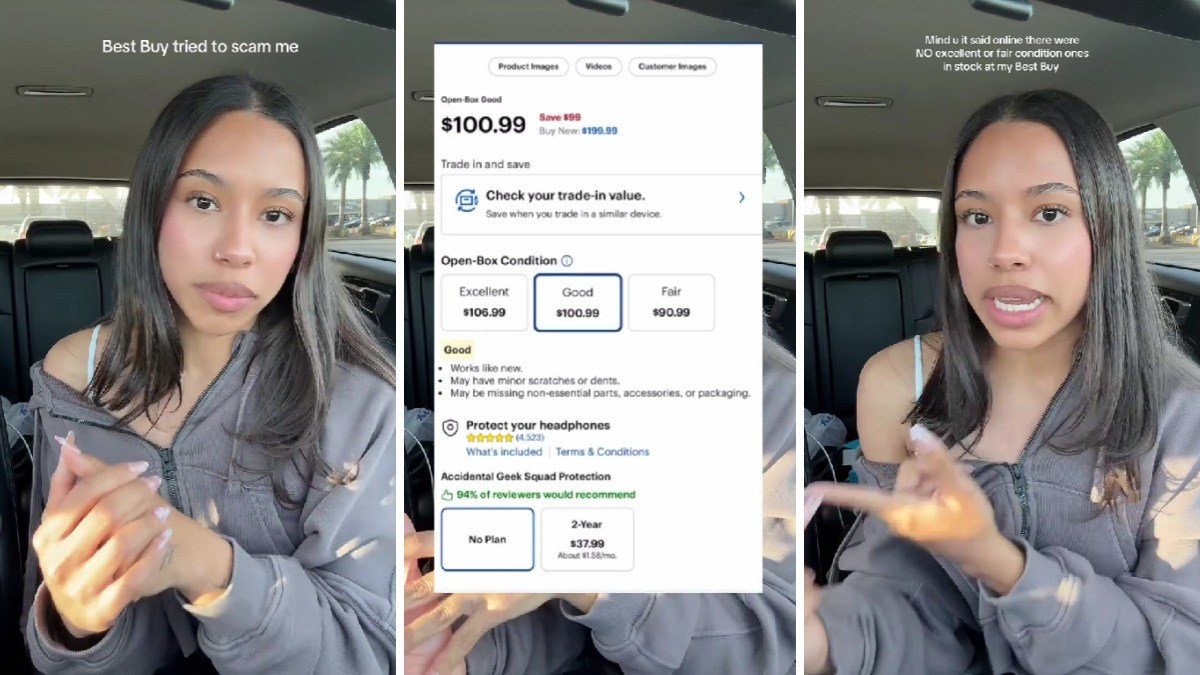
If you’ve ever felt the sting of a deal gone wrong at a big-box retailer, you’re not alone. The friction between online inventory systems and the reality of what’s sitting on a store shelf is a headache that many of us have dealt with at least once. Recently, fitness content creator Angie Pineda found herself in the middle of a frustrating retail standoff over a pair of headphones that highlights just how messy the shopping experience can become when technology and human service don’t quite sync up.
Pineda, @musclemuffinn on TikTok, a 24-year-old fitness influencer based in the New Orleans area, shared her experience in a recent video that has since gained significant traction online. It’s the kind of story that resonates because it touches on a universal frustration: trying to snag a fair price on an open-box item, only to be met with confusion and resistance from store staff.
In her recount, Pineda explained that she had been hunting for a pair of Shokz Dot headphones. While the regular retail price for these is about $199.99, she had spotted an online listing for an open-box pair in good condition priced at roughly $100.99. Crucially, the listing indicated that the item was available for pickup at her local store within an hour.
When she arrived, things took a turn
A worker at the Best Buy store brought out a box marked at $140 for excellent condition, but when they scanned it, the system confirmed the $100 price she had seen online. Despite this, staff refused to price-match, claiming there was a discrepancy between store and online open-box inventory. The situation escalated when a manager arrived.
According to Pineda, the manager insisted that the $100 deal was only available for items shipping from other states, like Kentucky or Texas, and denied that the box in his hand was the same item listed online. Pineda noted that she remained calm throughout, even when the manager typed on a computer and walked away without offering any further explanation or resolution. At that point, the online listing suddenly showed the item as unavailable.
Frustrated but persistent, Pineda requested a second manager. She explained the situation, emphasizing that she was simply trying to purchase the item she had seen online for local pickup. After the second manager asked for her phone and performed what Pineda described as “some little thing” on it, the purchase went through at the $100 price point.
Although staff initially told her she would have to wait until the next day to pick them up, she received a notification shortly after and was able to secure the headphones that same evening. It turned out to be the exact pair that had been sitting in the store all along.
This experience is notable given the shifting landscape of how people buy tech
A 2026 Back-to-School Tech Shopping Report from Best Buy Canada sheds some light on the situation. The report found that 63% of Canadians have purchased refurbished, open-box, or traded-in devices in the past year. For younger generations like Gen Z, who are leading this trend with a 71% adoption rate, buying recirculated tech isn’t just about saving money. It’s also driven by a desire to reduce environmental impact and extend the lifecycle of devices.
Open-box products, which are items that have been unboxed, returned, or used for in-store displays, have broad appeal. On average, these items can save shoppers around 28% off the original retail price. For many, this is a top-tier way to access newer models or specific features without the full price tag. However, as Pineda’s experience shows, the process of actually getting those items into your hands can sometimes be far more complicated than the marketing suggests.
Mark Leahy, Senior Director of Service Programs and Reverse Logistics at Best Buy Canada, has noted that the category looks very different now than it did a few years ago. While there is no shortage of quality in the secondary market, the infrastructure supporting these sales – like inventory tracking and staff training on how to handle price discrepancies – is clearly still a work in progress.
When a customer is told one thing by an online portal and something completely different by a store employee, it creates a lack of trust. This can turn a simple transaction into a major ordeal.
The comments on Pineda’s video reflect this divide
Some viewers defended the store, noting that online and in-store inventories are often managed by different systems. Others, however, stood by Pineda, questioning why a store wouldn’t honor a price for an item that is physically sitting in their inventory. It’s a classic case of a policy that might make sense on a corporate spreadsheet but feels completely arbitrary to a customer standing in the aisle with their phone in hand.
Ultimately, Pineda’s story is a reminder of the power of persistence. By documenting the listing and refusing to accept that the item “didn’t exist” at the store, she was able to navigate the system to get the result she wanted. It’s a relatable win for any shopper who has ever felt like they were being told “no” by a system that clearly wasn’t working correctly.
(Featured images: Angie Pineda @musclemuffinn on TikTok)
Have a tip we should know? [email protected]
Follow The Mary Sue:
