


Man Crafts His Thesis Around SpongeBob SquarePants. He Came Up With a Theory: ‘The Krusty Krab Itself is Kind of Like a McDonald’s in the Suburbs’
What it's like to watch SpongeBob SquarePants with reading glasses.
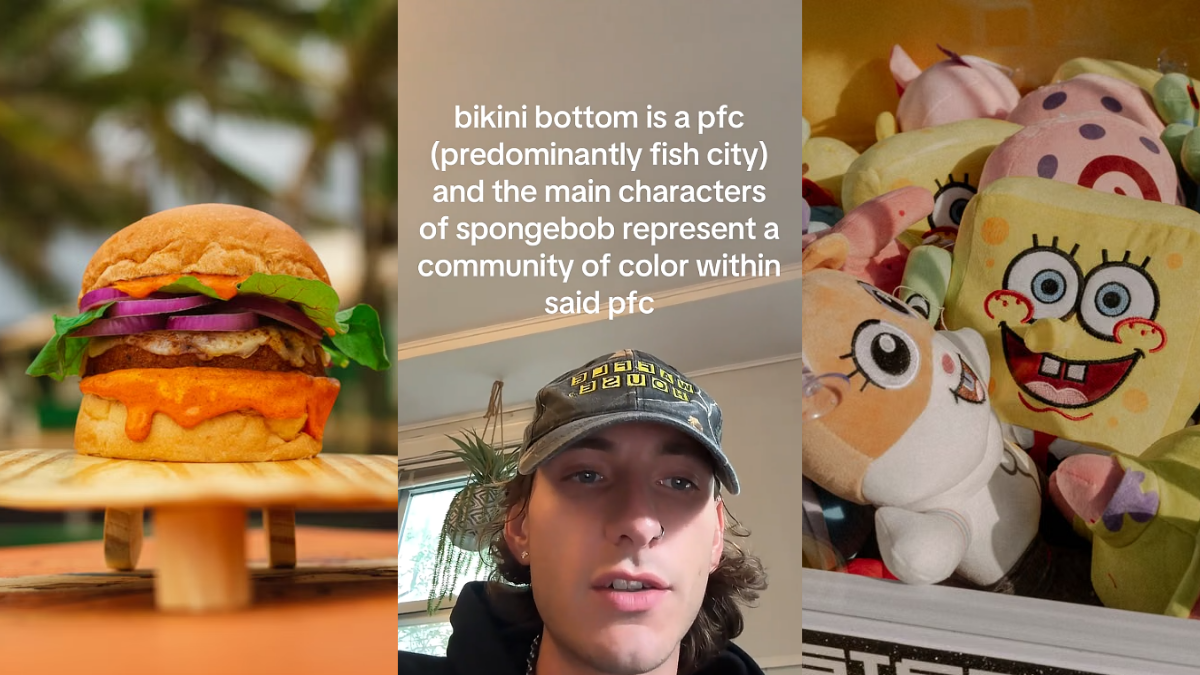
Pop culture is often dissected in academic dissertations, but a student (@ytlatinx) has cooked up a potential thesis topic about SpongeBob SquarePants that’s gone viral on TikTok.
“I don’t think this was the intent, but Bikini Bottom is a PFC—it’s a Predominantly Fish City,” he explained. The student expanded on his idea, saying the show’s main characters represent a community of color within the homogeneous city. He observed that Bikini Bottom has two main ethnic groups—regular fish and anchovies. The main cast, however, doesn’t fit into these two major ethnic groups.
“All these named characters are not, like, proper fish, for lack of a better term,” the student said. He said SpongeBob, Squidward, Patrick, Mr. Krabs, and the rest are from subgroups of fish. They don’t resemble the incidental fish with two fins and a dorsal fin, as seen in Bikini Bottom. The main cast consists of crustaceans, cephalopods, and, in SpongeBob’s case, a porifera.
An observation worth cooking up like a Krabby Patty
“There’s a few named characters that are proper fish, but they don’t seem to be directly associated with the community of color that SpongeBob mostly exists within,” the student continued. While watching the episode titled ‘The Chaperone,’ the student observed that Mr. Krabs’ daughter, Pearl, went to a predominantly fish school. Throughout the episode, the difference between Pearl, a whale, and the fish cast of anchovy was pronounced. The student also noted that the difference was emphasized as early as episode one. In that episode, Mr. Krabs mentioned that he could smell the anchovy coming to the Krusty Krab.
“The Krusty Krab itself is kind of like a McDonald’s in the suburbs—like, all of the employees are employees of color, and almost all the customers are, almost uniformly, like fish, in the predominantly fish city,” he observed. But unlike a McDonald’s that has a drive-thru with a family of eleven, the Krusty Krab only has SpongeBob and Squidward to rely on for labor. The student also mentioned the character Bubble Bass, who he called a “fish of privilege.” As a bass fish, he tormented SpongeBob SquarePants and other employees at the Krusty Krab over missing pickles in a patty, making him the episode’s villain. Fishes of color, which the student classifies SpongeBob and his peers as, only socially connect with other fishes through institutions like boating school and the like. They don’t interact by choice but by necessity.
Other minorities in SpongeBob SquarePants
“Mermaid Man and Barnacle Boy—not only are they GUNC, aka gay plus unc versions of Patrick and Squidward. But they’re the only ones unique in their retirement community. They’re the only ones that are not fish,” he said. But he also noted that Sandy, as a squirrel, is a migrant researcher who chose to relocate to Bikini Bottom. While she’s friends with SpongeBob, she’s also friends with Larry the Lobster. Despite being a fish of color, Larry has a good standing with the Bikini Bottom community as a lifeguard.
“It’s just an interesting note that the main characters of the show happen to be, like, the minorities within the city,” the student said. He hasn’t formalized the thesis yet, and there’s no update on the working framework. Nevertheless, he asked social media users to add to his thesis, and many commenters did.
One commenter wrote, “Mr. Krabs and Plankton also grew up in extreme poverty likely because of reed-lining and fishstemic racism.” Others also stated their analysis, pointing out that real systemic conditions could have influenced the structure of Bikini Bottom.
Another commented, “I think arguing that this “wasn’t on purpose” could be even more interesting: that these systems and sentiments are so prominent in everyone’s subconsciouses and pattern recognitions that they become media plots and even tropes.” Although the thesis may be a reach for some, one social media user expressed, “I’m upset that this is an academically sound thesis.” But this student isn’t the first to draw connections between media and reality. One woman made a three-part series connecting the Twilight series to Mormons—a theory that could make fans rethink the story beyond Team Jacob or Team Edward.
Have a tip we should know? [email protected]
Follow The Mary Sue:
