


Illinois man stops by Walmart’s garden section. He claims the plants may not be what they seem: ‘intentionally made it so they will die’
Buying a cactus usually seems simple. Most people pick one that looks healthy, check the price, and take it home without thinking much about how it was grown.
But things get confusing when part of the plant appears to be glued on. A colorful decoration may look real at first, leaving shoppers wondering what they are actually buying.
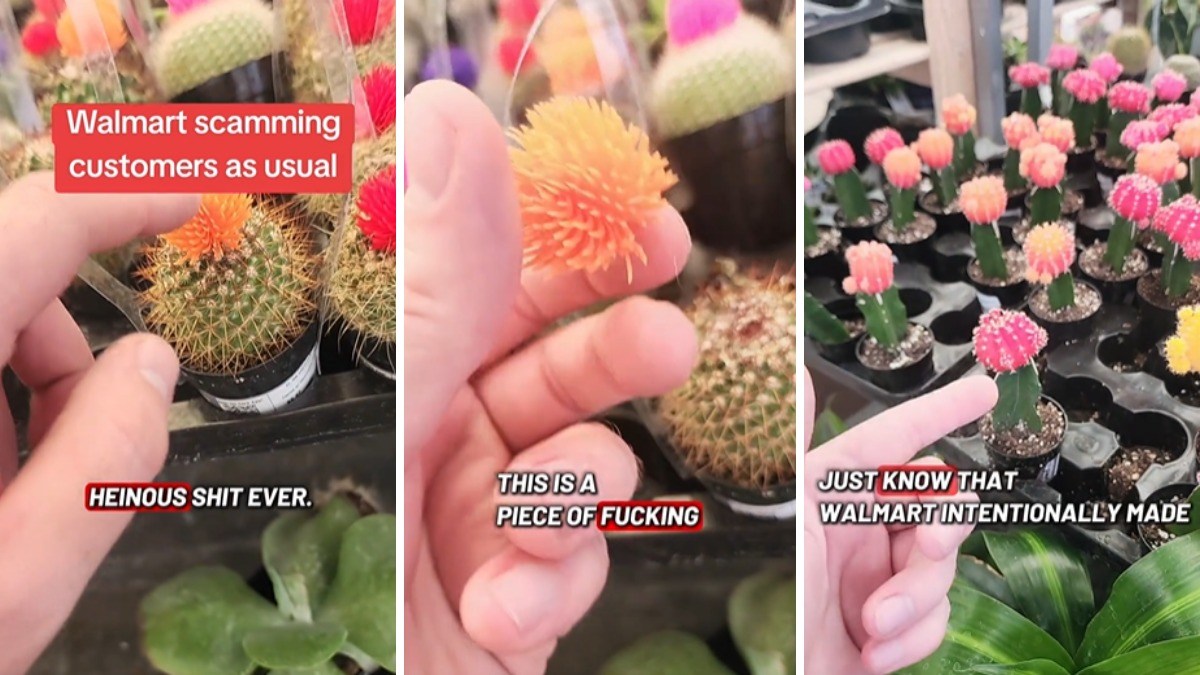
TikTok creator Harley (@collectorofhobbies) had that reaction while looking at cacti at Walmart. After spotting what he believed was a plastic decoration, he began questioning the grafted plants too. “This is some of the most heinous shit ever,” Harley says.
So, are these cacti actually meant to die?
Harley begins by focusing on a colorful piece attached to one of the cacti. After inspecting it, he argues that the decoration is plastic and points to what he believes is visible glue holding it in place. “This is literally plastic,” he says. “This is a piece of f*cking plastic, like a cat toy.”
He then moves to another cactus that looks quite different. Pointing to its brightly colored upper section and green base, Harley says, “This and this are two different plants.” He identifies it as a grafted cactus, where two plants have been joined together.
Harley claims the colorful portion cannot photosynthesize on its own and depends on the green cactus underneath for nutrients. “It will suck all the nutrients out of this one,” he says, arguing that the plants are difficult to keep alive. “They’re very hard to keep alive, and that’s why they graft them onto there.”
Harley takes the accusation further by blaming Walmart when these plants die. “Just know that Walmart intentionally made it so they will die,” he tells viewers. There is no evidence presented that Walmart intentionally sells cacti designed to die, and grafting is a legitimate horticultural technique.
Colorful moon cacti are one common example. The brightly colored upper cactus can lack sufficient chlorophyll to support itself through photosynthesis, so growers graft it onto a green rootstock that can provide what it needs. That dependence does not make the upper plant “plastic,” nor does it establish that the resulting cactus was deliberately created to have a short life.
That distinction matters because store-bought plants can struggle for plenty of reasons after leaving the shelf. Walmart customers have even tried to rescue wilted plants they found struggling in the store, showing that a plant’s condition can become part of the buying decision before it ever reaches someone’s home.
Care can become another problem once the plant gets there. Owners do not always know what a particular variety needs, and seemingly healthy plants can decline when those requirements are missed. That confusion is hardly limited to cacti, with plant owners also encountering common care mistakes that can cause orchids to die.
Viewers were quick to challenge Harley’s broader conclusion. “They’re not hard to keep alive at all, I’ve had mine for almost 3 years, stop spreading misinformation,” one commenter wrote. Another had found an entirely different use for the grafted plant. “I bought one of the grafted ones so that I could cut off the top,” they wrote. “I have a beautiful dragon fruit plant now. 10/10.”
Others pointed out that these cacti are not unique to Walmart. One person said they had purchased a similar plant from Lowe’s, while another simply responded, “These are legitimate propagation techniques.”
Harley’s video may have given shoppers a reason to look more closely at the cactus shelf, but it does not establish that Walmart is intentionally selling plants designed to die. The plastic decoration and the grafted cactus are also two separate issues: one concerns what has been attached to a plant for appearance, while the other is an established method of growing varieties that may not survive on their own.
Have a tip we should know? [email protected]
Follow The Mary Sue:
