


Nashville Man Notices Blended Fuel Being Sold for the Same Price. Then His Truck Allegedly Fails After One Fill-Up: ‘I’m Telling You’
Sounding the alarm.
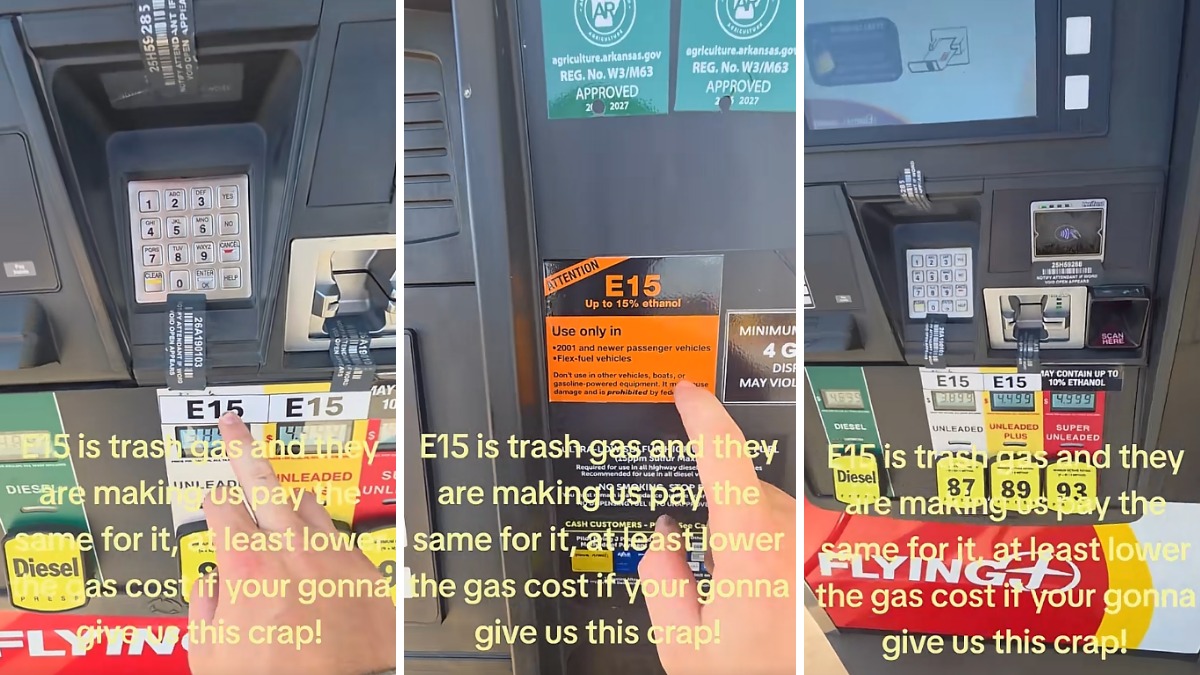
Nashville man J. Bradshaw is calling out E15 gasoline after his truck allegedly failed following a single fill-up, and his viral TikTok rant is sparking fresh debate over fuel blends, pricing, and vehicle compatibility. Bradshaw, who posts under the handle @j.bradshaw94, shared his frustration in a video titled “E15 gas is trash,” where he films a gas pump offering E15 for the same price as regular 87-octane unleaded.
The clip has racked up millions of views, over 337,000 likes, and thousands of comments, turning his personal experience into a larger conversation. Bradshaw points to the pump’s orange warning label, which identifies E15 as a blend containing up to 15% ethanol. The label clearly states the fuel is approved for 2001 and newer passenger vehicles and flex-fuel vehicles, while warning against using it in older cars, boats, or small engines.
Bradshaw says the E15 option was newly added to the pump and argues that selling it at the same price as regular gasoline is unfair, given what he sees as its lower quality. He also connects the fuel to his truck’s sudden failure, explaining that he had used other gasoline for years without issue but experienced problems immediately after using E15. The video’s caption leaves little room for doubt: “I’m telling you, this right here will f— up older vehicles.”
He doesn’t stop there
In a second video, Bradshaw takes a more collective approach, suggesting drivers band together to demand change. The caption reads, “Everybody dont go to work for about a week and i bet they fix that,” framing the issue as one of consumer power versus corporate and government decisions. His videos tap into broader frustrations over fuel pricing, vehicle maintenance, and the feeling that drivers have little control over what’s happening at the pump.
The timing of his posts is especially relevant, given recent federal policy changes. Starting May 1, 2026, the Environmental Protection Agency authorized nationwide summer sales of E15, lifting seasonal restrictions that previously limited its availability during high-ozone months. The move is intended to address fuel supply concerns and give consumers more options, but it’s also reigniting debates over cost, performance, and environmental impact.
E15 is a blend of up to 15% ethanol and 85% gasoline, and while federal regulators approve it for most 2001 and newer passenger vehicles, it’s not recommended for older cars, motorcycles, boats, or small engines like lawnmowers. Supporters argue that expanding E15 sales could lower pump prices, boost demand for corn-based ethanol, and support American farmers.
Critics, however, question whether those savings will hold up once you factor in E15’s lower energy content and potential hit to fuel economy. There are also concerns about smog, environmental effects, and the cost of repairs if drivers unknowingly use the wrong fuel in their vehicles. Bradshaw’s videos don’t settle these technical debates, but they do highlight how national fuel policies play out in real time for everyday drivers.
Many commenters echo his concerns
One user, claiming to be a mechanic, simply wrote, “I am a mechanic. dont use this fuel.” Another speculated about the government’s motives, saying, “The government doesn’t want older vehicles on the road for some reason…” Others were more direct, with one commenter stating, “E15 gas is for flex fuel vehicles only!!!” and another adding, “They can’t track or control older vehicles that’s why.”
The most common advice in the comments was straightforward: “If you see e15 fuel, just go somewhere else, please.” These responses suggest that many drivers are already wary of E15, regardless of what federal guidelines say.
Bradshaw’s experience also raises questions about labeling and consumer awareness. The orange warning label on the pump is meant to inform drivers about E15’s limitations, but it’s clear that not everyone reads or understands these warnings. His videos show how easily a driver can unknowingly fill up with a fuel that might not be compatible with their vehicle, especially if the option is suddenly introduced without much notice.
This is particularly concerning for owners of older cars, who may not realize their vehicles aren’t approved for E15 until it’s too late. The fact that E15 is being sold at the same price as regular gasoline adds another layer of frustration, as drivers may feel they’re being shortchanged if the fuel delivers worse performance or efficiency.
For now, Bradshaw’s videos serve as a real-world example of how these larger policy debates play out in everyday life. His truck’s alleged failure after using E15 may not be definitive proof that the fuel is to blame, but it’s a reminder that fuel choices aren’t just about price. Rather, they’re about compatibility, performance, and peace of mind.
(Featured images: J. Bradshaw @j.bradshaw94 on TikTok)
Have a tip we should know? [email protected]
Follow The Mary Sue:
